
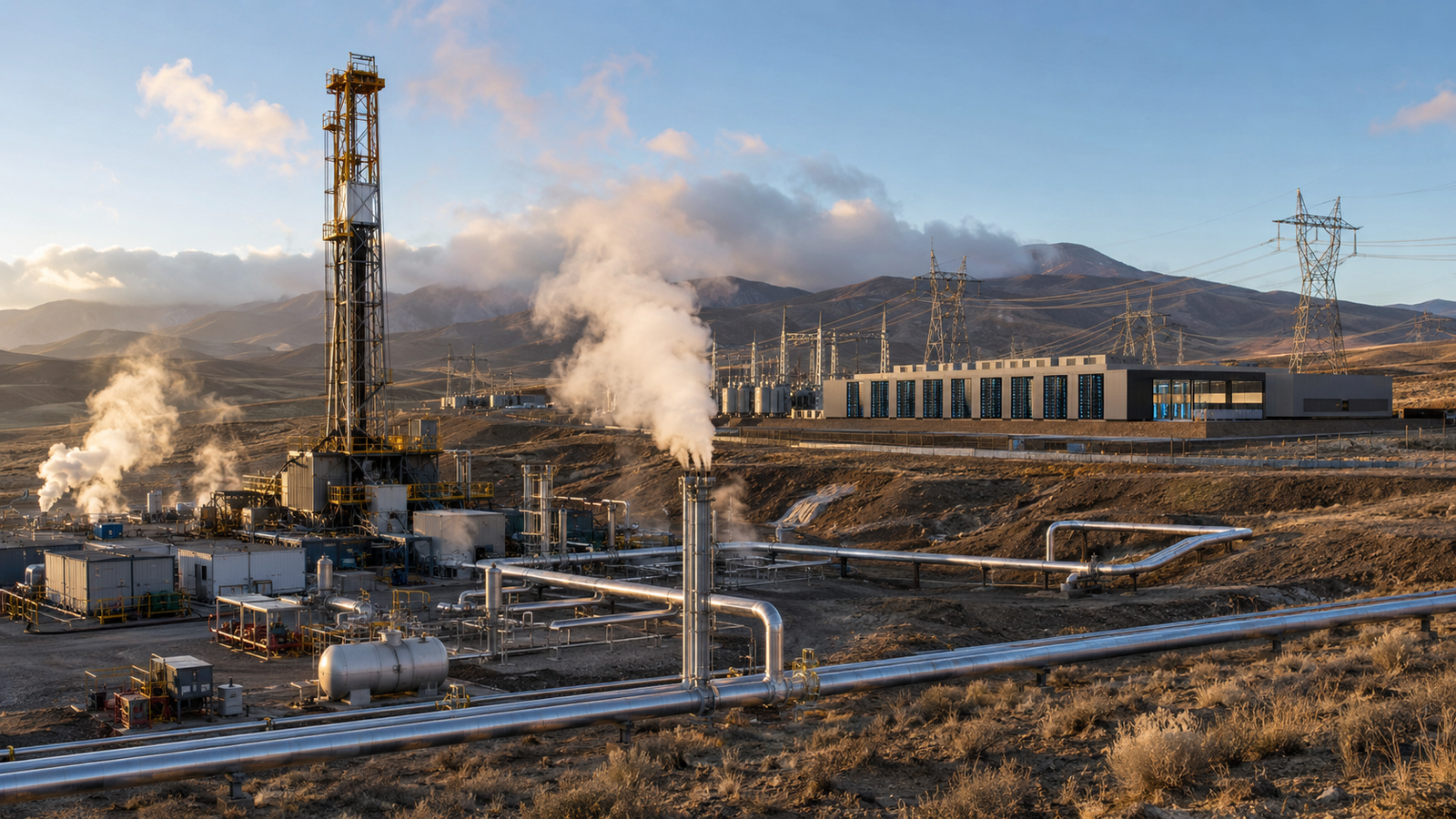
The artificial-intelligence boom is no longer just a chip story. It is becoming a power story—and Fervo Energy’s public-market debut may be one of the clearest signs yet that investors are starting to treat electricity supply as a critical part of the AI infrastructure trade.
Houston-based Fervo Energy surged in its Nasdaq debut under the ticker FRVO, after pricing its IPO at $27 per share and closing its first trading day at $36.54, a gain of roughly 35%. The company raised about $1.89 billion in an upsized offering, making it one of the most closely watched clean-energy listings of the year and a major test of investor appetite for next-generation geothermal power.
For investors, the message is clear: Wall Street is searching for the next layer of AI winners beyond semiconductors, cloud software, and data centers. Fervo’s IPO suggests geothermal energy could become part of that broader infrastructure stack, especially as artificial intelligence drives massive demand for reliable, around-the-clock electricity.
Why Fervo’s IPO Matters Now
Fervo is not a traditional renewable-energy company. Its core pitch is that enhanced geothermal systems can produce clean, constant power by adapting drilling and reservoir techniques from the oil-and-gas industry. Instead of depending on naturally occurring geothermal reservoirs in limited locations, Fervo uses techniques such as horizontal drilling and engineered reservoirs to unlock geothermal energy in more places.
That matters because AI data centers need steady, high-capacity electricity. Wind and solar can be low-cost and scalable, but they are intermittent. Natural gas can provide firm power, but it carries emissions and fuel-price exposure. Nuclear offers baseload power but often faces long development timelines and regulatory complexity. Geothermal sits in a potentially attractive middle ground: clean, firm, and increasingly scalable if drilling costs decline.
This is why Fervo’s debut is drawing attention well beyond the climate-tech market. Investors are increasingly asking which companies can solve the AI power bottleneck. That list may include power producers, utilities, grid equipment suppliers, transmission companies, natural gas operators, nuclear developers, battery firms, and now enhanced geothermal companies.
The Numbers Behind the Debut
The scale of investor demand was notable. Fervo priced 70 million shares at $27, above the previously raised range, after upsizing the offering from its original plan. The IPO raised approximately $1.89 billion and valued the company around $7.7 billion to $8 billion, depending on the methodology used by market reports.
The strong first-day move reflects enthusiasm, but it also creates a valuation debate. Barron’s reported that Fervo generated only about $138,000 in revenue last year while posting a $57.8 million loss. The Wall Street Journal similarly noted that the company has not yet generated significant revenue and remains loss-making while it scales its technology and project base.
That combination—large valuation, limited current revenue, and major future opportunity—is exactly what makes Fervo an emerging-industries story. Investors are not buying current earnings. They are buying the possibility that Fervo can become a major supplier of clean baseload power in a world where AI, electrification, and industrial reshoring push electricity demand higher.
The Utah Project Is the Key Test
Fervo’s most important asset is its large-scale Cape Station project in Utah. The Houston Chronicle reported that the project is expected to generate 500 megawatts of power, while the company has more than 38 gigawatts of early-stage projects in its pipeline.
The Wall Street Journal reported that Fervo is investing more than $2 billion in Utah to develop what it describes as the world’s largest enhanced geothermal project, with the project scheduled to begin coming online later this year. Financial Times reported that Fervo aims to produce 100 megawatts from the Utah project by 2027, highlighting the step-by-step nature of commercialization.
For investors, Utah is the proving ground. If Cape Station performs as planned, it could validate enhanced geothermal as a scalable power source. If delays, cost overruns, drilling challenges, transmission constraints, or permitting problems emerge, the market may reassess the premium valuation quickly.
Why AI Data Centers Are Central to the Thesis
The AI connection is not just a marketing angle. It is central to the investor case.
Data centers require reliable electricity. AI workloads are especially power-intensive because large-scale model training and inference require dense compute clusters, cooling systems, networking equipment, and continuous uptime. As hyperscalers and enterprise AI users expand infrastructure, electricity access is becoming a competitive advantage.
Fervo already has important technology-sector relationships. Barron’s noted that the company is backed by Bill Gates-linked investors and has partnerships with major technology firms including Alphabet. Financial Times reported that Fervo’s Nevada project supplies 3.5 megawatts to Google and that the company has more than 600 megawatts in power purchase agreements.
That is the investor hook: if tech companies need more clean, firm power, geothermal could become a strategic asset class. Fervo is positioning itself as an energy supplier for exactly that future.
The Bull Case: A New Category of Clean Baseload Power
The bull case for Fervo is straightforward. Enhanced geothermal could transform geothermal from a niche energy source into a scalable infrastructure solution. If Fervo can reduce drilling and construction costs, replicate projects across multiple regions, and sign long-term contracts with utilities and data-center operators, the company could become one of the most important emerging power platforms in the U.S.
The company also has a favorable policy backdrop. Financial Times reported that geothermal has received support from the Trump administration’s energy agenda, with the U.S. government pledging $171 million in grants for the industry and preserving access to Inflation Reduction Act-era tax credits through 2035.
That bipartisan appeal matters. Geothermal combines clean-energy benefits with oil-and-gas expertise, domestic energy production, and grid reliability. In a polarized energy-policy environment, that gives the sector a broader political base than some other renewable technologies.
The Bear Case: Costs, Capex, and Execution Risk
The risks are equally clear.
Fervo’s current financials are early-stage. The company has limited revenue, meaningful losses, and heavy capital-spending requirements. The Houston Chronicle reported that Fervo expects about $1.2 billion in capital expenditures in 2026, while it recorded a $58 million net loss in 2025.
Cost reduction is another major issue. Barron’s and the Wall Street Journal both noted that Fervo must bring construction costs down from roughly $7,000 per kilowatt toward about $3,000 per kilowatt to compete more effectively with conventional power sources.
That is a major operational challenge. Geothermal projects require drilling, reservoir engineering, infrastructure buildout, transmission access, power-conversion equipment, and long development timelines. Any delay can affect returns. Any cost inflation can pressure margins. Any technical underperformance can damage investor confidence.
Investors should also remember that public markets often reward emerging infrastructure stories early, then become more demanding once quarterly reporting begins. Fervo will need to prove that its backlog, contracts, and project pipeline can convert into revenue and cash flow.
Key Investment Insight
Fervo’s IPO signals that investors are expanding the AI trade from chips and cloud platforms into the physical infrastructure required to power them.
The opportunity is real: clean baseload power could become one of the most valuable bottlenecks in the AI economy. Companies that can provide reliable electricity to data centers, utilities, and industrial customers may attract premium valuations.
But the risk is also significant. Fervo is not yet a mature cash-flow business. It is a capital-intensive growth company with a promising technology, early commercial traction, and substantial execution risk. Investors should watch the stock carefully, but avoid treating the IPO pop as proof that the business model is already fully de-risked.
The most important indicators to monitor are: Cape Station construction progress, signed power purchase agreements, cost-per-kilowatt improvements, project financing terms, revenue conversion, and customer diversification beyond early technology partners.
What Investors Should Watch Next
Fervo’s debut could lift attention across several adjacent investment themes: geothermal drilling services, grid infrastructure, power equipment, transmission, clean-energy financing, data-center power procurement, and utility-scale baseload generation.
Investors should also watch whether other clean-energy and grid-infrastructure companies use Fervo’s successful IPO as a signal to come public. If the market remains receptive, the AI power trade could become one of the defining emerging-industry themes of 2026.
The broader takeaway is simple: AI needs more than chips. It needs electricity, land, cooling, transmission, and resilient infrastructure. Fervo’s IPO shows that public markets are beginning to price that reality.
Stay with MoneyNews.Today for daily investor-focused coverage of emerging industries, AI infrastructure, clean energy, public-market debuts, and the trends shaping tomorrow’s portfolios.




