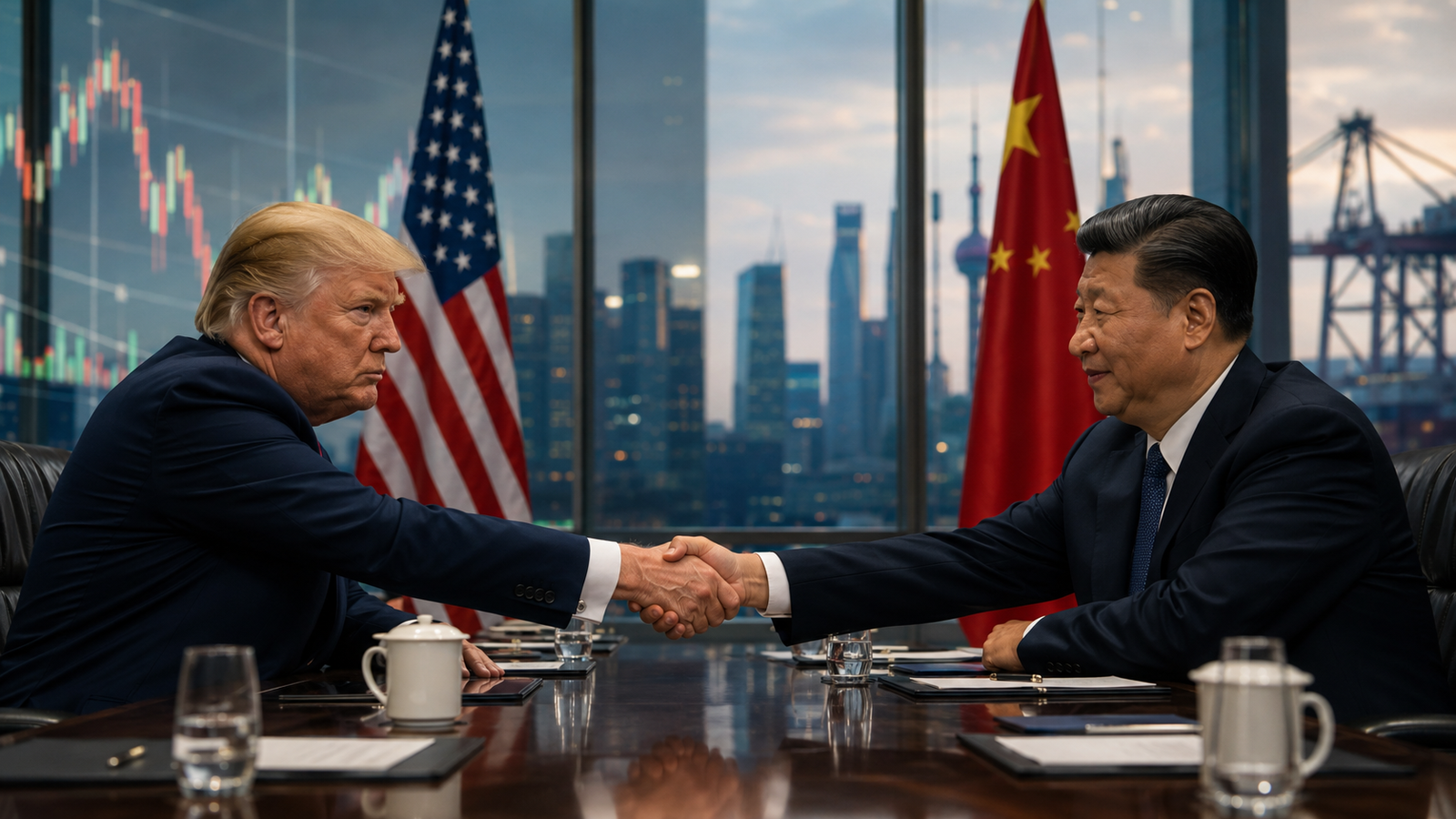
The most important market-moving political story today is not coming from Washington or Wall Street. It is coming from Beijing, where President Donald Trump and Chinese President Xi Jinping are trying to stabilize the world’s most consequential economic relationship while warning signs remain visible across trade, technology, energy, and Taiwan.
For investors, the Trump–Xi summit is more than diplomatic theater. It is a live risk event for semiconductors, electric vehicles, industrials, energy, agriculture, commodities, and multinational technology companies. Markets are watching for signs that the two governments can reduce friction on trade and business access, but Xi’s warning that mishandling Taiwan could lead to “clashes and even conflicts” reminded investors that geopolitical risk remains embedded in U.S.-China exposure.
The summit also has a strong corporate dimension. Nvidia CEO Jensen Huang, Tesla CEO Elon Musk, and Apple CEO Tim Cook were among the business leaders seen in Beijing as China signaled that it may “open wider” to U.S. companies. That message could support investor sentiment toward companies with large China exposure, but only if it is followed by concrete policy deliverables rather than symbolic language.
Why This Summit Matters for Markets
U.S.-China relations influence nearly every major asset class. When the two countries appear to be moving toward cooperation, investors often bid up technology, industrials, luxury goods, autos, energy, and commodities. When tensions rise, markets tend to price in supply-chain risk, tariff risk, export-control risk, and geopolitical premium.
This summit matters because it comes at a moment when investors are already balancing several pressures: elevated stock valuations, sticky inflation, a powerful AI-led equity rally, energy-market volatility, and fragile global supply chains. A positive U.S.-China headline can lift risk appetite quickly. A negative headline—especially on Taiwan, chips, or tariffs—can reverse sentiment just as fast.
AP reported that the two leaders discussed trade, military tensions, Iran, economic cooperation, market access, fentanyl-related chemical exports, agriculture, and energy issues including the Strait of Hormuz and possible Chinese purchases of U.S. oil. That is a broad agenda, and each item has market implications.
For investors, the key is not whether the summit produces warm public statements. The key is whether it reduces uncertainty around the sectors most exposed to U.S.-China policy.
Taiwan Remains the Market’s Biggest Geopolitical Risk
The most serious warning from the summit came from Xi’s comments on Taiwan. AP reported that Xi warned Trump that mishandling Taiwan could lead to serious conflict between China and the United States. The Washington Post similarly reported that Xi warned of possible “conflicts” if the issue is mismanaged.
For investors, Taiwan is not an abstract geopolitical issue. It is central to the global semiconductor supply chain. Taiwan is home to the world’s most important advanced chip manufacturing ecosystem, and any escalation around the island could affect AI chips, consumer electronics, cloud infrastructure, automotive semiconductors, defense technology, and global inflation.
That is why Taiwan language matters so much. Even if no immediate policy change occurs, more aggressive rhetoric can increase the risk premium on semiconductor stocks and multinational companies with supply chains across Taiwan, China, and the United States.
Investors should watch whether the summit produces any military-to-military communication framework, crisis-management channel, or statement on maintaining stability in the Taiwan Strait. Those would be more meaningful than ceremonial gestures because they could reduce the probability of miscalculation.
Trade Hopes Support Risk Appetite, but Details Are Still Thin
The market-friendly side of the summit is China’s attempt to reassure U.S. business leaders. Financial Times reported that Xi told executives from Nvidia, Tesla, and Apple that China’s market would “only open wider and wider,” signaling an effort to improve business confidence amid ongoing tensions over trade, technology restrictions, and supply-chain rules.
That message matters because U.S. companies still rely heavily on China for sales, manufacturing, supply chains, or all three. Apple depends on China as both a major consumer market and production hub. Tesla operates a major Shanghai factory and competes in China’s EV market. Nvidia is directly exposed to U.S. export restrictions affecting advanced AI chips.
However, investors should treat “open wider” language carefully. Markets need evidence. Concrete deliverables could include easier market access, tariff relief, faster regulatory approvals, expanded agricultural purchases, energy contracts, reduced restrictions on certain technology sales, or clearer rules around supply-chain compliance.
Without those specifics, the summit may improve short-term sentiment without changing the longer-term risk profile.
Semiconductors Are at the Center of the Trade
No sector is more sensitive to U.S.-China policy than semiconductors.
AI chips are both a commercial growth engine and a national-security flashpoint. Nvidia, AMD, Broadcom, Marvell, Micron, semiconductor equipment firms, and advanced packaging suppliers can all be affected by changes in export controls, Chinese demand, or retaliatory policy.
The presence of Nvidia CEO Jensen Huang in Beijing underscores how important this issue is for investors. AP images and reporting confirmed that Huang attended the summit events, while Financial Times reported that Nvidia was among the major U.S. companies represented as China sought to reassure American executives.
The investor question is straightforward: will the summit create room for U.S. chip companies to sell more products into China without crossing Washington’s national-security red lines?
If the answer is yes, semiconductor sentiment could improve, especially for companies with meaningful China exposure. If the answer is no—or if Taiwan rhetoric escalates—chip stocks could face renewed volatility even if AI demand remains strong.
EVs, Apple, Energy, and Commodities Are Also in Focus
Tesla investors are watching the summit because China remains one of the world’s most important EV markets. Elon Musk’s presence in Beijing highlights Tesla’s dependence on Chinese demand, regulatory relationships, manufacturing scale, and competition from domestic EV makers. Any improvement in U.S.-China commercial relations could help sentiment toward Tesla and other companies exposed to Chinese consumers.
Apple investors are watching for a different reason. Apple’s China exposure spans both sales and supply-chain operations. If Beijing signals a more supportive environment for U.S. consumer technology companies, Apple could benefit. But if political tensions worsen, Apple remains vulnerable to regulatory pressure, consumer nationalism, and production disruption.
Energy is another key area. AP reported that the talks touched on keeping the Strait of Hormuz open amid the Iran conflict and included interest in China buying more U.S. oil. That matters for oil producers, refiners, shipping companies, and energy-service firms. A major U.S.-China energy-purchase framework could support U.S. crude demand and improve sentiment in parts of the energy sector.
Commodities and industrials are also exposed. Any discussion of rare earths, tariffs, or supply-chain rules can affect manufacturers, automakers, defense contractors, battery companies, mining stocks, and clean-energy suppliers. China’s role in critical minerals remains a major strategic advantage, and investors should watch whether rare earth export controls or mineral supply commitments appear in post-summit statements.
What Investors Should Watch Next
The most important summit outcome will not be the tone of the photographs or the state dinner. It will be the substance of any follow-up framework.
Investors should monitor five areas.
First, chip access. Any shift in AI semiconductor export rules could move Nvidia, AMD, Broadcom, semiconductor equipment stocks, and AI infrastructure names.
Second, tariffs. A tariff truce extension or sector-specific tariff relief would support industrials, retailers, autos, and consumer goods companies.
Third, Taiwan language. Calm, measured wording would reduce geopolitical risk. Escalatory language would raise the risk premium across semiconductors and global supply chains.
Fourth, energy and agricultural purchases. Commitments from China to buy more U.S. oil, LNG, soybeans, corn, or other commodities would affect energy producers, agricultural exporters, shipping, and commodity-linked equities.
Fifth, market access for U.S. companies. Investors need to see whether China’s “open wider” message translates into practical benefits for Apple, Tesla, Nvidia, and other multinationals.
Key Investment Insight
The Trump–Xi summit is a market catalyst, but not a green light to chase every China-exposed stock.
The best opportunity may be in high-quality companies that benefit from improved U.S.-China relations but can still perform if tensions remain unresolved. That includes companies with strong balance sheets, diversified revenue streams, pricing power, and exposure to durable themes such as AI infrastructure, energy security, automation, and supply-chain resilience.
Investors should be cautious with companies whose entire bull case depends on a diplomatic breakthrough. Summit optimism can fade quickly if follow-up policy details disappoint.
For traders, the clearest near-term playbook is to watch semiconductors, EVs, Apple suppliers, energy names, and commodity-linked stocks for headline-driven moves. For long-term investors, the more important trend is the continued fragmentation of global supply chains. Even if this summit lowers tensions temporarily, companies and governments are still likely to diversify production, secure critical minerals, and build regional technology capacity.
The Bottom Line for Investors
The Trump–Xi summit gives markets both hope and warning. The hope is that the world’s two largest economies can stabilize trade, expand business access, and reduce uncertainty for major U.S. companies operating in China. The warning is that Taiwan remains a high-stakes flashpoint capable of disrupting the global economy and market leadership in a matter of days.
For now, investors should treat the summit as a volatility event rather than a solved problem. Positive headlines may support risk assets, especially technology and industrials, but durable upside depends on measurable agreements.
Stay with MoneyNews.Today for daily investor-focused coverage of market-moving political developments, global trade, technology policy, commodities, and the sectors shaping portfolio performance.