
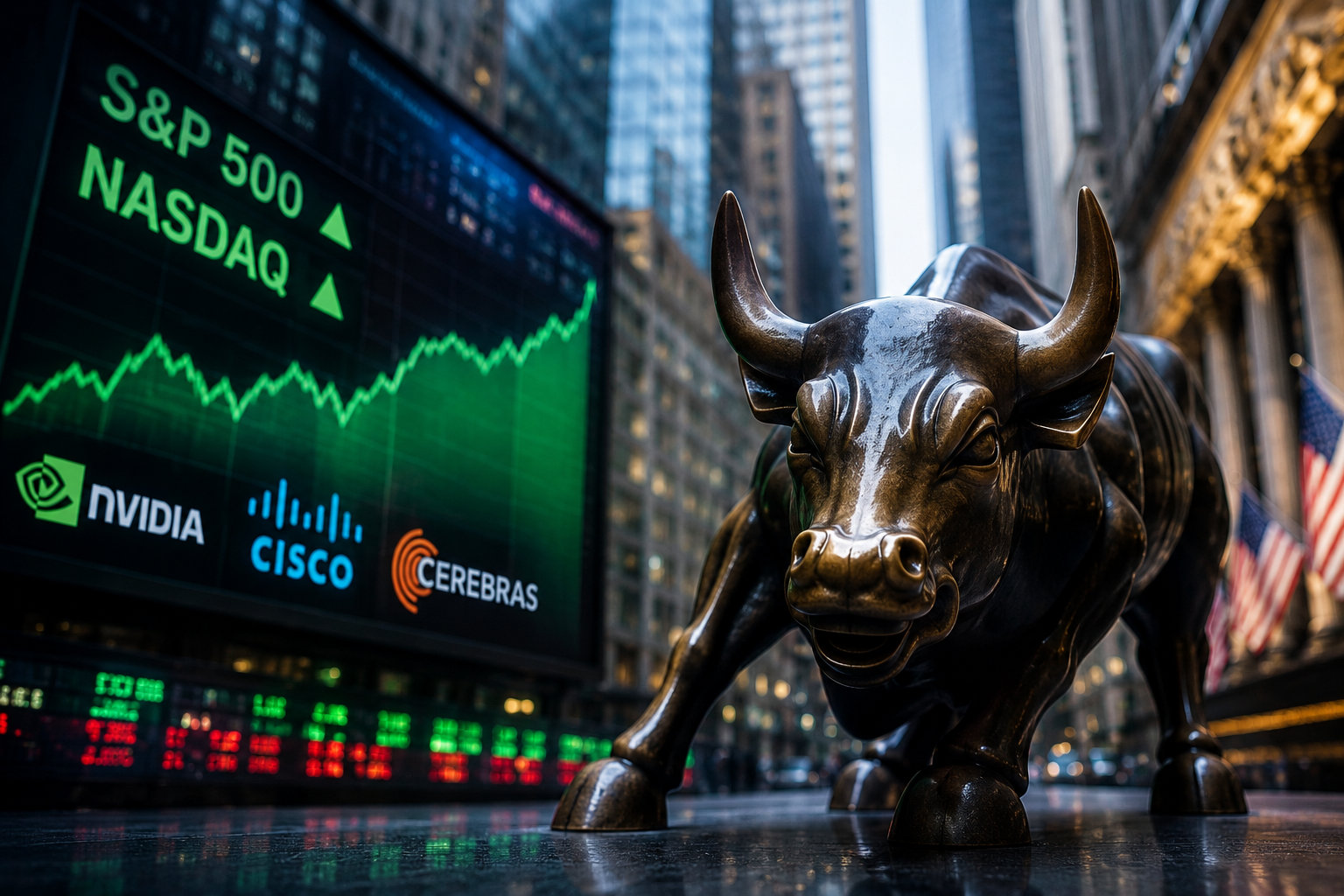
Wall Street is entering Thursday’s session with one dominant message: the AI trade is still powerful enough to pull the broader market higher, even as inflation, interest rates, and geopolitical headlines keep investors on alert.
U.S. stock futures moved higher on May 14, with the S&P 500 and Nasdaq positioned near fresh records after another strong technology-led session. MarketWatch reported that the S&P 500 and Nasdaq Composite were approaching their 18th and 14th record highs of the year, respectively, as investors continued to favor AI-linked stocks and large-cap technology leaders.
The rally is being driven by a familiar group of market leaders: Nvidia, Cisco, and newly public AI chipmaker Cerebras. But beneath the headline strength, investors face a more complicated setup. The market’s momentum remains concentrated in AI and mega-cap technology, while inflation data, Treasury yields, retail sales, oil prices, and U.S.-China developments could quickly test risk appetite.
For investors, the key question is not whether AI is still the market’s strongest theme. It clearly is. The more important question is whether this rally can broaden beyond a narrow group of technology winners.
AI Is Back at the Center of Market Leadership
The latest move in futures reflects renewed enthusiasm for AI infrastructure, a theme that has supported U.S. equities throughout 2026. The Associated Press reported that futures were higher before the opening bell, with the Dow up 0.7%, S&P 500 up 0.3%, and Nasdaq up 0.2%, helped by optimism around technology stocks and U.S.-China talks.
Nvidia remains the symbolic center of the trade. Business Insider reported that Nvidia shares hit a new all-time high on Wednesday, climbing as much as 3% to $227.84 before closing at $225.83, lifting the company’s market value above $5.5 trillion. Bank of America reportedly raised its price target to $320, calling Nvidia a top sector pick, while Wells Fargo lifted its target to $315, citing the company’s evolving role in AI capacity and infrastructure.
That matters because Nvidia is no longer viewed by investors as simply a chip company. It has become a proxy for AI data-center spending, cloud infrastructure demand, enterprise automation, and the broader buildout of next-generation computing capacity.
Cisco added another layer to the AI infrastructure story. AP reported that Cisco shares jumped about 15% after strong quarterly results and raised guidance, helped by AI infrastructure demand. For investors, Cisco’s move suggests the AI rally is not limited to GPU suppliers. Networking, optical systems, security, data-center hardware, and power-management infrastructure are also becoming investable parts of the AI supply chain.
Then there is Cerebras, whose IPO has become one of the market’s most closely watched AI events. MarketWatch noted that investors were monitoring Cerebras after it launched the largest IPO of the year, making its trading debut an important sentiment check for AI infrastructure demand.
The Record-High Market Is Still Narrow
The market’s headline strength is impressive, but investors should pay close attention to breadth.
On Wednesday, the S&P 500 rose 0.6% to 7,444.25, while the Nasdaq climbed 1.2% to 26,402.34, with both indexes setting new record closes, according to AP. The Dow slipped 0.1%, and the Russell 2000 gained less than 0.1%, showing that the rally remained heavily dependent on technology strength rather than broad participation across the entire market.
That divergence is important. A market led by a small group of mega-cap technology names can keep indexes rising for a long time, but it can also become more vulnerable if leadership stocks stumble. When breadth is weak, investors have less margin for error because index performance depends disproportionately on a handful of names.
This is why investors should avoid assuming that record highs automatically mean the average stock is participating. The indexes can look healthy even while many sectors lag.
The current market resembles a momentum-led environment where investors are willing to pay premium valuations for companies with direct exposure to AI spending, strong earnings visibility, and dominant competitive positions. That favors names such as Nvidia and large-cap technology platforms, but it creates risk for investors chasing extended charts without defined entry points or stop-loss discipline.
Inflation and Rates Remain the Main Macro Risk
The AI trade may be driving the rally, but macro data still matters.
MarketWatch noted that the bullish tone is persisting despite the 10-year Treasury yield hovering near 4.50% after unexpectedly high inflation data earlier in the week. Higher yields can become a problem for growth stocks because they reduce the present value of future earnings and make bonds more competitive with equities.
Inflation remains a key risk because it affects Federal Reserve policy expectations. If inflation remains sticky, the Fed has less room to cut rates. If rate cuts are delayed or taken off the table, high-valuation technology stocks could face pressure, especially those trading on long-term growth assumptions rather than current profits.
Investors are also watching consumer strength. Retail sales data matters because it shows whether households are still spending despite higher prices and borrowing costs. A strong retail sales report could support earnings expectations but also reinforce inflation concerns. A weak report could raise worries about consumer fatigue and slower economic growth.
That tension creates a difficult environment for traders. Good economic data may not always be good for stocks if it pushes yields higher. Weak data may not be positive either if it signals slowing demand.
U.S.-China Headlines Are Boosting Sentiment
Geopolitics is another major driver of today’s market tone. AP reported that investors were focused on President Donald Trump’s meeting with Chinese President Xi Jinping in Beijing, with markets supported by optimism around economic cooperation and technology access.
This matters directly for AI and semiconductor stocks. Nvidia CEO Jensen Huang was among the U.S. executives involved in the China-related market narrative, and investors are watching whether U.S.-China engagement improves the outlook for chip exports, enterprise technology demand, and supply-chain stability.
MarketWatch reported that Nvidia shares reached a new premarket high after comments from Xi suggesting China would continue opening to U.S. business leaders. Even modestly positive U.S.-China headlines can support semiconductors, industrials, consumer technology, and multinational companies with meaningful China exposure.
But investors should treat this as a catalyst, not a guarantee. U.S.-China relations remain structurally complex, especially around chips, AI, national security, Taiwan, and export controls. Positive summit headlines can lift markets in the short term, but policy details will determine whether the optimism is durable.
Why This Matters for Investors
The current setup rewards investors who understand both momentum and risk management.
Momentum clearly favors large-cap technology, AI infrastructure, and companies with direct exposure to data-center spending. Nvidia’s continued strength, Cisco’s AI-related upside, and Cerebras’ IPO attention all point to a market still willing to reward AI beneficiaries.
But valuation discipline is becoming more important. When markets approach records and leadership narrows, the risk of sharp rotations increases. Investors who chase extended AI names after major moves may be exposed if earnings guidance disappoints, Treasury yields rise, or geopolitical optimism fades.
The better approach is selective participation. Investors can watch for companies with real revenue acceleration, expanding margins, strong balance sheets, and durable competitive advantages. AI exposure alone is no longer enough. The market will increasingly separate companies monetizing AI from companies merely marketing themselves around AI.
Key Investment Insight
The key takeaway for investors is that the AI trade remains the market’s primary engine, but the rally is not risk-free.
Large-cap technology and AI infrastructure stocks remain in leadership, and futures strength suggests investors are still willing to buy the theme near record highs. However, narrow breadth means portfolio risk should be managed carefully. Investors should avoid chasing parabolic moves and instead look for high-quality AI exposure on pullbacks, earnings resets, or technical consolidations.
Stocks and sectors to watch include semiconductors, AI networking, data-center infrastructure, cloud platforms, optical components, power equipment, cooling systems, and cybersecurity. At the same time, investors should monitor whether the rally expands into industrials, small caps, financials, and consumer names. Broader participation would make the market advance healthier.
What to Watch Next
The next market signals are clear: Nvidia’s price action, Cerebras’ trading debut, Cisco’s follow-through, retail sales data, Treasury yields, and U.S.-China summit developments.
If AI leaders continue to rise while yields stay contained, the S&P 500 and Nasdaq could extend their record-setting advance. If yields climb or AI leadership falters, the market may face a rotation or consolidation phase.
For now, Wall Street is still betting that AI spending can offset macro uncertainty. That is a powerful trend, but investors should respect the risks beneath the surface.
Stay with MoneyNews.Today for daily market-moving coverage, investor-focused analysis, and actionable insights across stocks, AI, crypto, commodities, and global markets.




