
For the past several years, the artificial intelligence revolution has largely been defined by massive datacenters, cloud computing infrastructure, and the race among technology giants to build increasingly powerful AI models. Investors have rewarded companies supplying the hardware and software that power this transformation, helping drive one of the strongest technology bull markets in recent history.
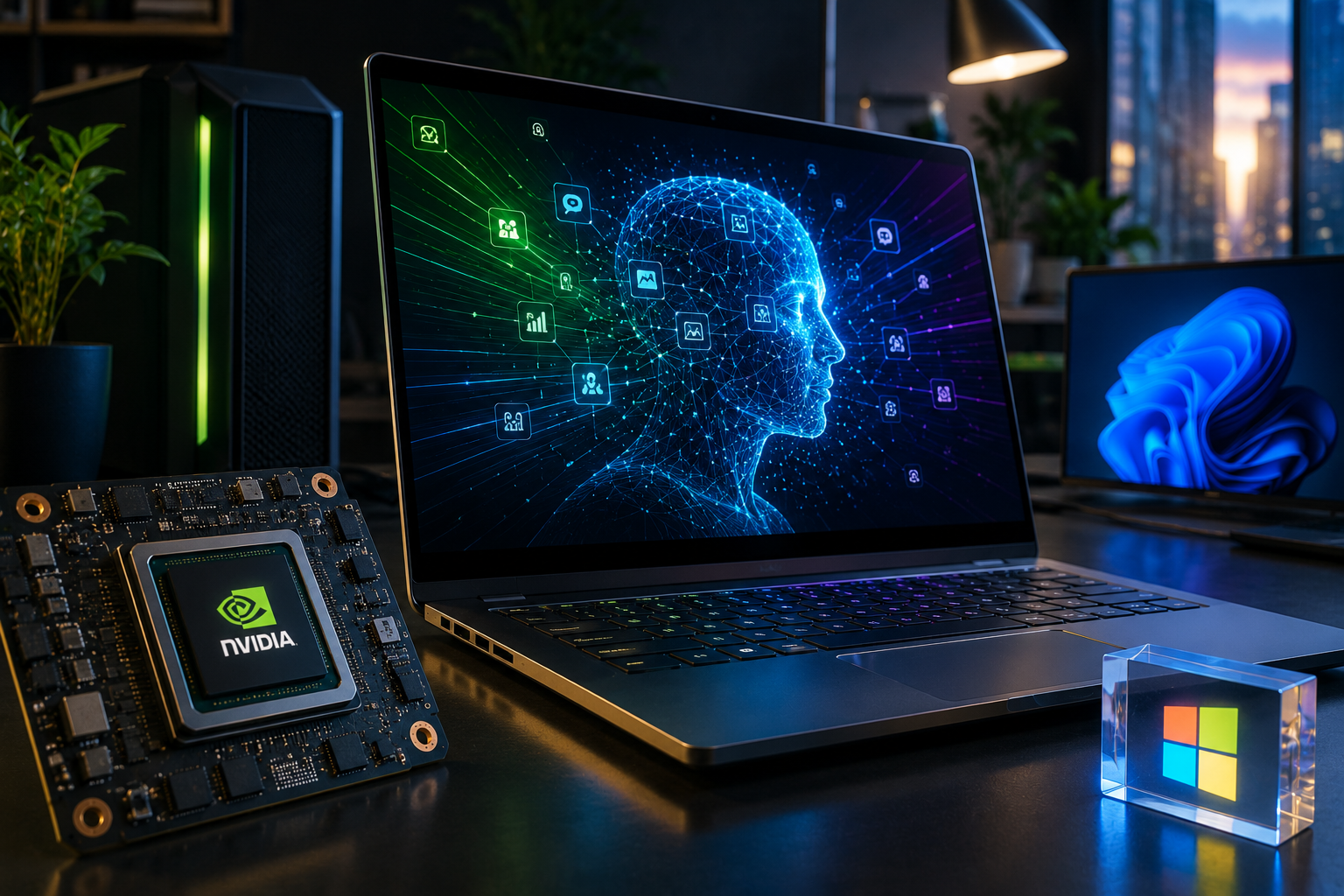
Now, Nvidia and Microsoft are attempting to bring that same AI revolution directly to consumers and enterprises through a new generation of AI-powered personal computers.
At Computex Taiwan on June 1, 2026, Nvidia unveiled its RTX Spark chip, a new platform designed to run AI agents and advanced AI workloads directly on laptops and desktop computers. Developed in partnership with Microsoft, the technology represents one of the most significant shifts in personal computing since the smartphone era. More importantly for investors, it could spark a major PC upgrade cycle that benefits semiconductor manufacturers, hardware vendors, software developers, and enterprise technology providers.
As artificial intelligence increasingly moves from the cloud to the device itself, investors are beginning to ask whether AI-powered PCs could become the next major growth engine for the technology sector.
The Next Evolution of Personal Computing
The personal computer market has experienced several transformative moments over the past four decades.
The rise of graphical user interfaces helped bring computing to the mainstream. The internet era connected PCs to the world. Mobile devices reshaped how users interacted with technology. Cloud computing enabled access to software and services from virtually anywhere.
Today, artificial intelligence appears poised to drive the next major transition.
Unlike traditional PCs, AI-native computers are designed to perform complex AI tasks locally. Rather than sending every request to a cloud server, these devices can run AI models directly on the machine, enabling faster responses, lower latency, improved privacy, and reduced dependence on internet connectivity.
The RTX Spark platform is specifically designed to support AI agents capable of performing increasingly sophisticated tasks, including content creation, workflow automation, software development assistance, data analysis, and personalized productivity management.
For consumers, this could fundamentally change how computers are used. For enterprises, it may create opportunities to deploy AI tools at scale while maintaining greater control over sensitive data.
Why Nvidia and Microsoft Are Making This Move Now
The timing of the announcement is not accidental.
Global AI spending continues to accelerate, with research firms including IDC, Gartner, and McKinsey projecting hundreds of billions of dollars in annual AI-related investment by the end of the decade. However, much of that spending has been concentrated in datacenters and cloud infrastructure.
As AI adoption expands, technology companies are increasingly looking for ways to bring AI capabilities directly to end users.
Nvidia’s RTX Spark platform represents a strategic effort to extend its dominance beyond AI infrastructure and into everyday computing devices. Meanwhile, Microsoft continues integrating AI throughout its ecosystem, from Windows and Microsoft 365 to Copilot and enterprise software offerings.
Together, the two companies are positioning themselves at the center of what could become a new computing paradigm.
For investors, the significance lies in the potential size of the opportunity. The global PC installed base numbers in the billions of devices. Even a modest AI-driven upgrade cycle could generate substantial demand across multiple technology segments.
A New PC Upgrade Cycle Could Be Emerging
One of the most compelling aspects of the AI PC narrative is its potential impact on hardware demand.
The PC market has faced challenges in recent years as replacement cycles lengthened and innovation slowed. Many consumers and businesses found little reason to upgrade devices that continued to perform adequately for everyday tasks.
Artificial intelligence may change that equation.
Industry analysts increasingly believe that AI-native computing capabilities could become a major purchasing factor for both consumers and enterprises. Devices equipped with dedicated AI processing capabilities may offer functionality unavailable on older hardware.
Research firms including Canalys and IDC have projected significant growth in AI PC shipments over the coming years as manufacturers integrate AI acceleration into their product lines.
This trend could create opportunities not only for Nvidia and Microsoft but also for PC manufacturers such as Dell, HP, Lenovo, and Asus, as well as component suppliers throughout the semiconductor ecosystem.
Historically, major technology transitions have generated substantial replacement demand. Investors are closely watching whether AI PCs can become the next catalyst.
Competition Is Intensifying
The launch of RTX Spark also intensifies competition across the technology industry.
Nvidia and Microsoft are entering a market where several major players are pursuing similar opportunities.
Apple continues advancing its own AI strategy through increasingly powerful silicon and integrated software ecosystems. Intel is investing heavily in AI-enabled processors designed for personal computers. AMD has expanded its AI capabilities across both consumer and enterprise markets. Qualcomm is pushing AI-focused chips that leverage its expertise in mobile computing.
The result is an increasingly competitive environment where innovation, software integration, and developer adoption will likely determine long-term winners.
While Nvidia currently dominates the AI infrastructure market, success in AI PCs will depend on factors beyond raw computing performance. User experience, software compatibility, developer support, and ecosystem integration will all play critical roles.
For investors, this competitive landscape creates both opportunities and risks.
Why On-Device AI Matters
One of the most important themes emerging from the RTX Spark announcement is the growing importance of on-device AI.
Cloud-based AI services have delivered remarkable capabilities, but they also come with challenges. Sending data to remote servers introduces latency, increases bandwidth requirements, and raises privacy concerns.
Running AI locally offers several advantages:
Faster Performance
Local processing can significantly reduce response times for AI applications.
Improved Privacy
Sensitive information can remain on the device rather than being transmitted to external servers.
Reduced Cloud Costs
Organizations may lower infrastructure expenses by shifting certain AI workloads to endpoint devices.
Greater Reliability
AI capabilities remain available even when internet connectivity is limited.
These advantages help explain why technology companies are increasingly investing in AI hardware designed specifically for local processing.
The Broader Investment Opportunity
While Nvidia and Microsoft dominate today’s headlines, investors should recognize that the AI PC trend could create opportunities throughout the broader technology ecosystem.
Semiconductor Manufacturers
Demand for AI-capable processors, memory chips, and specialized accelerators could increase significantly.
PC Manufacturers
Companies producing laptops and desktops may benefit from an AI-driven replacement cycle.
Software Developers
Applications designed to leverage local AI processing may gain competitive advantages.
Enterprise Technology Providers
Businesses seeking secure and efficient AI deployment could increasingly adopt AI-native hardware.
Cloud Providers
Although some workloads may move to devices, cloud platforms will continue supporting large-scale AI training and orchestration.
The emergence of AI PCs is therefore not a zero-sum game. Instead, it may expand the overall AI market while creating new revenue opportunities across multiple sectors.
Risks Investors Should Monitor
Despite the excitement surrounding AI-powered PCs, several challenges remain.
Consumer adoption rates remain uncertain, particularly if AI-enabled devices command premium prices. Enterprises may also take time to evaluate return-on-investment metrics before initiating large-scale upgrades.
Competition could pressure margins, while software ecosystems may require years to fully mature.
Additionally, some AI capabilities still depend heavily on cloud infrastructure, meaning the transition toward on-device AI is likely to be gradual rather than immediate.
Investors should therefore balance enthusiasm with realistic expectations regarding adoption timelines.
Key Investment Insight
The launch of Nvidia’s RTX Spark platform in partnership with Microsoft signals that artificial intelligence is moving beyond the datacenter and into everyday computing. If AI-native PCs gain traction, the industry could experience one of its most significant upgrade cycles in years.
Investors should monitor semiconductor companies, PC manufacturers, software developers, and enterprise technology providers positioned to benefit from on-device AI adoption. While challenges remain, the convergence of artificial intelligence and personal computing may become one of the defining technology investment themes of the second half of the decade.
Stay ahead of the trends shaping global technology markets by following MoneyNews.Today for daily investor insights, market analysis, and breaking financial news.




