
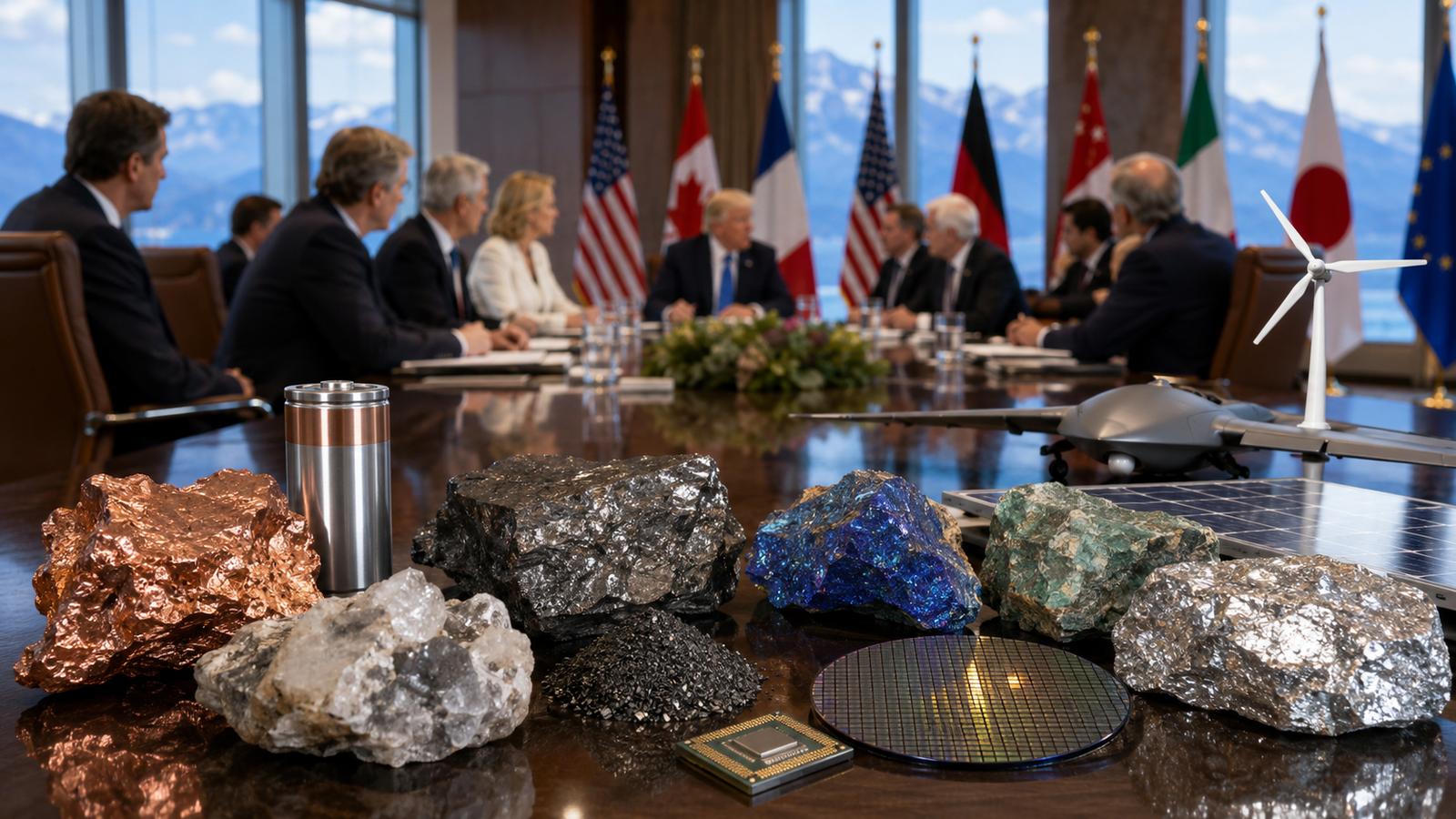
Artificial intelligence, electric vehicles, advanced defense systems, and clean-energy infrastructure may appear to belong to different industries, but they all depend on one increasingly valuable asset: critical minerals.
That reality is driving one of the most important geopolitical and investment debates of 2026.
As G7 leaders gather to discuss economic security and supply-chain resilience, the Trump administration’s proposal to establish a Western critical-minerals pricing framework has become a central topic of discussion. The initiative aims to reduce dependence on China for strategically important minerals such as lithium, rare earths, copper, graphite, nickel, and cobalt—materials essential to modern technology and national security.
While the proposal has generated support among some policymakers concerned about supply-chain vulnerabilities, it has also faced skepticism from G7 allies and industry participants who worry about market distortions, implementation challenges, and potential trade tensions.
For investors, however, the broader message is becoming increasingly clear: critical minerals are no longer simply commodities. They have evolved into strategic assets at the intersection of politics, technology, energy security, and economic policy.
The companies and countries that control these resources may play a defining role in the next decade of global growth.
The New Battleground for Economic Security
For decades, globalization encouraged nations to prioritize efficiency and cost reduction in supply chains.
That approach is now being reconsidered.
The COVID-19 pandemic, geopolitical conflicts, trade disputes, and growing competition between the United States and China have exposed vulnerabilities in critical supply chains across multiple industries.
Few sectors illustrate this challenge more clearly than critical minerals.
According to data from the International Energy Agency (IEA), demand for minerals used in electric vehicles, battery storage systems, renewable energy infrastructure, and advanced electronics is expected to increase substantially over the coming decade.
At the same time, China maintains a dominant position in the processing and refining of many critical minerals, giving it significant influence over global supply chains.
Reuters reported on June 15 that the Trump administration’s proposal seeks to address this imbalance by creating a framework that could encourage Western nations to coordinate pricing mechanisms and investment strategies for strategic minerals.
The objective is straightforward: strengthen domestic and allied supply chains while reducing strategic dependence on geopolitical competitors.
Why Critical Minerals Matter More Than Ever
The importance of critical minerals extends far beyond the mining industry.
Artificial Intelligence Infrastructure
The ongoing AI investment boom is creating enormous demand for data centers, semiconductor manufacturing, electrical infrastructure, and advanced computing systems.
Copper remains one of the most important metals supporting this expansion due to its role in electrical transmission and power systems.
As major technology companies continue investing billions of dollars into AI infrastructure, copper demand is expected to remain strong.
Electric Vehicles
The electric vehicle sector remains a major consumer of lithium, nickel, cobalt, graphite, and rare-earth materials.
Despite fluctuations in EV sales growth, long-term demand projections remain substantial as governments and manufacturers continue pursuing electrification initiatives.
Defense and National Security
Critical minerals have become essential components in military systems, aerospace technologies, communications equipment, and advanced weapon platforms.
As geopolitical competition intensifies, securing reliable access to these materials has become a national-security priority for many governments.
Energy Transition
Renewable energy projects require significantly more mineral inputs than traditional fossil-fuel infrastructure.
Wind turbines, solar installations, battery systems, and transmission networks all depend heavily on strategic metals.
This broad demand base helps explain why policymakers increasingly view critical minerals as foundational economic assets.
The Challenge Facing Western Governments
Although many Western nations possess significant mineral resources, developing domestic supply chains is not a simple process.
Mining projects often require:
- Lengthy permitting processes
- Significant capital investment
- Environmental reviews
- Infrastructure development
- Processing and refining capacity
In many cases, bringing a new mine into production can take a decade or longer.
China’s dominance stems not only from resource ownership but also from decades of investment in refining and processing capabilities.
According to industry reports and analyses from organizations such as the IEA and McKinsey, building competitive Western supply chains will require coordinated investment across mining, processing, logistics, and manufacturing.
This challenge explains why policymakers are increasingly discussing industrial strategies and government support programs.
The debate is no longer whether critical minerals matter—it is how quickly alternative supply chains can be developed.
Why Investors Are Paying Attention
The market implications of this shift are substantial.
Historically, mining investments were often viewed primarily through the lens of commodity cycles and economic growth expectations.
Today, political considerations are becoming equally important.
Government incentives, strategic partnerships, trade policies, and national-security initiatives can significantly influence the outlook for mineral producers.
Investors are increasingly evaluating companies based not only on reserves and production potential but also on their strategic importance within emerging supply chains.
This has created new opportunities across several categories.
Lithium Producers
Lithium remains one of the most closely watched commodities due to its role in battery manufacturing.
While prices have experienced volatility in recent years, long-term demand projections continue to support investment interest.
Rare-Earth Companies
Rare-earth elements are essential for magnets used in electric vehicles, defense systems, and renewable-energy technologies.
Western governments have identified rare-earth supply chains as a key strategic priority.
Copper Producers
Copper may be one of the most compelling long-term opportunities.
Demand from AI infrastructure, electrification projects, renewable energy systems, and grid modernization efforts continues to grow.
Many analysts believe future supply shortages could emerge if new production fails to keep pace with demand.
Strategic Mineral Developers
Smaller companies developing critical-mineral projects may benefit from government grants, financing support, and partnerships designed to strengthen domestic supply chains.
However, these opportunities often come with higher execution and regulatory risks.
Future Trends to Watch
Several developments could shape the critical-minerals investment landscape over the coming years.
G7 Policy Coordination
Investors should monitor whether G7 nations move toward greater cooperation on critical-mineral supply chains.
Joint initiatives could accelerate investment and improve project economics.
Government Incentives
Tax credits, subsidies, loan programs, and strategic investment funds may become increasingly important catalysts for the sector.
AI Infrastructure Expansion
The rapid growth of artificial intelligence is creating new sources of mineral demand, particularly for copper and other industrial metals.
U.S.-China Competition
Trade policy and geopolitical tensions will likely remain major drivers of market sentiment and supply-chain investment decisions.
Resource Nationalism
Countries with significant mineral reserves may seek greater control over strategic resources, potentially affecting supply availability and pricing.
Key Investment Insight
Critical minerals have evolved from a commodity story into a national-security and industrial-policy story.
That distinction matters because government support can significantly alter market dynamics, project economics, and investment opportunities.
Investors should pay close attention to lithium, rare-earth, copper, graphite, and strategic mineral producers that are positioned to benefit from supply-chain realignment efforts.
The companies most likely to succeed may not necessarily be the largest producers today, but rather those strategically aligned with emerging Western supply-chain initiatives and long-term infrastructure investment trends.
Looking Ahead
The debate surrounding the Trump administration’s critical-minerals strategy highlights a broader transformation occurring across global markets.
Governments are increasingly treating strategic resources as essential components of economic security, technological competitiveness, and national defense.
As policymakers, industry leaders, and investors navigate this new landscape, critical minerals are becoming one of the most important themes shaping the future of energy, technology, manufacturing, and global trade.
For investors, understanding these shifts may prove just as important as analyzing traditional commodity fundamentals.
Stay informed with MoneyNews.Today for daily investor insights, geopolitical market analysis, and the latest developments shaping global investment opportunities.




