
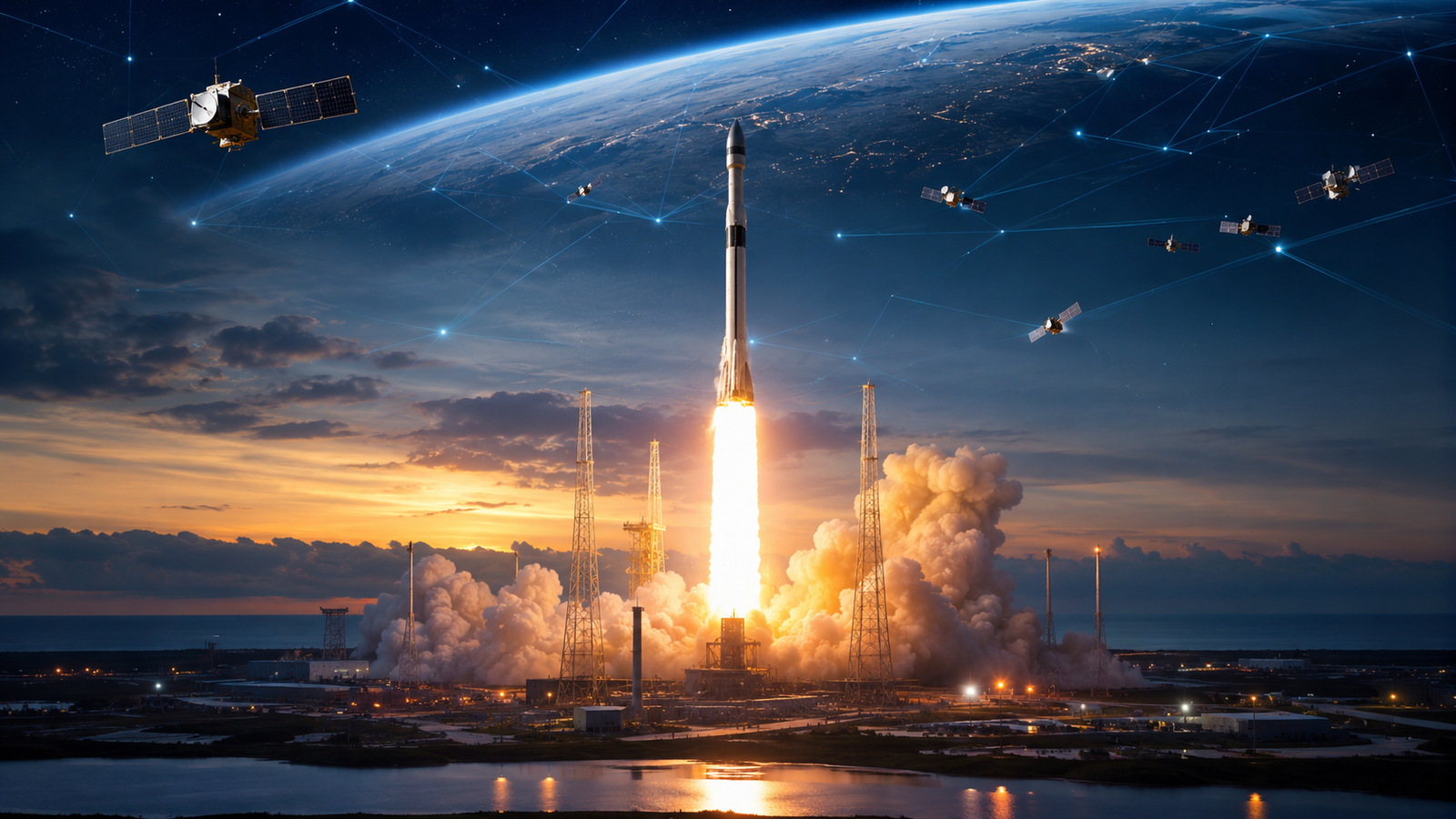
SpaceX’s historic public-market debut is quickly becoming more than an IPO story. It is becoming a referendum on whether investors are ready to treat space infrastructure, satellite broadband, defense communications, and AI-enabled aerospace systems as a core part of the next technology supercycle.
After pricing its initial public offering at $135 per share, SpaceX shares surged on their first trading day and continued higher in premarket trading, according to MarketWatch. The move has placed the Elon Musk-led company at the center of a broader investor conversation: space-tech is no longer a speculative niche reserved for venture capital and government contractors. It is now a mainstream public-market theme tied directly to artificial intelligence, defense modernization, global connectivity, and next-generation infrastructure.
For investors, the question is not simply whether SpaceX is an exciting company. The more important question is whether its IPO marks the start of a new investable category.
SpaceX’s IPO Changes the Market Conversation
According to SpaceX’s official IPO announcement, the company priced 555,555,555 Class A shares at $135 per share and began trading on Nasdaq under the ticker SPCX. The company also granted underwriters a 30-day option to purchase additional shares, a common feature in major public offerings that can help meet excess demand.
The debut was widely covered by major financial outlets, including MarketWatch, Barron’s, and The Wall Street Journal. Barron’s reported that SpaceX closed its first trading day at $160.95, above the $135 offer price. The Wall Street Journal also highlighted the company’s powerful market debut and the scale of investor demand.
That performance matters because SpaceX is not a traditional technology listing. It sits at the intersection of multiple high-growth themes: reusable rockets, satellite broadband, government launch contracts, defense communications, lunar and Mars ambitions, AI-enabled operations, and potentially orbital data-center infrastructure over time.
For public-market investors, this is a rare chance to price a company that has already become systemically important to space access and satellite communications.
Why Investors Are Treating SpaceX as an Infrastructure Stock
The strongest bull case for SpaceX is not just rocket launches. It is infrastructure control.
SpaceX has built a vertically integrated model that includes launch vehicles, satellite networks, manufacturing, software, ground stations, and global broadband distribution through Starlink. That gives the company exposure to several revenue pools at once. It can serve commercial customers, governments, telecom markets, defense agencies, maritime users, aviation customers, and remote regions with limited terrestrial internet access.
This makes SpaceX different from many earlier space companies that depended heavily on one product category or government contracts. Investors appear to be valuing SpaceX as a platform company, not merely an aerospace manufacturer.
The timing is also important. Artificial intelligence is driving explosive demand for compute, data transfer, low-latency networks, and resilient communications. Satellite broadband and space-based infrastructure may become increasingly relevant as enterprises, governments, and defense agencies look for connectivity that is harder to disrupt than traditional ground-based systems.
That is why SpaceX’s IPO is being discussed alongside the broader AI infrastructure trade. Investors who have already bid up semiconductor, data-center, and cloud stocks are now asking whether satellite networks and launch capacity belong in the same long-term infrastructure basket.
The AI Infrastructure Angle
AI systems do not operate in isolation. They require chips, power, cooling, data centers, networks, cybersecurity, and increasingly distributed communications. SpaceX’s Starlink network gives the company a unique position in the connectivity layer of the AI economy.
For investors, the link between SpaceX and AI may not be immediate revenue from model training. Instead, the opportunity is in enabling data transmission, remote operations, autonomous systems, defense applications, and industrial connectivity. AI-powered logistics, mining, agriculture, aviation, maritime operations, and battlefield communications all require reliable networks in difficult environments.
SpaceX also benefits from a strategic advantage: governments are increasingly prioritizing resilient communications. The war in Ukraine demonstrated the importance of satellite internet in conflict zones, and defense agencies around the world are now rethinking how they secure communications infrastructure. That makes the space industry more closely tied to national security budgets.
This convergence of AI, defense, and communications is one reason investors are watching SpaceX so closely. It is not just a rocket company. It is a potential backbone for parts of the future digital economy.
Supplier Stocks Could See Second-Order Momentum
The direct spotlight is on SpaceX, but the broader opportunity may extend across the space-tech supply chain.
Investors should watch companies tied to launch systems, satellite components, propulsion, advanced materials, defense communications, ground infrastructure, semiconductors, sensors, power systems, and cybersecurity. If SpaceX’s public-market success validates space infrastructure as an investable theme, capital could flow into companies that support or compete with the broader space economy.
This is similar to what happened during the AI chip rally. Nvidia became the flagship name, but investor interest later expanded into memory, networking, cooling, power equipment, data-center real estate, and cloud software. SpaceX could play a similar role for space-tech by acting as the anchor that draws attention to the ecosystem around it.
However, investors should be selective. Not every space-related company will benefit equally. Businesses with real contracts, scalable manufacturing, strong balance sheets, and exposure to defense or commercial satellite demand may be better positioned than speculative companies with limited revenue.
Valuation Risk Is the Key Concern
The biggest risk for investors is valuation.
A strong IPO pop can create momentum, but it can also pull forward years of expected growth. After a high-profile debut, retail and institutional investors often rush into the story, especially when the company is tied to a charismatic founder and multiple megatrends. That can make near-term prices vulnerable to profit-taking, lock-up expirations, earnings expectations, or any operational setback.
SpaceX also operates in capital-intensive markets. Rockets, satellites, launch sites, manufacturing systems, and network infrastructure require enormous spending. While the company has built a strong reputation for execution, investors still need to evaluate margins, cash flow, debt levels, regulatory exposure, and the path to sustained profitability as a public company.
There is also geopolitical risk. Space infrastructure is increasingly linked to national security. Government contracts can be valuable, but they can also invite regulatory scrutiny, export controls, and political pressure. Investors should not treat SpaceX like a simple consumer-tech growth stock.
Future Trends to Watch
The first trend to monitor is Starlink’s growth trajectory. Subscriber expansion, enterprise adoption, aviation and maritime contracts, and government deals will be key indicators of whether SpaceX can turn satellite broadband into a durable cash engine.
The second trend is launch demand. If commercial satellite deployment, defense missions, lunar projects, and scientific payloads continue to expand, SpaceX’s reusable launch advantage could remain a major competitive moat.
The third trend is AI-linked infrastructure demand. Investors should watch for partnerships or contracts involving autonomous systems, defense AI, remote industrial operations, and distributed data connectivity.
The fourth trend is index inclusion and institutional ownership. A company of SpaceX’s size may attract passive flows and long-term institutional demand, but that can also increase volatility if expectations become too aggressive.
Key Investment Insight
SpaceX’s IPO may mark the moment space-tech becomes a mainstream public-market theme. The company gives investors exposure to reusable rockets, satellite broadband, defense communications, global connectivity, and AI-related infrastructure in a single platform.
The opportunity is substantial, but the trade is not risk-free. Investors should avoid chasing hype blindly and instead focus on three questions: Can SpaceX convert its technological lead into durable cash flow? Can Starlink scale profitably across commercial, consumer, and government markets? And can the company justify a premium valuation as a public stock?
For investors who missed the first wave of AI infrastructure winners, SpaceX’s debut may open a new chapter in the broader technology buildout. But discipline matters. The best opportunities may include both SpaceX and the suppliers powering the next generation of launch systems, satellite networks, defense connectivity, semiconductors, and data infrastructure.
Stay with MoneyNews.Today for daily investor-focused coverage of the market trends, IPOs, emerging industries, and technology shifts shaping tomorrow’s portfolios.




