
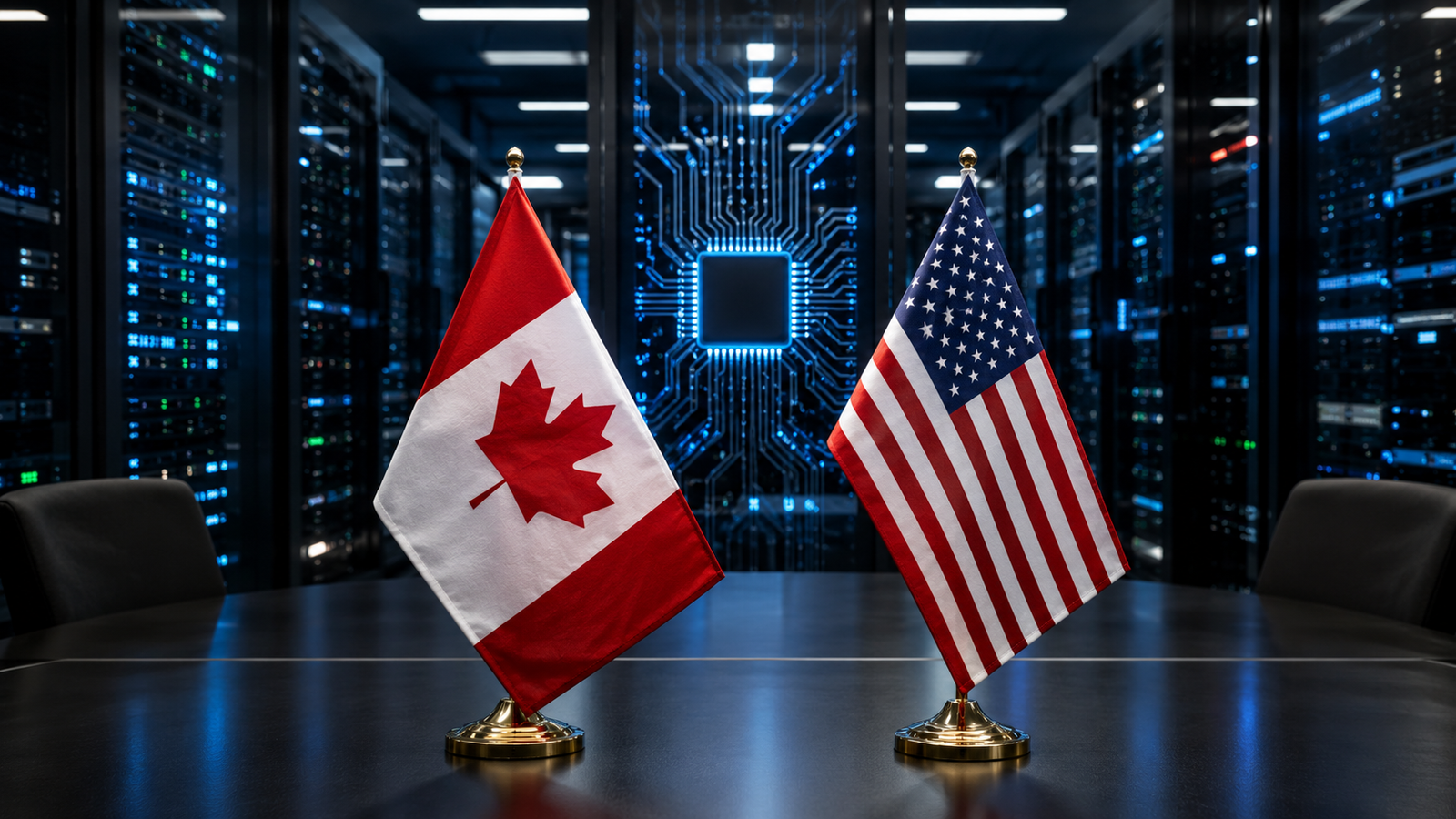
Canada’s latest warning over U.S. artificial intelligence restrictions is more than a diplomatic headline. For investors, it is a signal that the next phase of the AI boom may be shaped not only by chips, cloud capacity, and model performance, but also by national security policy, export controls, data sovereignty, and the growing desire of governments to reduce dependence on a handful of U.S.-based technology providers.
Canadian Prime Minister Mark Carney said U.S. restrictions affecting Anthropic’s advanced AI models show the strategic risk of relying too heavily on a small number of American AI companies. According to AP News, Anthropic took certain advanced models offline to comply with U.S. restrictions on foreign access, prompting Carney to argue that countries like Canada must learn from the episode and diversify their technology dependencies.
For investors, the message is clear: AI is no longer just a software growth story. It is becoming infrastructure, industrial policy, and geopolitical leverage. That shift could create new opportunities in Canadian AI infrastructure, sovereign cloud, cybersecurity, data centers, enterprise software, and trusted AI compliance. It could also introduce new risks for U.S. AI leaders whose global expansion may increasingly depend on regulatory approval and national security alignment.
Why This Matters for Investors
The market has spent the past two years rewarding companies tied to generative AI, cloud computing, advanced semiconductors, and data-center buildouts. But Carney’s comments point to a new layer of risk: access risk.
If governments can restrict who uses frontier AI models, then investors must start treating AI platforms less like ordinary software products and more like strategic assets. That changes the valuation framework. A company may have best-in-class technology, but if regulators limit access across borders, revenue growth, customer adoption, and enterprise deployment timelines can become harder to forecast.
This is especially important for cloud and software investors. Many enterprises outside the United States are building AI workflows on top of American infrastructure providers, model developers, and chip ecosystems. If those tools become subject to tighter restrictions, businesses may look for local alternatives or “sovereign AI” providers that can offer better continuity, data control, and regulatory certainty.
That does not mean U.S. AI leaders are suddenly unattractive. In fact, export controls and security rules can strengthen their competitive moats by making it harder for foreign rivals to access the most advanced technology. But the same rules can also reduce addressable market size, increase compliance costs, and push allied countries to invest in domestic alternatives.
Canada’s Sovereign AI Push
Canada has already been moving in this direction. Recent reporting on the Canadian government’s AI strategy highlights plans to strengthen domestic AI capacity, support large-scale data centers, update privacy protections, and create a trusted AI certification framework. The strategy reflects a broader belief that AI infrastructure is becoming as important to economic competitiveness as energy, telecom, and transportation networks.
For investors, this creates a practical watchlist. Companies that benefit from sovereign AI demand may include data-center operators, cloud infrastructure providers, cybersecurity vendors, AI compliance platforms, power and grid suppliers, and enterprise software firms serving regulated industries.
Canada’s opportunity is not necessarily to replace U.S. AI giants. That would be difficult given the scale of American capital expenditure, talent concentration, and semiconductor access. Instead, Canada may focus on trusted deployment, regulated-sector AI, privacy-sensitive data applications, government AI infrastructure, and partnerships with allied nations.
That niche could still be valuable. Banks, insurers, hospitals, utilities, telecom companies, and government agencies often need more than the most powerful model. They need secure deployment, auditability, data residency, compliance controls, and continuity of access. If U.S. export controls make access less predictable, demand for sovereign or hybrid AI systems could rise.
The Anthropic Case Shows How Fast Policy Can Move
The Anthropic situation is important because it shows how quickly government action can reshape AI availability. AP reported that Anthropic took advanced models offline to comply with U.S. restrictions on foreign access. Whether investors view that as prudent national security policy or a disruptive intervention, the market implication is the same: frontier AI is now inside the policy perimeter.
That has consequences across the AI stack. Model developers may need stronger compliance systems. Cloud platforms may need more granular controls over who can access specific models. Enterprise customers may need backup providers or local deployment options. Cybersecurity firms may see rising demand for AI governance tools, identity controls, and model-access monitoring.
The policy risk is particularly relevant for companies selling AI services internationally. If frontier models become subject to country-specific access rules, revenue recognition, contract terms, and customer onboarding could become more complex. Investors should watch whether companies begin disclosing more detail about geopolitical exposure, model-access restrictions, and compliance costs in future earnings calls.
Winners and Losers in the New AI Sovereignty Trade
The clearest potential winners are infrastructure providers tied to local AI capacity. Data centers, power infrastructure, high-performance computing, networking equipment, and cloud security could all benefit if Canada and other allied economies accelerate domestic AI investment.
Cybersecurity is another area to watch. As AI models become more powerful, governments will likely demand stronger controls around identity, data access, model behavior, and cross-border usage. That could support demand for companies specializing in zero-trust security, data-loss prevention, secure cloud access, governance, risk, and compliance software.
Enterprise software providers may also benefit if they can offer AI tools that meet local regulatory standards. In regulated sectors, “trusted AI” may become a competitive differentiator. Investors should pay attention to vendors that can combine AI productivity with privacy, explainability, audit trails, and jurisdiction-specific data handling.
The potential losers are companies whose valuations assume frictionless global AI adoption. If governments begin treating frontier models as strategic assets, international growth may be less linear than investors expect. That does not necessarily break the AI bull case, but it makes stock selection more important.
What Investors Should Watch Next
The first thing to watch is whether Canada’s rhetoric turns into procurement. Government AI strategy is meaningful, but budgets, contracts, and infrastructure partnerships matter more for investors. Any announcements around sovereign data centers, AI supercomputing, public-sector AI platforms, or trusted certification programs could create investable signals.
Second, watch how U.S. AI companies respond. If model providers create country-specific products, compliance tiers, or allied-nation access frameworks, that may reduce disruption while preserving security controls. If restrictions expand, investors may need to reassess revenue assumptions for companies with significant non-U.S. enterprise demand.
Third, follow the G7 discussion around AI governance. Canada’s warning comes as advanced economies are trying to balance innovation, security, privacy, and economic competitiveness. Coordinated rules among allies could reduce uncertainty. Fragmented rules could increase costs for global AI companies.
Fourth, monitor capital expenditure. Sovereign AI is expensive. It requires chips, energy, cooling, data centers, skilled workers, and cybersecurity. If Canada and other countries pursue AI independence aggressively, the investment cycle could broaden beyond U.S. hyperscalers into regional infrastructure providers and specialized technology suppliers.
Key Investment Insight
The AI investment story is shifting from “who has the best model?” to “who controls access to the full AI stack?” That stack includes models, chips, cloud infrastructure, energy, data, cybersecurity, regulation, and national policy.
For investors, the practical takeaway is to avoid viewing AI as a single-sector trade. The opportunity is spreading across infrastructure, security, software compliance, data governance, and sovereign cloud. U.S. AI leaders may remain dominant, but Canada’s warning shows that governments are increasingly unwilling to depend entirely on foreign-controlled technology systems.
Investors should watch Canadian and North American companies positioned around AI infrastructure, trusted cloud services, cybersecurity, data-center capacity, and regulated-sector enterprise AI. At the same time, they should evaluate U.S. AI companies for geopolitical exposure, export-control risk, and their ability to maintain international access without triggering national security concerns.
The AI boom is still alive, but it is becoming more political, more regulated, and more infrastructure-heavy. That creates both risk and opportunity. For investors willing to look beyond the obvious mega-cap winners, Canada’s warning may mark the beginning of a broader sovereign AI investment cycle.
Stay with MoneyNews.Today for daily investor-focused coverage of the market trends, policy shifts, and technology developments shaping tomorrow’s portfolios.




