
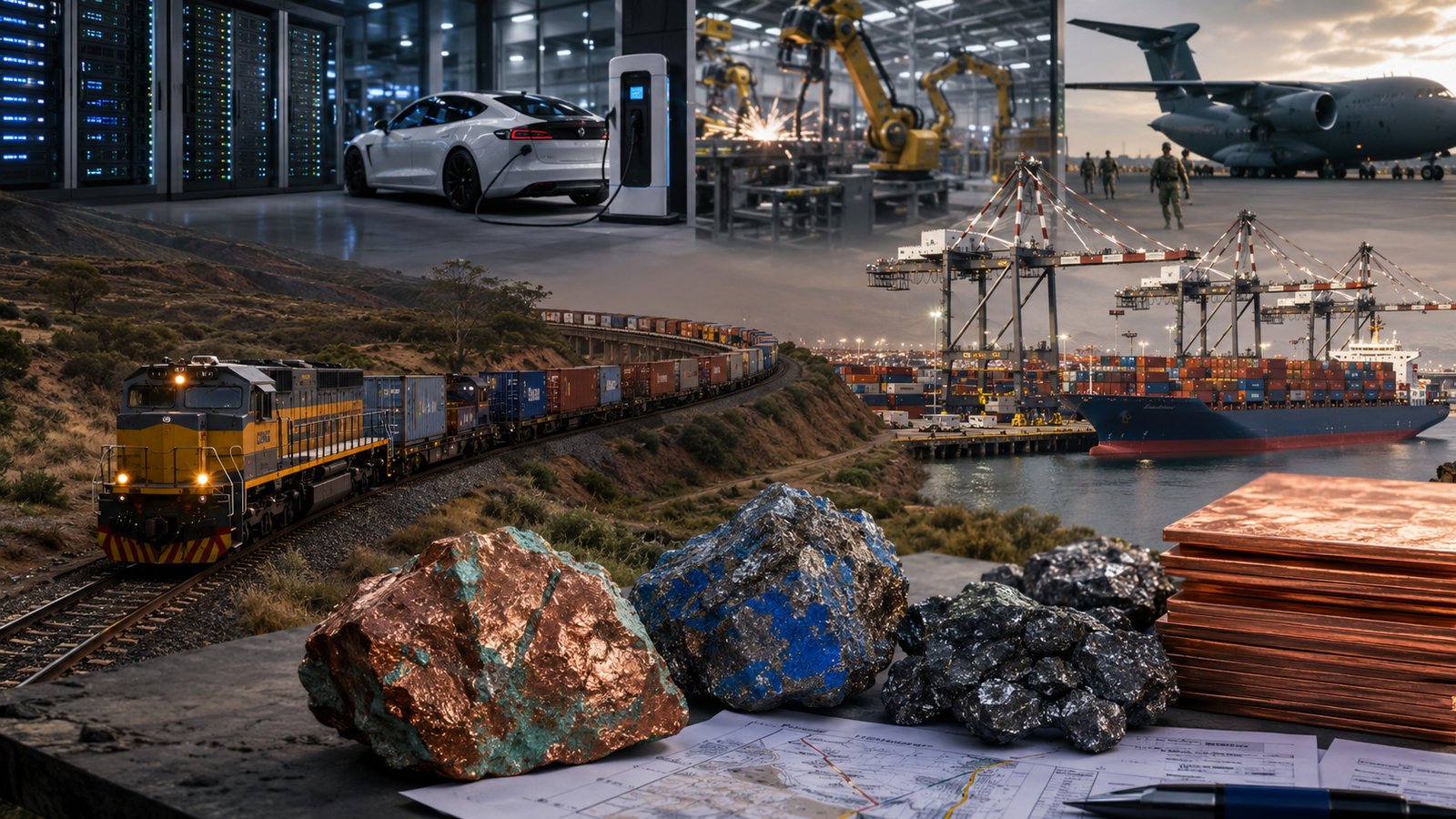
The race to secure critical minerals has become one of the most important investment themes of the decade, and the latest move by the United States underscores just how high the stakes have become.
As artificial intelligence data centers multiply, electric vehicle production expands, and defense modernization accelerates, governments and corporations are scrambling to secure reliable supplies of the raw materials that power the modern economy. Against this backdrop, the United States and Zambia have expanded a $491 million infrastructure initiative supporting mineral transportation along the Lobito Corridor, a strategic trade route connecting Central Africa’s vast mineral resources to Western markets.
According to Reuters, the expanded partnership is designed to improve transportation infrastructure for critical minerals, including copper and cobalt, while strengthening supply chains outside China’s sphere of influence. For investors, the development is more than a geopolitical story—it is another sign that critical minerals are increasingly being treated as strategic assets essential to economic growth, technological innovation, and national security.
As governments invest billions to reshape global supply chains, investors are closely watching mining companies, refiners, infrastructure operators, and logistics providers that stand to benefit from this historic transformation.
Why Critical Minerals Have Become a Strategic Priority
For decades, globalization encouraged companies to prioritize efficiency and cost reduction when sourcing raw materials. Today, however, supply-chain resilience has become just as important as price.
Critical minerals such as copper, cobalt, lithium, nickel, and rare earth elements play essential roles in technologies that are driving the next phase of economic growth. Electric vehicles require significantly more copper than traditional vehicles. AI data centers depend on extensive electrical infrastructure and advanced electronics. Defense systems rely on specialized minerals for guidance systems, communications equipment, and advanced manufacturing.
At the same time, concerns have grown regarding global concentration of mineral processing and refining capacity.
According to data from the International Energy Agency (IEA), China dominates processing capacity across several critical mineral categories, including rare earth elements and battery materials. This concentration has prompted Western governments to accelerate efforts aimed at diversifying supply chains and reducing dependence on any single country.
The Lobito Corridor initiative reflects this broader strategy.
By improving transportation links between mineral-rich regions of Central Africa and global export markets, policymakers hope to create alternative supply routes that can support long-term industrial and technological development.
The Strategic Importance of the Lobito Corridor
While investors often focus on mining projects themselves, transportation infrastructure is equally important in determining whether mineral resources can be developed efficiently.
The Lobito Corridor stretches through parts of Zambia, the Democratic Republic of Congo, and Angola, connecting some of the world’s richest deposits of copper and cobalt to export facilities on the Atlantic coast.
The region contains a significant share of global copper and cobalt reserves, making it a critical component of future supply chains.
Copper demand has become particularly important as electrification and AI infrastructure investments accelerate worldwide.
According to projections from industry groups and energy analysts, global copper demand could increase substantially over the next decade due to growth in:
- Artificial intelligence data centers
- Electric vehicles
- Renewable energy projects
- Electrical transmission infrastructure
- Advanced manufacturing facilities
Similarly, cobalt remains a key component in battery production and energy storage systems, although technological advancements continue to influence future demand dynamics.
The expansion of transportation infrastructure along the Lobito Corridor aims to improve access to these resources while reducing logistical bottlenecks that have historically constrained production and exports.
The Growing Link Between AI and Mining
One of the most overlooked aspects of the AI revolution is its growing dependence on physical resources.
Investors often associate AI with software companies, cloud computing platforms, and semiconductor manufacturers. However, every AI system ultimately relies on a vast network of physical infrastructure requiring enormous quantities of metals and minerals.
Data centers require extensive electrical wiring, cooling systems, transformers, and networking equipment—all of which depend heavily on copper.
As AI adoption expands, demand for electricity is rising sharply. Utilities, transmission operators, and infrastructure developers are investing billions to expand capacity, further increasing demand for industrial metals.
Industry analysts from firms including McKinsey and Deloitte have highlighted the growing relationship between digital infrastructure and resource consumption. While AI is often viewed as a software-driven opportunity, its long-term growth is increasingly tied to the availability of strategic raw materials.
This trend has elevated the importance of mining and metals companies within broader technology and infrastructure investment themes.
Why Investors Are Paying Attention
The renewed focus on critical minerals is creating opportunities across multiple sectors.
Mining Companies
Producers of copper, cobalt, lithium, nickel, and rare earth elements may benefit from increased demand and supportive government policies aimed at securing supply chains.
Refining and Processing Firms
Mining is only one part of the value chain. Companies involved in refining, processing, and upgrading raw materials could play an increasingly important role as Western countries seek to build domestic capabilities.
Infrastructure Developers
Projects involving railways, ports, roads, and logistics networks are becoming essential components of critical mineral strategies. Infrastructure providers may benefit from significant public and private investment.
Industrial Equipment Suppliers
The development of new mines and processing facilities requires specialized machinery, automation systems, and engineering services, creating opportunities throughout the industrial sector.
As governments allocate capital toward supply-chain diversification, investors are evaluating which segments of the ecosystem stand to capture the greatest value.
Geopolitics Is Reshaping Commodity Markets
The critical minerals story is no longer driven solely by traditional supply-and-demand fundamentals.
Geopolitical considerations increasingly influence investment decisions, government policy, and corporate strategy.
The United States, Canada, the European Union, Japan, and other allies have launched initiatives aimed at strengthening access to strategic resources. These efforts include direct investments, public-private partnerships, tax incentives, and infrastructure projects designed to support domestic and allied supply chains.
The Lobito Corridor initiative is one example of this broader trend.
Rather than relying exclusively on market forces, governments are actively shaping resource development strategies to address economic and national security concerns.
For investors, this means understanding geopolitical developments has become increasingly important when evaluating opportunities in the mining and materials sectors.
Future Trends to Watch
Several developments are likely to shape the critical minerals market over the coming years.
Copper Demand Growth
Copper remains one of the most important commodities supporting electrification and AI infrastructure. Supply constraints could create favorable market conditions for producers.
Western Processing Expansion
Governments are investing heavily in refining and processing capacity, potentially creating new opportunities beyond traditional mining operations.
Infrastructure Investment
Transportation corridors, ports, rail networks, and energy infrastructure are becoming increasingly important components of mineral supply chains.
Strategic Partnerships
Cross-border agreements between governments, mining companies, and financial institutions are likely to accelerate as competition for resources intensifies.
Resource Nationalism
Countries rich in mineral resources may seek greater control over production and exports, creating both opportunities and risks for investors.
These trends suggest that critical minerals will remain a major focus for policymakers, corporations, and financial markets throughout the remainder of the decade.
Key Investment Insight
The expansion of the Lobito Corridor initiative highlights a fundamental shift in how governments and investors view critical minerals. These resources are no longer simply industrial commodities—they have become strategic assets supporting artificial intelligence, energy transition initiatives, advanced manufacturing, and national security priorities.
Investors should closely monitor copper, cobalt, lithium, and rare-earth supply chains, while also paying attention to companies involved in refining, logistics, infrastructure development, and transportation networks. As Western nations continue diversifying supply chains away from concentrated sources, businesses positioned at key points within the critical minerals ecosystem may benefit from long-term structural growth trends.
The intersection of geopolitics, technology, and resource security is creating one of the most compelling investment themes of the decade. Understanding these dynamics will be essential for investors seeking exposure to industries powering the future global economy.
Stay informed with MoneyNews.Today for daily investor insights, market-moving developments, and expert analysis on the trends shaping global markets and investment opportunities.




