
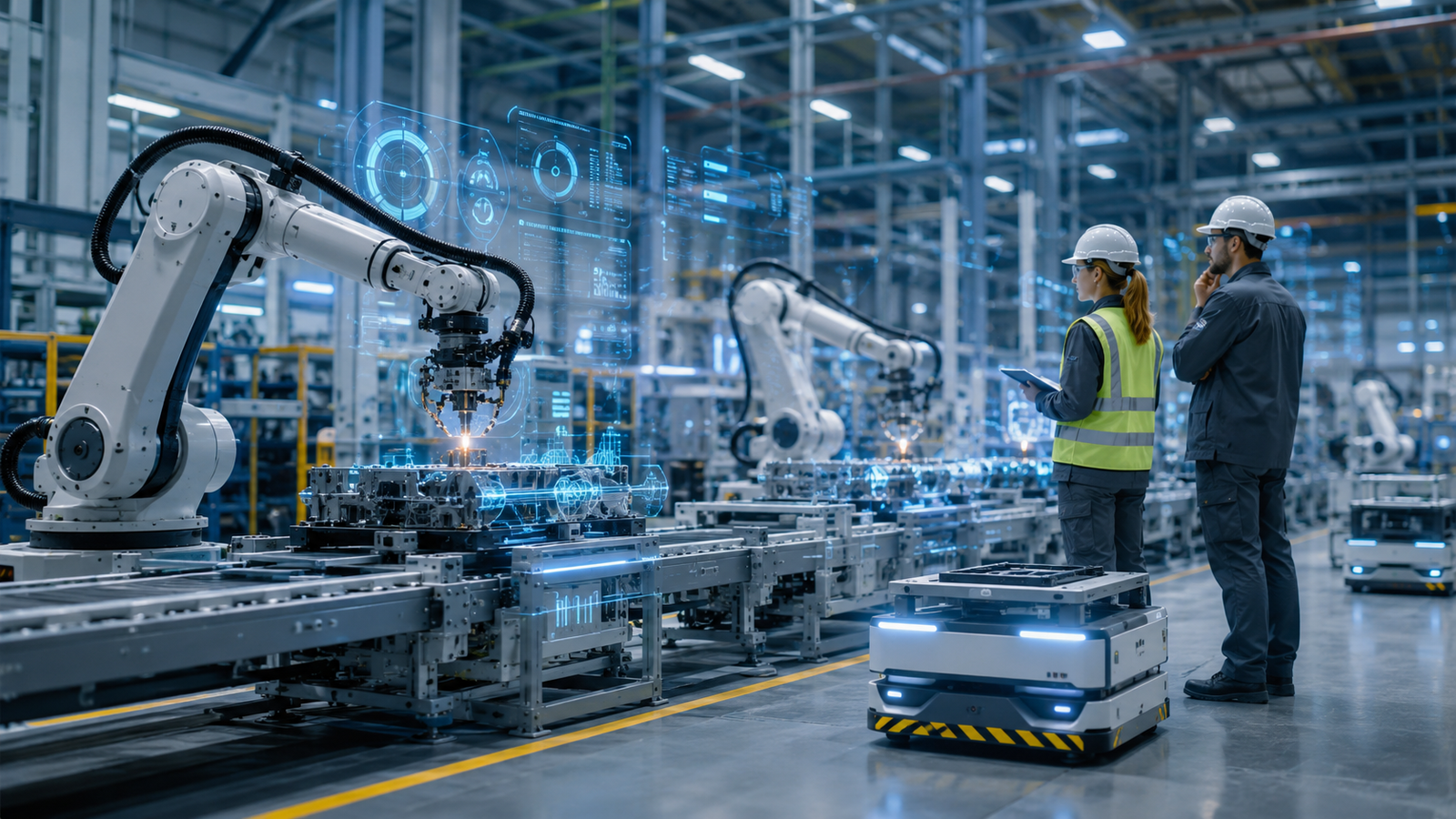
The artificial intelligence investment boom may be entering its most transformative phase yet—and it is moving beyond software and into the physical world.
While investors spent much of the past three years focusing on AI chatbots, large language models, and cloud computing infrastructure, a new trend is rapidly gaining momentum across factories, warehouses, logistics centers, and industrial facilities worldwide. Physical AI—the integration of artificial intelligence into robots, autonomous systems, and industrial automation—is emerging as one of the fastest-growing areas of capital investment, creating new opportunities across multiple industries.
Recent discussions at Automate 2026, North America’s largest automation conference, along with a growing number of corporate announcements and industry reports, suggest manufacturers are accelerating investments in robotics and AI-powered production systems to address labor shortages, improve productivity, and strengthen supply-chain resilience. For investors, the shift represents a potentially significant expansion of the AI opportunity beyond software and semiconductors.
As companies increasingly deploy intelligent machines capable of performing real-world tasks, the next generation of AI winners may be found not only in Silicon Valley but also on factory floors, warehouse networks, and industrial production lines.
The Next Evolution of the AI Boom
The first phase of the AI revolution was dominated by software.
Companies raced to develop generative AI models, cloud providers expanded computing capacity, and semiconductor manufacturers benefited from unprecedented demand for AI chips. Investors rewarded businesses that could capitalize on the explosive growth in digital AI applications.
Today, a second phase is beginning to take shape.
Physical AI combines artificial intelligence, machine learning, robotics, computer vision, sensors, and automation systems to enable machines to understand and interact with the physical world. Rather than simply generating text or analyzing data, these systems can move products through warehouses, inspect manufacturing defects, operate industrial equipment, and perform complex tasks with minimal human intervention.
Industry experts increasingly view physical AI as one of the largest long-term opportunities within the broader artificial intelligence market.
Research from McKinsey estimates that automation technologies could generate trillions of dollars in economic value over the coming decade as companies seek greater efficiency and productivity. Meanwhile, the International Federation of Robotics (IFR) continues to report rising global robot installations as manufacturers invest in automation to remain competitive.
The convergence of AI and robotics is accelerating those trends.
Why Manufacturers Are Increasing Automation Spending
Several powerful economic forces are driving investment in physical AI.
Persistent Labor Shortages
Manufacturers across North America continue to face labor constraints in critical areas such as production, logistics, warehousing, and skilled technical roles.
Even as economic conditions fluctuate, many industries struggle to recruit and retain workers for repetitive, physically demanding, or highly specialized tasks.
Automation provides a potential solution.
AI-powered robotic systems can operate continuously, reduce dependence on labor availability, and improve operational consistency. For many companies, investing in automation has become a strategic necessity rather than a discretionary expense.
Productivity Pressures
Productivity has become one of the most important competitive advantages in modern manufacturing.
As input costs, wages, and operational expenses rise, companies are searching for ways to produce more with fewer resources. Intelligent automation systems help optimize workflows, reduce downtime, minimize errors, and improve overall efficiency.
Executives increasingly view AI-powered automation as a direct path toward higher margins and stronger profitability.
Supply Chain Resilience
The supply-chain disruptions experienced over the past several years have reshaped corporate priorities.
Companies are investing in automation to improve visibility, flexibility, and responsiveness throughout their operations. Smart factories equipped with AI-driven systems can adapt more quickly to changing demand patterns and operational challenges.
For investors, this trend suggests automation spending may remain resilient even during periods of broader economic uncertainty.
The Industries Positioned to Benefit
While much of the market’s attention remains focused on AI software companies, physical AI is creating opportunities across a diverse ecosystem of businesses.
Robotics Manufacturers
Industrial robotics companies are among the most direct beneficiaries of increasing automation adoption.
Demand is growing for robotic arms, autonomous mobile robots, warehouse systems, collaborative robots, and advanced manufacturing equipment capable of integrating AI capabilities.
As deployment expands, robotics firms could experience sustained revenue growth driven by long-term automation trends.
Industrial Sensor Providers
Physical AI systems depend on sensors to collect real-world data.
Machine vision systems, cameras, lidar sensors, proximity detectors, and industrial monitoring devices serve as the “eyes and ears” of intelligent machines.
Companies supplying these technologies occupy a critical position within the automation value chain.
Smart Factory Technology Firms
The rise of Industry 4.0 has increased demand for software and hardware platforms that connect machines, analyze production data, and optimize industrial operations.
These solutions enable manufacturers to leverage AI insights across entire production environments.
Logistics and Warehouse Automation Providers
E-commerce growth and supply-chain modernization continue driving investment in warehouse automation.
AI-powered sorting systems, autonomous vehicles, robotic picking technologies, and inventory management platforms are becoming increasingly common throughout logistics networks.
This segment represents one of the fastest-growing applications of physical AI.
Why Investors Are Paying Attention
The investment case for physical AI extends beyond simple automation.
Many analysts believe robotics and intelligent machines could become one of the largest beneficiaries of AI adoption over the next decade because they directly address measurable business challenges.
Unlike some AI applications that focus on enhancing knowledge work, physical AI often delivers tangible operational improvements that can be quantified through:
- Lower labor costs
- Increased production output
- Reduced error rates
- Improved safety performance
- Faster order fulfillment
- Higher asset utilization
These measurable outcomes make automation investments easier to justify from a return-on-investment perspective.
As a result, capital spending on robotics and automation technologies is increasingly viewed as a strategic growth category rather than a cyclical expense.
The Role of Physical AI in the Industrial Economy
Physical AI is also becoming a central component of broader industrial transformation efforts.
Governments and corporations alike are investing heavily in advanced manufacturing capabilities. The reshoring of production, expansion of semiconductor fabrication facilities, growth of electric vehicle manufacturing, and modernization of supply chains all require sophisticated automation technologies.
This creates a powerful feedback loop.
As industries invest in new facilities, demand rises for robotics, sensors, AI software, industrial networking systems, and automation equipment. These investments, in turn, improve productivity and support additional economic growth.
The result is a structural trend that may persist for years rather than quarters.
Future Trends to Watch
Several developments could shape the next phase of physical AI adoption.
Collaborative Robots (Cobots)
Cobots designed to work alongside human employees are becoming more capable, affordable, and easier to deploy across industrial settings.
Autonomous Warehouses
Major logistics operators continue expanding investments in AI-powered fulfillment centers capable of operating with minimal human intervention.
AI-Driven Quality Control
Machine vision systems are increasingly being used to identify manufacturing defects faster and more accurately than traditional inspection methods.
Humanoid Robotics
While still in the early stages, advancements in humanoid robotics are attracting significant investor interest as technology companies explore applications across manufacturing, logistics, and service industries.
Industrial Digital Twins
Manufacturers are increasingly creating digital replicas of facilities that allow AI systems to optimize operations before changes are implemented in the physical world.
These innovations could significantly expand the addressable market for physical AI technologies over the coming decade.
Key Investment Insight
The next major chapter of the AI revolution may be unfolding outside data centers and software applications. Physical AI and robotics are rapidly becoming essential tools for manufacturers, logistics providers, and industrial operators seeking productivity gains, cost reductions, and supply-chain resilience.
Investors should look beyond traditional AI software leaders and monitor companies involved in robotics, industrial automation, machine vision, sensors, warehouse technology, and smart manufacturing infrastructure. As automation spending accelerates, these segments could emerge as some of the most attractive long-term investment opportunities within the broader AI ecosystem.
The convergence of artificial intelligence and industrial automation is transforming how goods are produced, moved, and delivered. For investors seeking exposure to the next wave of technological innovation, physical AI may prove to be one of the most compelling themes of the decade.
Stay informed with MoneyNews.Today for daily investor insights, market-moving developments, and expert analysis on the trends shaping tomorrow’s investment opportunities.




