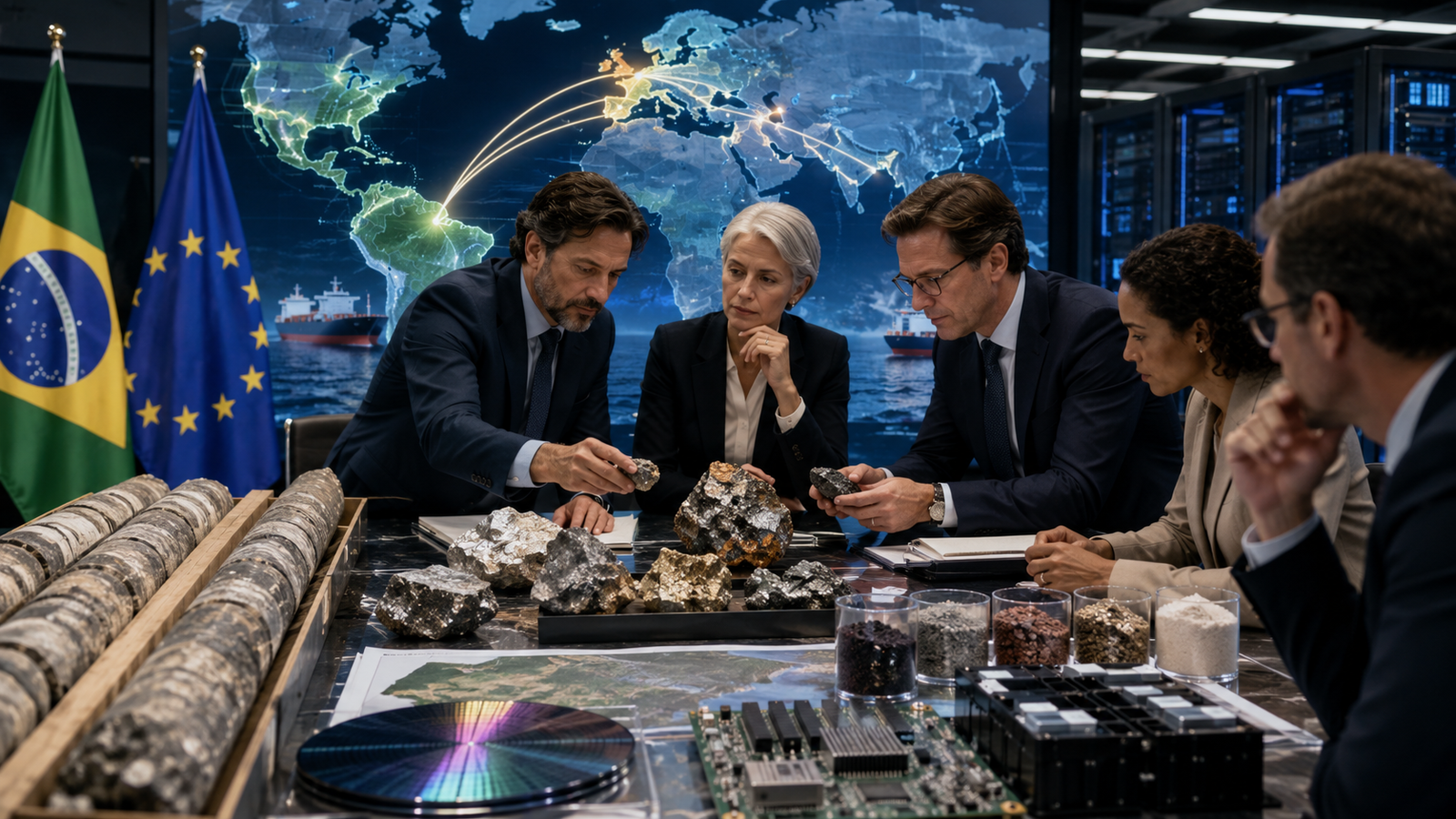
Artificial intelligence may be dominating market headlines, but beneath the surface, a less visible battle is rapidly becoming one of the most important investment themes of the decade. Governments around the world are racing to secure access to critical minerals—the raw materials powering AI infrastructure, advanced semiconductors, defense technologies, electric vehicles, and the global energy transition.
The latest development came on June 22, as Reuters reported that the European Union is pursuing a strategic critical-minerals partnership with Brazil, a country that possesses some of the world’s most significant reserves of rare earth elements and other strategically important resources. The move underscores a growing reality that investors can no longer ignore: critical minerals have evolved from ordinary commodities into geopolitical assets at the center of economic and national security policy.
As Western economies seek to reduce dependence on Chinese supply chains, competition for resource security is intensifying. For investors, the implications extend far beyond mining stocks. The emerging race for critical minerals is reshaping global trade relationships, government investment priorities, industrial policy, and long-term capital allocation across multiple sectors.
The New Global Resource Competition
For decades, global supply chains prioritized efficiency and cost reduction. Countries and corporations sourced materials from wherever production was cheapest and most accessible.
That model is increasingly being challenged.
Recent geopolitical tensions, supply chain disruptions, export restrictions, and national security concerns have prompted governments to rethink their dependence on foreign suppliers for strategically important resources.
Critical minerals have become a central focus of this shift.
These materials include rare earth elements, lithium, nickel, cobalt, copper, graphite, and other resources essential to modern technology. They are required for advanced semiconductor manufacturing, data centers, electric vehicle batteries, renewable energy systems, military equipment, and AI infrastructure.
According to Reuters, the European Union’s outreach to Brazil reflects growing urgency among Western governments to diversify supply sources and reduce vulnerabilities associated with concentrated global production.
For investors, this is not simply a mining story. It is a story about how nations are repositioning themselves for the next generation of economic and technological competition.
Why Brazil Has Become a Strategic Target
Brazil is emerging as one of the most important countries in the global critical minerals landscape.
The country possesses significant reserves of rare earth elements, nickel, lithium, graphite, and other strategic resources that are increasingly in demand. As governments seek alternatives to existing supply chains, Brazil offers both geological potential and geopolitical stability compared with some other resource-rich regions.
The European Union’s efforts to strengthen ties with Brazil are part of a broader trend that has gained momentum over the past several years.
The United States, Canada, Japan, Australia, and European nations have all expanded initiatives aimed at securing access to critical materials. These efforts include trade agreements, financing programs, strategic partnerships, and direct investments in mining and processing projects.
Industry analysts increasingly view Brazil as a potential cornerstone of future Western supply chains.
For mining investors, the country’s growing strategic importance could attract additional exploration spending, infrastructure investment, and long-term commercial agreements.
China’s Dominance Remains the Key Driver
The critical minerals race is largely being driven by concerns over China’s dominant position in global supply chains.
According to data from the International Energy Agency (IEA), China controls significant portions of global rare earth processing, battery material refining, and critical mineral manufacturing capacity. While resource deposits exist across multiple regions, refining and processing capabilities remain heavily concentrated.
This has become a major concern for Western policymakers.
Many advanced technologies rely on materials that pass through Chinese supply chains before reaching end users. As geopolitical tensions have increased, governments have accelerated efforts to diversify sourcing and develop domestic processing capabilities.
The result is a structural shift that could influence investment decisions for years.
Rather than prioritizing the lowest-cost supplier, governments and corporations are increasingly prioritizing security, resilience, and strategic control.
This trend is creating new opportunities for mining companies, processors, refiners, and infrastructure providers located in politically aligned jurisdictions.
Why AI Is Fueling Demand
Artificial intelligence is becoming one of the most important drivers of critical mineral demand.
Much of the public conversation surrounding AI focuses on software, chatbots, and advanced models. However, AI relies heavily on physical infrastructure.
Data centers require enormous quantities of copper for electrical systems and networking equipment. Advanced semiconductors depend on specialized materials and manufacturing processes. Power grids supporting AI infrastructure require significant upgrades and expansion.
According to estimates from major consulting firms including McKinsey and industry research organizations, AI-related infrastructure investment could reach hundreds of billions of dollars annually over the coming decade.
Every new data center, chip fabrication facility, and high-performance computing cluster increases demand for strategically important materials.
As a result, the AI investment boom is increasingly becoming a critical minerals story.
Investors who focus solely on software companies may overlook some of the most significant beneficiaries of the broader AI ecosystem.
Why This Matters for Investors
The growing importance of critical minerals is creating opportunities across several industries.
Mining and Exploration Companies
Firms with exposure to rare earths, copper, lithium, nickel, and graphite could benefit from increasing demand and government support.
Processing and Refining Businesses
One of the largest supply chain bottlenecks exists in refining capacity. Companies capable of processing critical materials may become increasingly valuable as governments seek to localize supply chains.
Infrastructure and Industrial Companies
New mines, processing facilities, transportation networks, and energy infrastructure will require significant capital investment.
North American and Canadian Producers
The United States and Canada continue expanding critical minerals initiatives through public funding, regulatory support, and strategic partnerships. Companies operating in politically stable jurisdictions may receive additional attention from investors and policymakers.
Future Trends to Watch
Several developments could shape the next phase of the critical minerals investment story.
Expansion of Strategic Partnerships
The EU-Brazil discussions may serve as a blueprint for future agreements involving resource-rich nations.
Government Investment Programs
Expect continued public funding, loan guarantees, and industrial incentives designed to strengthen supply chain security.
Growth in Domestic Processing
Western governments increasingly recognize that mining alone is insufficient. Refining and processing capacity will become a major investment priority.
Increased Mergers and Acquisitions
Large mining companies and industrial groups may pursue acquisitions to secure access to strategic resources and processing capabilities.
AI Infrastructure Expansion
As AI spending accelerates, demand for copper, rare earths, and other critical materials could continue rising alongside technological adoption.
Key Investment Insight
The most important takeaway for investors is that critical minerals are no longer simply commodities. They have become strategic assets at the intersection of technology, geopolitics, national security, and industrial policy.
The European Union’s pursuit of a partnership with Brazil highlights how governments are actively reshaping resource markets in response to growing concerns about supply chain resilience. This trend is likely to accelerate as demand rises from artificial intelligence, semiconductors, defense systems, electric vehicles, and energy infrastructure.
Investors should closely monitor companies involved in rare earths, copper, nickel, lithium, graphite, and mineral processing, particularly those operating in North America, Canada, Australia, and other strategically aligned regions. Businesses with proven reserves, refining capabilities, and government-backed partnerships may be particularly well positioned to benefit from long-term structural demand growth.
The race for critical minerals is becoming one of the defining investment themes of the next decade. Understanding where capital, policy, and supply chains are moving today could help investors identify tomorrow’s winners.
For more daily market intelligence, metals and mining analysis, and actionable investor insights, stay connected with MoneyNews.Today, your trusted source for the financial news that matters most.