
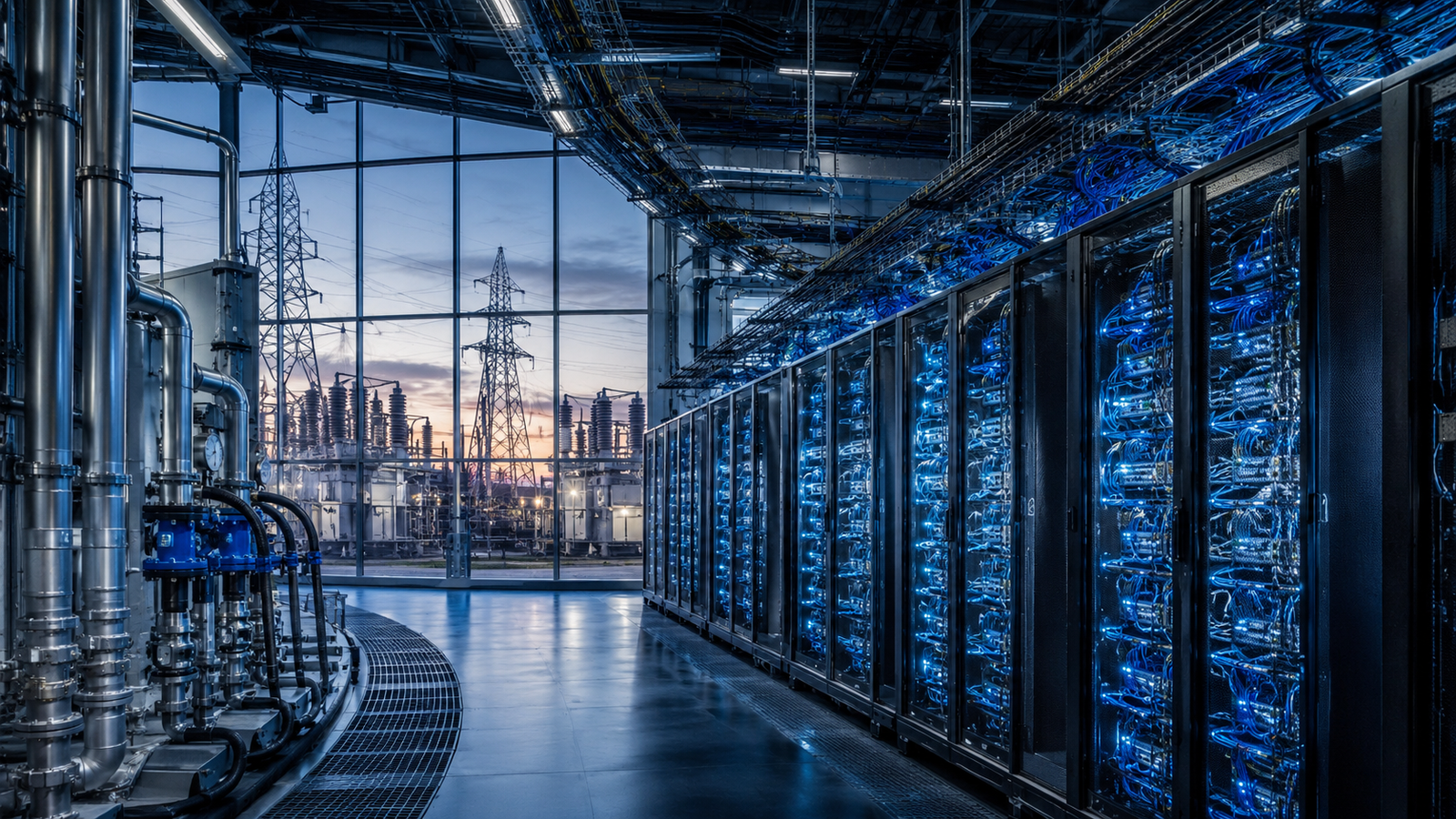
The artificial intelligence investment story is entering a new chapter—and investors are increasingly looking beyond chipmakers. While semiconductor stocks have experienced heightened volatility in recent weeks amid valuation concerns, institutional capital continues flowing into the infrastructure powering the AI revolution. From hyperscale data centers and electric utilities to cooling technologies and high-speed networking equipment, the next wave of AI investment is expanding well beyond graphics processors.
The shift reflects a broader realization on Wall Street: AI is no longer just about developing smarter models—it is about building the physical backbone capable of supporting an unprecedented surge in computing demand. According to Reuters and The Wall Street Journal, institutional investors remain focused on companies developing AI infrastructure, with capital increasingly directed toward data centers, power generation, digital infrastructure, and advanced networking.
For investors, this represents one of the most important emerging industry themes of 2026. As semiconductor valuations become more challenging, infrastructure providers may offer a broader and potentially more sustainable opportunity to participate in the long-term AI growth story.
The AI Boom Is Becoming an Infrastructure Story
Artificial intelligence has triggered one of the largest technology investment cycles in decades. Since generative AI became mainstream, global technology companies have dramatically increased spending on computing infrastructure to support increasingly complex AI models.
Major hyperscale cloud providers—including Microsoft, Amazon, Alphabet, Meta Platforms, and Oracle—continue investing tens of billions of dollars annually in AI-focused capital expenditures. These investments extend far beyond purchasing GPUs from Nvidia or AMD. They include constructing massive AI data centers, expanding fiber-optic networks, upgrading power systems, deploying advanced cooling technologies, and securing reliable electricity supplies.
Reuters reported on July 7 that institutional investors continue allocating capital toward these supporting industries, even as semiconductor stocks fluctuate. The Wall Street Journal also highlighted that AI infrastructure has become one of the strongest themes attracting long-term investment across public and private markets.
This shift suggests investors increasingly recognize that AI cannot scale without a significant expansion of the underlying physical infrastructure.
Why Data Centers Have Become the New Growth Engine
Data centers are emerging as one of the biggest beneficiaries of AI adoption.
Unlike traditional cloud computing, modern AI workloads require enormous computing clusters operating around the clock. Training and deploying large language models consumes significantly more electricity, networking bandwidth, and cooling capacity than conventional enterprise applications.
As a result, technology companies are rapidly expanding their global data center footprints.
Industry analysts estimate that AI servers consume several times more power than traditional enterprise servers, increasing demand for advanced electrical systems, transformers, backup power solutions, liquid cooling technologies, and high-capacity networking equipment.
This has transformed data centers from a relatively stable real estate investment into a strategic technology asset.
Institutional investors increasingly view data center operators as essential infrastructure supporting the next decade of AI growth.
Power Generation Is Becoming a Strategic Investment Theme
One of the most overlooked beneficiaries of AI expansion may be the power sector.
Every new AI data center requires substantial electricity capacity, and the rapid growth of hyperscale facilities is placing increasing pressure on electrical grids across North America.
Utilities, independent power producers, and renewable energy developers are benefiting from long-term contracts with technology companies seeking reliable electricity supplies.
Governments in both the United States and Canada are also encouraging investments in grid modernization, energy storage, transmission infrastructure, and clean power generation to support expanding digital economies.
According to industry research from the International Energy Agency (IEA), electricity demand from data centers is expected to continue rising throughout the decade as AI adoption accelerates globally.
For investors, this creates opportunities extending well beyond traditional technology stocks.
Cooling Systems Are Becoming Mission-Critical
AI servers generate significantly more heat than conventional computing systems.
Managing that heat efficiently has become one of the industry’s largest engineering challenges.
Traditional air-cooling systems are increasingly being supplemented—or replaced—by advanced liquid cooling technologies capable of handling higher computing densities while reducing energy consumption.
This trend is benefiting companies specializing in:
- Liquid cooling systems
- Precision climate control
- Thermal management
- Industrial HVAC technologies
- Energy-efficient cooling infrastructure
As AI clusters continue expanding, cooling solutions are expected to become an increasingly important component of overall data center investment.
Many analysts believe this segment could experience sustained growth even if semiconductor spending moderates.
Networking Infrastructure Is Growing in Importance
Artificial intelligence also requires exceptionally fast communication between thousands of interconnected processors.
This has increased demand for:
- High-speed Ethernet equipment
- Optical networking
- Fiber infrastructure
- Advanced switches
- AI networking platforms
- Interconnect technologies
Networking companies have become essential participants in the AI ecosystem, enabling large-scale computing clusters to operate efficiently.
Industry experts expect networking investment to remain robust as AI models continue increasing in complexity.
Institutional investors are therefore broadening their AI exposure beyond chip manufacturers toward companies enabling high-performance data transmission.
Why Investors Are Diversifying Beyond Semiconductor Stocks
Semiconductor companies have delivered exceptional returns throughout the AI boom.
However, many investors now believe portions of the sector are trading at historically elevated valuation multiples.
Recent market volatility reflects growing concerns that expectations for future growth have become increasingly demanding.
Rather than reducing AI exposure altogether, institutional investors appear to be rotating capital into adjacent infrastructure segments that may offer attractive long-term growth with less valuation risk.
Infrastructure companies generally benefit from longer project cycles, recurring customer relationships, and predictable capital investment programs.
These characteristics may provide greater earnings stability during periods of market volatility.
Future Trends Investors Should Watch
Several long-term developments could continue supporting AI infrastructure investment over the coming years.
Expansion of Hyperscale Data Centers
Technology companies are expected to continue constructing large AI campuses across North America, Europe, and Asia to support expanding cloud AI services.
Grid Modernization
Governments and utilities will likely accelerate investments in electricity generation, transmission networks, and renewable energy projects to accommodate increasing AI power demand.
Liquid Cooling Adoption
As AI hardware becomes more powerful, liquid cooling technologies could become standard across next-generation data centers.
Private Infrastructure Investment
Private equity firms, infrastructure funds, pension managers, and sovereign wealth funds continue increasing allocations toward digital infrastructure assets with stable long-term cash flows.
AI Enterprise Adoption
As more businesses integrate AI into daily operations, demand for cloud computing capacity and supporting infrastructure should continue expanding beyond the largest technology companies.
Why This Matters for Investors
The AI investment landscape is evolving.
The first phase rewarded companies developing advanced AI chips and software platforms.
The second phase is increasingly focused on building the infrastructure required to deploy AI at global scale.
This broader investment opportunity includes sectors that traditionally received less attention from technology investors, including utilities, industrial equipment manufacturers, electrical engineering firms, digital infrastructure providers, and specialized real estate operators.
For diversified investors, this evolution may create opportunities that are less dependent on semiconductor valuations while still benefiting from continued AI adoption.
Key Investment Insight
Artificial intelligence is no longer just a software story—it is becoming one of the largest infrastructure investment cycles in modern history.
While semiconductor stocks remain central to AI development, institutional capital is increasingly flowing toward companies supplying the physical foundation of the AI economy. Data centers, electric utilities, cooling technology providers, networking equipment manufacturers, and digital infrastructure operators all stand to benefit as demand for AI computing capacity continues to rise.
Investors should monitor capital expenditure plans from hyperscale cloud providers, electricity demand forecasts, data center construction announcements, and infrastructure spending trends throughout the remainder of 2026. Companies enabling AI deployment—not just AI creation—may emerge as some of the strongest long-term beneficiaries of this evolving market cycle.
Stay with MoneyNews.Today for daily investor-focused coverage of emerging industries, artificial intelligence, technology, capital markets, and the global trends shaping tomorrow’s investment opportunities.




