
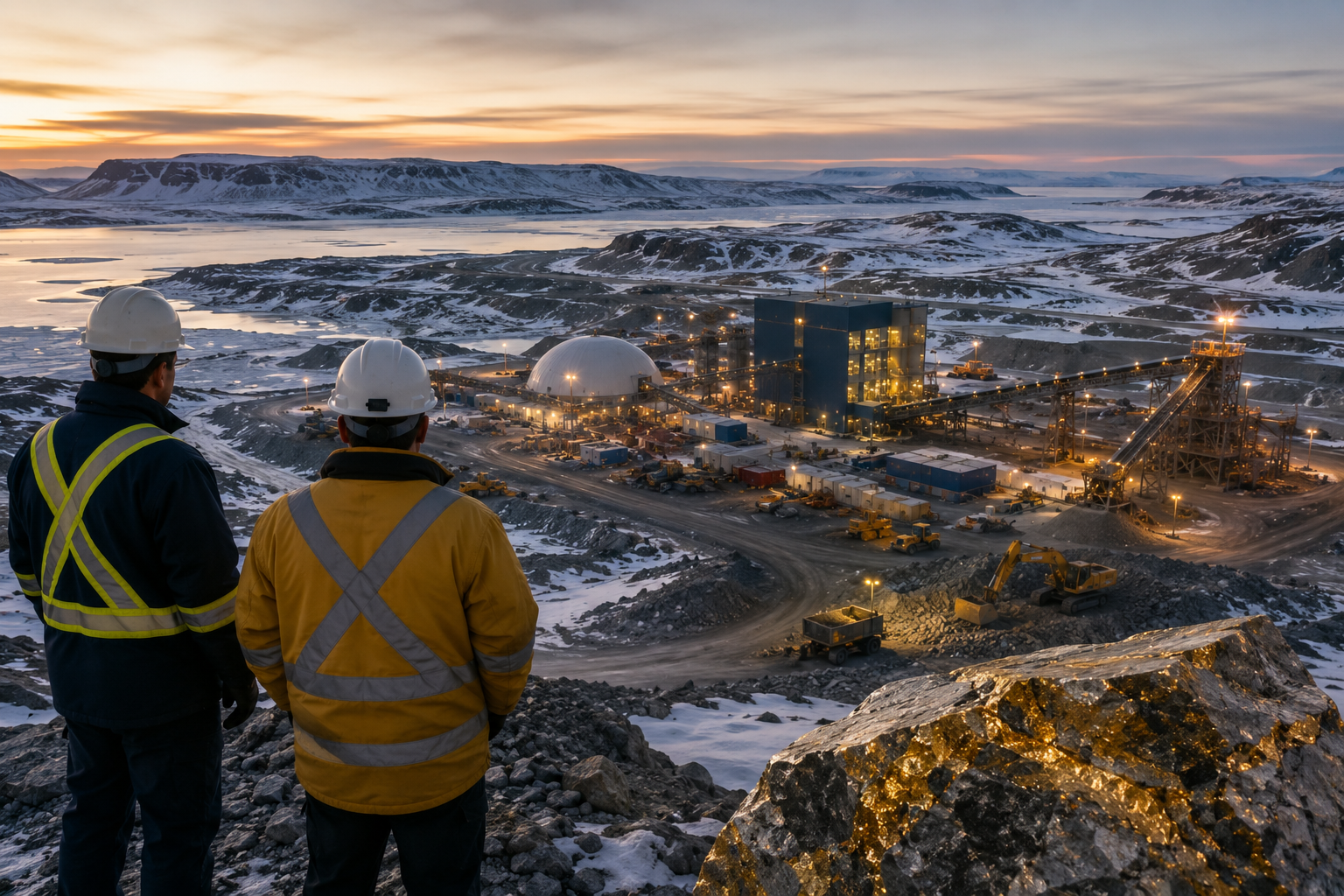
The global race for strategic resources is accelerating, and Canada’s Arctic region is rapidly becoming one of the mining industry’s most closely watched frontiers. In a major move that signals growing confidence in long-term precious metals demand, Agnico Eagle Mines has approved a massive $2.4 billion investment to expand the Hope Bay gold project in Nunavut, Canada.
The decision marks one of the largest new mining developments announced in Canada this year and underscores how major gold producers are aggressively positioning themselves for a future defined by geopolitical uncertainty, persistent inflation risks, and increasing competition for critical resources.
According to reporting from the The Wall Street Journal, the Hope Bay project is expected to produce as much as 435,000 ounces of gold annually once fully operational. The expansion reflects not only bullish long-term expectations for gold prices but also a broader strategic shift toward strengthening domestic resource production in politically stable jurisdictions.
For investors, the announcement highlights a powerful trend reshaping global commodity markets: major mining companies are no longer simply chasing short-term profits. They are building long-duration strategic assets designed to secure supply in a world increasingly defined by inflation volatility, geopolitical fragmentation, and rising demand for critical minerals.
Why the Hope Bay Expansion Matters
The Hope Bay project sits in Nunavut, one of Canada’s resource-rich Arctic regions that has attracted increasing attention from both mining companies and policymakers. While Arctic mining projects historically faced significant logistical and infrastructure challenges, rising commodity prices and growing strategic interest in domestic resource security are changing the economics of large-scale northern developments.
Agnico Eagle’s investment demonstrates how mining giants are willing to commit substantial capital to long-life projects despite elevated construction costs and complex operating environments.
The scale of the project is significant.
Expected annual production of approximately 435,000 ounces positions Hope Bay among Canada’s major future gold operations. More importantly, the project expands Agnico Eagle’s already strong footprint within Canada’s mining sector, reinforcing the company’s status as one of the world’s leading gold producers.
The expansion also reflects growing confidence in long-term bullion demand.
Gold prices have remained historically elevated amid persistent inflation concerns, geopolitical instability, and rising central bank purchases. Investors globally continue viewing gold as a hedge against monetary uncertainty and macroeconomic volatility.
As a result, mining companies are increasingly prioritizing production growth while commodity prices remain favorable.
Gold’s Strategic Importance Is Growing Again
For much of the previous decade, gold miners struggled with inconsistent investor sentiment as low inflation and strong equity markets reduced demand for defensive assets. That environment has shifted dramatically.
The current macroeconomic landscape is once again reinforcing gold’s importance within global portfolios.
Persistent inflation concerns, rising government debt levels, geopolitical tensions, and central-bank diversification strategies are all contributing to stronger long-term interest in precious metals.
Central banks globally have significantly increased gold purchases in recent years as nations seek to diversify reserves away from overreliance on the U.S. dollar and traditional sovereign debt assets. At the same time, institutional investors are increasingly using gold exposure as protection against market volatility and inflation uncertainty.
This renewed demand environment has encouraged mining companies to accelerate expansion plans.
Agnico Eagle’s move reflects broader industry confidence that elevated gold prices may persist longer than many analysts previously expected.
The company is not alone.
Across North America, Australia, and Latin America, mining firms are pursuing new projects, reserve expansions, and acquisition strategies aimed at increasing long-term production capacity.
For investors, this trend signals that the mining sector may be entering a new multi-year investment cycle driven by structural macroeconomic forces rather than short-term commodity speculation.
Canada’s Arctic Region Is Becoming a Strategic Resource Hub
The Hope Bay expansion also highlights the growing geopolitical importance of Canada’s Arctic region.
Governments and corporations are increasingly prioritizing domestic resource security amid rising global tensions, trade fragmentation, and concerns over concentrated supply chains. Critical minerals, precious metals, and strategic commodities are becoming central to national economic and industrial policy discussions.
Canada is uniquely positioned in this environment.
The country possesses vast reserves of gold, copper, nickel, lithium, uranium, and rare earth elements — many located in northern and Arctic regions that remain underdeveloped relative to their resource potential.
Federal and provincial policymakers have increasingly emphasized the importance of developing domestic mining infrastructure to support energy transition goals, supply-chain resilience, and long-term economic growth.
The Hope Bay investment aligns closely with these strategic priorities.
Large-scale Arctic developments also create broader economic opportunities tied to:
- Transportation infrastructure
- Energy systems
- Industrial logistics
- Indigenous partnerships
- Regional employment growth
However, Arctic mining projects also come with substantial challenges.
Harsh weather conditions, infrastructure limitations, environmental considerations, and high operating costs can create execution risks for mining operators. Investors will likely monitor construction timelines, permitting progress, and cost management closely as the project advances.
Why Investors Are Watching Gold and Copper Together
While Hope Bay is primarily a gold project, the broader mining investment story increasingly revolves around both gold and copper.
Gold continues benefiting from macroeconomic uncertainty and inflation concerns, while copper demand is accelerating because of electrification, artificial intelligence infrastructure, renewable energy development, and electric vehicle production.
Many investors now view these commodities as complementary long-term themes rather than separate investment categories.
Gold offers defensive portfolio characteristics during periods of economic instability, while copper represents exposure to global industrial growth and technological expansion.
This combination is creating renewed institutional interest in diversified mining companies with strong exposure to both precious and industrial metals.
According to analysis from major financial institutions including Goldman Sachs and McKinsey, global copper demand could rise dramatically over the coming decade as AI data centers, grid infrastructure, battery systems, and renewable energy projects expand worldwide.
At the same time, limited new mine development and declining ore grades are raising concerns about future supply shortages.
That dynamic may further strengthen investment interest across the broader mining sector.
Mining Stocks Are Regaining Institutional Attention
The mining industry spent years under pressure from investors concerned about operational discipline, environmental risks, and capital allocation. However, the sector is beginning to regain credibility as commodity fundamentals improve and global resource security becomes a larger strategic priority.
Gold miners in particular are benefiting from stronger free cash flow generation as elevated bullion prices improve profitability.
Many major mining companies now maintain healthier balance sheets, stronger dividend profiles, and more disciplined capital allocation strategies compared with previous commodity cycles.
This shift is attracting renewed institutional capital into the sector.
Mining equities also offer investors indirect exposure to inflation protection, commodity strength, and geopolitical trends without relying solely on physical commodity holdings.
As global markets become increasingly influenced by macroeconomic instability and supply-chain competition, resource-focused companies may continue gaining investor attention.
Key Investment Insight
Agnico Eagle’s $2.4 billion Hope Bay expansion represents more than a single mining project — it reflects a broader global shift toward resource security, long-term commodity investment, and strategic domestic production.
For investors, several themes stand out:
- Gold miners are expanding aggressively while bullion prices remain historically elevated
- Canada’s Arctic region is becoming increasingly important for long-term resource development
- Mining infrastructure tied to critical minerals and precious metals may benefit from rising geopolitical and industrial demand
- Gold and copper remain among the strongest long-term commodity themes tied to inflation protection and global electrification
Investors should closely monitor Canadian mining projects, infrastructure development in Arctic regions, commodity-price trends, and capital spending across the global mining industry.
The combination of inflation uncertainty, geopolitical instability, and growing demand for strategic resources may continue supporting the mining sector for years to come.
As commodity markets evolve and resource competition intensifies, companies positioned with high-quality reserves, stable jurisdictions, and scalable production capacity could emerge as major long-term winners.
Stay informed with more daily investor insights and commodity market analysis from MoneyNews.Today.




