
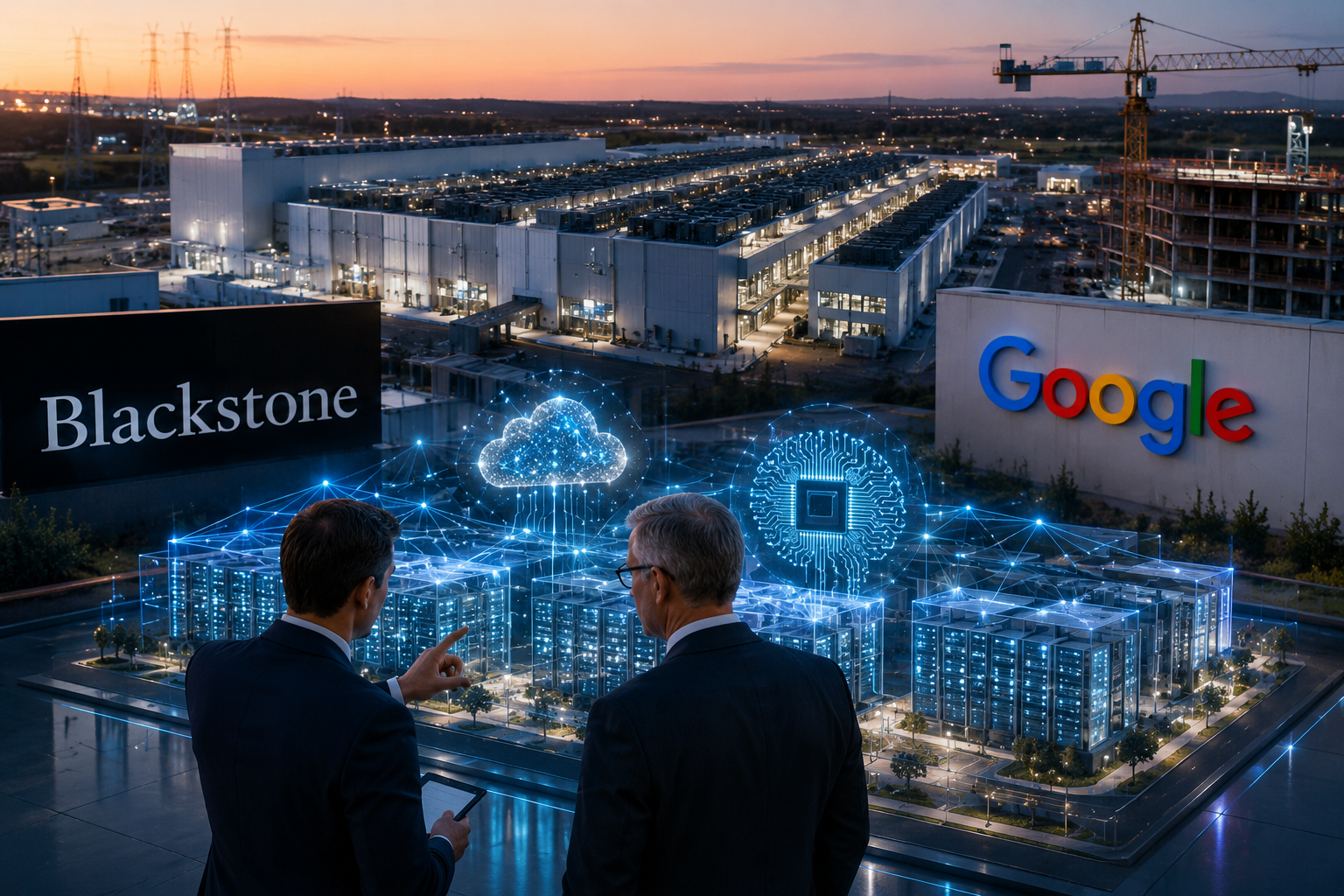
The artificial intelligence boom is entering a new phase — and it is no longer just about software models and chatbot competition. The next battleground is physical infrastructure.
In one of the most significant AI infrastructure deals announced this year, Blackstone and Google have launched a massive $5 billion joint venture aimed at expanding AI-focused cloud and data-center infrastructure across the United States.
The partnership, first highlighted through Reuters-linked market coverage and MLQ.ai reporting on May 20, 2026, reflects the accelerating global race to secure the computing power necessary to support advanced artificial intelligence systems. The venture will reportedly expand access to Google’s Tensor Processing Unit (TPU) infrastructure while scaling next-generation AI cloud capacity for enterprise and hyperscale customers.
For investors, the announcement underscores a major transformation taking place across the technology sector. AI is no longer simply a software story driven by applications like generative AI assistants and automation tools. It has evolved into a full-scale industrial buildout requiring enormous investments in data centers, semiconductors, electricity generation, networking systems, cooling technology, and cloud infrastructure.
The implications stretch far beyond Silicon Valley.
The AI infrastructure race is rapidly reshaping capital allocation strategies across private equity, utilities, industrials, real estate, and semiconductor markets. Investors are increasingly realizing that the long-term winners of the AI era may not only include software developers, but also the companies powering the physical backbone of artificial intelligence itself.
Why the Blackstone-Google Deal Matters
The scale and timing of the Blackstone-Google partnership reveal just how aggressively major institutions are positioning themselves for the next stage of AI growth.
Artificial intelligence workloads require extraordinary amounts of computational power. Training and operating advanced AI models consumes enormous processing capacity, storage infrastructure, and electricity. As demand for AI services explodes globally, hyperscalers are racing to secure enough compute resources to remain competitive.
Google’s TPU systems have become one of the company’s most important strategic assets in this race.
Unlike traditional CPUs, TPUs are specifically optimized for AI and machine-learning workloads, enabling faster processing and greater efficiency for large-scale AI operations. Expanding TPU availability through dedicated infrastructure partnerships allows Google to compete more aggressively with rivals such as Microsoft, Amazon, and NVIDIA in the rapidly growing AI cloud market.
For Blackstone, the venture reflects a broader trend in private equity toward infrastructure-driven investment opportunities tied to long-duration technological transformation.
Large institutional investors increasingly view AI infrastructure as a multi-decade investment theme similar to the early buildout of internet infrastructure, telecommunications networks, or energy systems.
The difference today is scale.
According to estimates from McKinsey, Goldman Sachs, and the International Energy Agency (IEA), global AI infrastructure spending could reach trillions of dollars over the coming decade as companies and governments compete to secure computing capacity.
AI’s Biggest Bottleneck Is No Longer Chips Alone
For much of the past two years, investor focus within the AI market centered heavily on semiconductor demand.
That trend helped drive massive rallies in companies tied to AI chips, particularly Nvidia and other semiconductor firms. However, the market is now recognizing that AI expansion depends on far more than processors alone.
The next challenge is infrastructure.
Data centers capable of supporting advanced AI models require:
- Massive electricity capacity
- Advanced cooling systems
- High-speed networking equipment
- Fiber connectivity
- Land development
- Industrial construction
- Power-grid upgrades
In many regions, access to electricity itself is becoming a critical constraint.
The International Energy Agency recently warned that AI-related data-center demand could dramatically increase electricity consumption over the coming decade. AI systems consume substantially more power than traditional cloud workloads because of the computational intensity required for training and inference operations.
This is creating entirely new investment opportunities across sectors that historically received little attention from technology-focused investors.
Utilities, power producers, electrical equipment suppliers, industrial engineering firms, and cooling-system manufacturers are increasingly becoming indirect beneficiaries of the AI boom.
Data Centers Are Emerging as One of Wall Street’s Hottest Themes
One of the clearest emerging trends in financial markets is the growing institutional interest in data-center infrastructure.
Data-center REITs and infrastructure-focused operators have become some of the strongest-performing segments tied to AI growth expectations. Investors increasingly view these businesses as essential infrastructure providers in the modern digital economy.
The Blackstone-Google deal further reinforces this narrative.
Private equity firms are aggressively expanding exposure to AI infrastructure because these assets often generate long-term, recurring cash flows tied to hyperscale cloud demand. Unlike speculative technology investments, infrastructure assets can provide more stable returns supported by contractual usage agreements and long-duration demand trends.
This shift is also attracting sovereign wealth funds, pension funds, and infrastructure investors seeking exposure to the AI economy without relying solely on volatile software valuations.
In many ways, the AI buildout is beginning to resemble an industrial expansion cycle rather than a traditional technology trend.
The AI Infrastructure Race Is Becoming a Geopolitical Issue
Another reason investors are paying close attention to AI infrastructure is the growing geopolitical importance of computing power.
Artificial intelligence is increasingly viewed as a strategic national asset with implications for economic competitiveness, military capability, cybersecurity, and technological leadership.
As a result, governments worldwide are supporting domestic AI infrastructure development through policy initiatives, incentives, and strategic partnerships.
The United States is aggressively expanding domestic semiconductor manufacturing and cloud infrastructure capacity, while China continues investing heavily in AI supercomputing systems and sovereign technology development.
This geopolitical competition is accelerating capital investment throughout the sector.
The Blackstone-Google partnership reflects how private capital and large technology firms are aligning around long-term strategic infrastructure priorities.
Investors should expect this trend to continue.
Rising Electricity Demand Could Reshape Energy Markets
Perhaps one of the most overlooked investment implications of the AI boom is its impact on electricity demand.
AI data centers consume enormous energy resources, and power availability is quickly becoming one of the most critical constraints for future AI expansion.
Industry analysts increasingly believe electricity demand tied to AI could become one of the defining investment themes of the next decade.
According to projections from the International Energy Agency, data-center energy consumption may rise sharply as AI adoption expands across industries. This could create major investment opportunities in:
- Nuclear energy
- Natural gas infrastructure
- Renewable power generation
- Battery storage systems
- Grid modernization
- Industrial cooling technologies
Utilities with stable generation capacity near major data-center regions may become increasingly valuable as hyperscalers compete for reliable energy access.
This represents a major shift in market thinking.
The AI revolution is no longer confined to software companies and semiconductor stocks. It is now influencing industrial policy, energy infrastructure, and real-world asset investment across the global economy.
Key Investment Insight
The $5 billion Blackstone-Google venture highlights how the AI boom is evolving from a software-driven narrative into a full-scale infrastructure investment cycle.
For investors, the implications are enormous.
The next phase of AI growth may increasingly benefit companies tied to:
- Data-center development
- Power generation and utilities
- Cooling and electrical systems
- Cloud infrastructure
- Semiconductor networking equipment
- Industrial construction and engineering
- Infrastructure-focused private equity platforms
Investors should closely monitor rising electricity demand, AI-related capital expenditures, hyperscaler infrastructure spending, and federal policy support tied to domestic technology expansion.
At the same time, valuation sensitivity remains an important consideration. As Treasury yields rise and financial conditions tighten, markets may become more selective regarding which AI-related companies can generate sustainable long-term returns.
The broader trend, however, remains clear: artificial intelligence is rapidly becoming one of the largest infrastructure investment themes in modern economic history.
The companies building the physical foundation of AI may ultimately prove just as important as the software firms capturing headlines today.
Stay ahead of the latest AI infrastructure trends and market-moving investment opportunities with daily financial coverage from MoneyNews.Today.




