
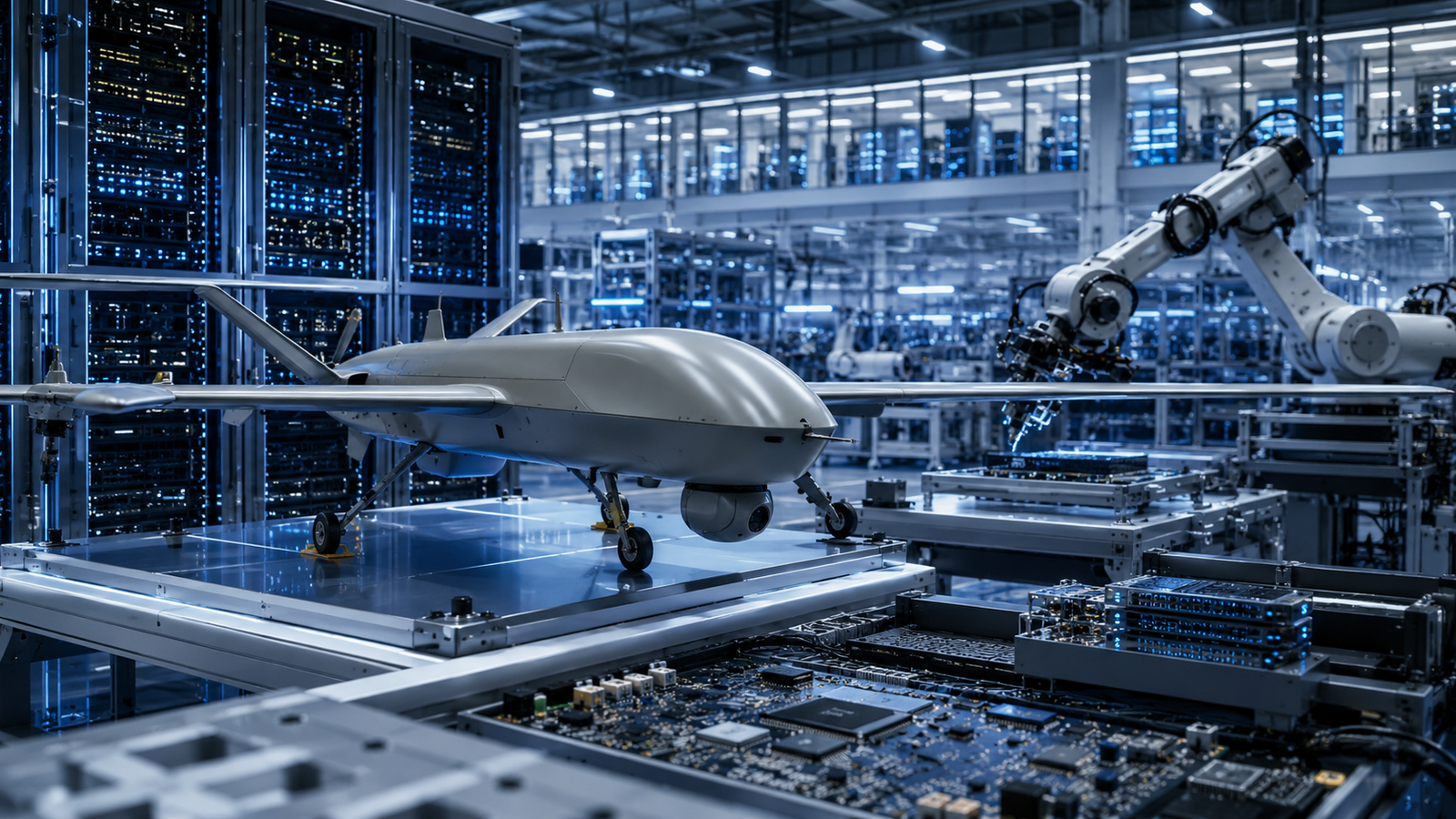
Wall Street’s next major investment boom may not come solely from consumer technology or traditional artificial intelligence software platforms. Increasingly, investor attention is shifting toward a new class of emerging industries sitting at the intersection of defense, AI, robotics, cybersecurity, and industrial automation.
As geopolitical tensions rise and governments modernize military capabilities, institutional capital is flowing aggressively into defense technology, drone manufacturing, autonomous systems, AI-powered surveillance, and critical infrastructure. What was once considered a niche segment of aerospace and defense is rapidly evolving into one of the most important long-term investment themes in global markets.
The shift is already becoming visible across financial markets.
Defense contractors tied to AI systems, drone manufacturing, cybersecurity, and advanced battlefield technologies have attracted growing investor interest in recent months, while venture capital and private equity firms continue pouring billions into dual-use technologies capable of serving both military and commercial applications.
According to Reuters market coverage and policy commentary tied to rising geopolitical instability, defense-linked technology spending is accelerating across the United States and allied nations as governments respond to evolving security threats, supply-chain vulnerabilities, and the growing importance of AI-driven warfare systems.
For investors, the implications may be significant.
The defense industry is no longer just about tanks, aircraft carriers, and fighter jets. Increasingly, it is becoming a technology sector.
The Rise of the “Dual-Use” Economy
One of the biggest trends driving investor interest is the rise of dual-use technologies — products and systems that can operate in both civilian and military environments.
Artificial intelligence, drones, robotics, autonomous navigation, cybersecurity software, satellite communications, and industrial automation systems all fall into this category.
This convergence is reshaping how governments allocate defense budgets and how investors evaluate long-term growth opportunities.
For example, drones originally developed for military reconnaissance are now widely used across logistics, agriculture, mining, infrastructure inspection, and emergency response. Similarly, AI software designed for battlefield intelligence can also power enterprise analytics, predictive maintenance, and industrial automation.
According to McKinsey and Bloomberg Intelligence estimates, autonomous systems and AI-enabled industrial technologies could become multi-trillion-dollar global markets over the next decade.
That growth potential is attracting institutional investors searching for the next major secular trend beyond traditional big-tech AI trades.
Why Geopolitical Tensions Are Accelerating Investment
The geopolitical backdrop is a major catalyst behind the sector’s rapid expansion.
The United States, NATO allies, and several Indo-Pacific nations are increasing defense modernization spending amid rising tensions involving China, Russia, the Middle East, and cyber warfare threats. Governments are prioritizing technologies capable of improving intelligence gathering, autonomous operations, cybersecurity resilience, and battlefield efficiency.
According to Reuters and U.S. Department of Defense budget commentary, military modernization initiatives increasingly emphasize:
- Autonomous drones
- AI-powered surveillance systems
- Cybersecurity infrastructure
- Quantum computing
- Space-based communications
- Advanced semiconductor systems
- Robotics and automation
This shift is creating substantial investment opportunities across public and private markets.
The conflict in Ukraine also accelerated global awareness around drone warfare and autonomous military systems. Low-cost drones, AI-assisted targeting, and electronic warfare systems demonstrated how quickly battlefield technologies are evolving.
As a result, investors are now paying far closer attention to defense-oriented technology firms that previously received limited mainstream market attention.
AI Infrastructure Is Expanding Beyond Big Tech
Artificial intelligence remains central to the broader investment narrative, but AI infrastructure is no longer confined to Silicon Valley software companies.
Defense agencies and industrial firms are becoming major buyers of AI-powered systems capable of supporting logistics, surveillance, cybersecurity, predictive maintenance, and autonomous decision-making.
This creates opportunities far beyond traditional AI software developers.
The rapid expansion of AI infrastructure is increasing demand for:
- Data centers
- Edge computing systems
- Semiconductor manufacturing
- High-performance networking
- Satellite infrastructure
- Energy generation
- Industrial robotics
- Cybersecurity systems
According to Goldman Sachs and Morgan Stanley research cited in recent market reports, AI infrastructure spending may remain elevated for years as governments and corporations compete for technological leadership.
Importantly, defense-related AI applications often involve long-term government contracts, creating potentially stable revenue streams for companies positioned within the ecosystem.
That dynamic makes the sector increasingly attractive for institutional investors seeking growth combined with relative earnings visibility.
Drone Manufacturing Is Becoming a Strategic Industry
Drone manufacturing is emerging as one of the fastest-growing segments within the broader defense technology landscape.
Once viewed primarily as military surveillance tools, drones are now central to logistics, agriculture, emergency response, infrastructure monitoring, and industrial automation.
Global drone spending is expected to rise sharply over the coming decade as governments and private industries adopt autonomous aerial systems for both defense and commercial operations.
According to estimates from Deloitte and PwC, the commercial drone market alone could exceed hundreds of billions of dollars globally over the next several years.
Meanwhile, military drone demand continues expanding as nations prioritize cost-effective autonomous systems capable of operating in contested environments.
Investors are increasingly focusing on companies involved in:
- Autonomous flight software
- Sensor technology
- AI-assisted navigation
- Drone manufacturing
- Battery systems
- Aerospace semiconductors
- Satellite communications
The sector also benefits from broader reshoring and supply-chain security trends as governments attempt to reduce dependence on foreign technology providers.
Cybersecurity and Industrial Automation Gain Momentum
As critical infrastructure becomes more digitally connected, cybersecurity is becoming inseparable from both defense technology and industrial systems.
Cyberattacks targeting energy grids, communications infrastructure, transportation systems, and financial networks have intensified government concerns worldwide.
This is driving increased investment into:
- Cybersecurity platforms
- AI-driven threat detection
- Industrial network security
- Secure cloud infrastructure
- Quantum-resistant encryption
At the same time, labor shortages and manufacturing reshoring efforts are accelerating industrial automation investments across North America.
Factories, warehouses, logistics centers, and defense supply chains increasingly rely on robotics and AI-driven operational systems to improve efficiency and resilience.
According to Bank of America Global Research, industrial automation could become one of the defining infrastructure investment themes of the next decade as AI expands beyond software and into physical systems.
Future Trends Investors Should Watch
Several long-term trends could continue shaping the sector:
Government Defense Spending Growth
Military modernization programs across the U.S. and allied nations remain a powerful driver of long-term industry demand.
AI Integration Across Defense Systems
AI-enabled intelligence, autonomous operations, and predictive analytics are likely to become standard components of modern defense infrastructure.
Drone Commercialization
Commercial drone adoption may accelerate across logistics, agriculture, mining, infrastructure inspection, and public safety industries.
Semiconductor and Supply-Chain Security
Advanced chips remain critical for AI, autonomous systems, and defense infrastructure, increasing the strategic importance of domestic semiconductor production.
Energy Infrastructure Expansion
AI facilities, autonomous systems, and industrial automation all require substantial energy infrastructure investment.
Key Investment Insight
Defense-linked emerging technologies are increasingly evolving into one of the most important institutional investment themes alongside artificial intelligence.
The convergence of AI, robotics, drones, cybersecurity, and industrial automation is reshaping both military systems and the global economy. Investors are no longer looking at defense purely as a traditional industrial sector — it is rapidly becoming a high-growth technology ecosystem supported by long-term geopolitical and infrastructure trends.
Companies positioned within AI infrastructure, autonomous systems, cybersecurity, aerospace technology, industrial robotics, and advanced manufacturing may continue benefiting from rising institutional capital flows and government modernization spending.
However, investors should also remain mindful of geopolitical volatility, regulatory risks, and elevated valuations across rapidly expanding technology sectors.
The long-term transformation of defense and industrial systems appears only to be beginning.
Stay with MoneyNews.Today for more daily investor insights covering AI, defense technology, emerging industries, global markets, and the economic trends shaping the future of investing.




