New channel assays from a wholly owned deposit beside Agnico Eagle’s Canadian Malartic complex lengthen a near-surface gold zone to almost 13 metres and point to an under-drilled corner of the open-pit footprint.
Most junior gold stories are told from the bottom of a drill hole. Renforth Resources Inc. (CSE: RFR, OTC: RFHRF, FSE: 9RR) is telling one from the top of the bedrock.
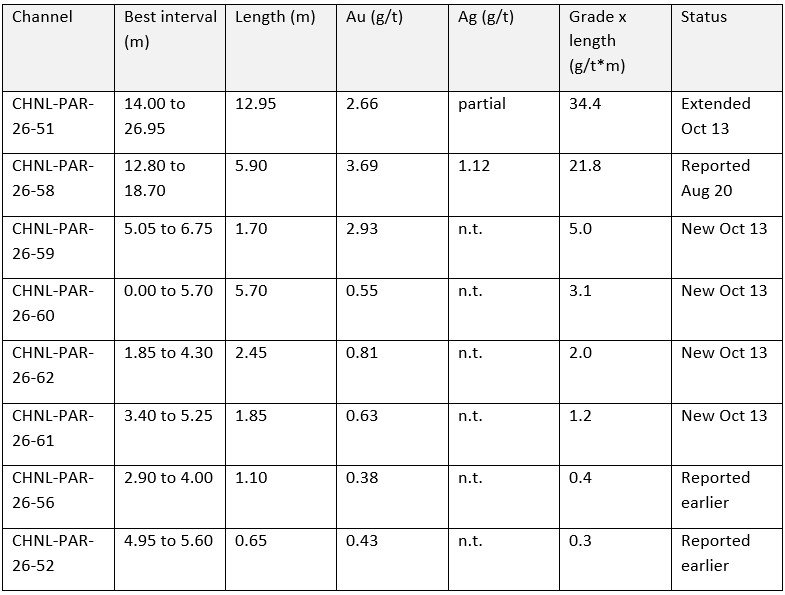
On October 13, the Toronto-based explorer reported the remaining assays from the surface channels cut this year inside the planned open-pit footprint of its Parbec gold deposit in Malartic, Quebec. Every new channel returned gold. The best new result was 6.20 grams per tonne gold over 0.50 metres, within 2.93 g/t over 1.70 metres, in channel CHNL-PAR-26-59.
The more telling number came from an older channel. Extension samples cut at both ends of CHNL-PAR-26-51 lengthened its mineralized interval to 12.95 metres grading 2.66 g/t gold. In August, the company had reported that same zone as 2.97 g/t over 10.2 metres. The zone grew by 27 per cent in length and stayed open at a grade that most open-pit operators in the Abitibi would welcome.
Why surface gold matters here
Parbec is not a grassroots prospect. It carries a current NI 43-101 mineral resource estimate, prepared by SGS Canada with an effective date of April 4, 2025, of 265,800 ounces of gold in the measured and indicated categories plus 97,000 inferred ounces. That estimate was built almost entirely from drill holes.
The 2026 program does something different. Crews stripped overburden from part of the pit footprint, washed the bedrock, mapped it by drone and cut continuous channels across the exposed rock with a diamond saw. The result is a geological map with gold values painted directly onto it, in an area the company describes as largely undrilled.
The highest-grade result of the season remains 28.77 g/t gold over 0.60 metres, within 8.02 g/t over 2.55 metres, in CHNL-PAR-26-58, first reported in August. The longest interval, CHNL-PAR-26-51, also carries the program’s best silver: 7.60 g/t Ag alongside 5.36 g/t gold over 0.60 metres.
“These new results continue and confirm our discovery process within our MRE open pit footprint on our Parbec gold deposit of unanticipated surface gold in an accessible location more than 50m removed from the rail line at Parbec,” said Nicole Brewster, President and CEO of Renforth.
That word, unanticipated, is the heart of the story. Gold sitting at surface inside a pit shell, outside the drill pattern that defined the resource, is the kind of finding that can change how a pit is drawn.
Location, location, location
Parbec sits on the Cadillac-Larder Lake fault, the structure that runs from Kirkland Lake to Val-d’Or and has hosted many of the most productive gold mines in Canadian history. The deposit is contiguous to Agnico Eagle’s (NYSE: AEM) (TSX: AEM) Canadian Malartic complex, one of the largest open-pit gold mines in the country, and is linked by an all-season road to the Malartic mill about five kilometres to the east.
For a deposit of this size, neighbours matter. A resource that sits a short haul from an operating mill, owned by a major producer that is always replacing ore, has a different set of exit options than one stranded in the bush.
The economics have moved
The April 2025 resource used a gold price of US$2,100 per ounce. The company notes that gold now trades above US$4,100. Renforth has signaled that its 0.27 g/t reporting cut-off, inherited from that estimate, is conservative at today’s prices, and it has shown two samples at 0.25 g/t in its tables for that reason.
In plain terms, material that fell below the cut-off at US$2,100 gold may become economic at twice that price. Any future resource update would be run at a materially higher metal price, which typically lowers the economic cut-off and can expand a pit.
What comes next
Renforth is still waiting on assays from two drill holes completed earlier this year that undercut the stripped area and extended deeper into the deposit. The company reports four flecks of visible gold in one of them. Field work pauses for the customary October hunting season, after which the company plans at least one more channel in the stripped area and will apply for permits to strip new, previously unexposed parts of the pit footprint where drilling has returned positive near-surface results.
The company’s stated strategy is to advance Parbec to the point where it can be monetized, and use that value to develop its Victoria nickel-focused polymetallic deposit, also contiguous to Canadian Malartic. Victoria hosts a resource declared over only about 12 per cent of a roughly 20-kilometre mineralized structure.
Ms. Brewster will present at the Precious Metals & Critical Minerals Virtual Investor Conference on Thursday, October 15, 2026, at 1:30 p.m. ET. Attendance is free and investors can book one-on-one meetings through the conference platform.
For investors who prefer their gold stories grounded in rock they can see, Parbec is worth a look.
Technical information in this article is drawn from Renforth’s October 13, 2026 news release, reviewed and approved by Francis R. Newton, P.Geo. (OGQ), an independent qualified person under NI 43-101. Channel lengths are measured on surface; true widths are not known. Mineral resources are not mineral reserves and do not have demonstrated economic viability. This article contains forward-looking information; readers should consult Renforth’s public filings on SEDAR+ and are cautioned not to place undue reliance on forward-looking statements. This is not investment advice.
Deep dive 1: the geologist’s read
The October results confirm that gold at Parbec is not confined to a single structure: it shows up in several parallel rock units across a stripped window roughly 150 m long, which is what a resource geologist wants to see before redrawing a pit.
Setting. Parbec straddles about 1.8 km of the Cadillac-Larder Lake Deformation Zone (Renforth, Feb 2021). The company has long interpreted a second style of mineralization in silicified diorite splays south of the break, hosted in Pontiac sediments (Renforth, Jul 2025). That is the same sedimentary package that hosts the Canadian Malartic orebody next door, a useful analogy but not proof of a similar deposit.
What the trench map shows. The August 2026 drone map (Minroc Management) records greywacke, diorite, felsite, quartz-feldspar porphyry (QFP), chloritic diorite or volcanics, sericite-chlorite schist and quartz veins, all trending west-northwest. The channels run roughly north-south, close to perpendicular to that fabric, which is the right orientation for sampling.
– CHNL-PAR-26-51, the 12.95 m interval, crosses diorite and a felsite band in the southeast of the strip.
– CHNL-PAR-26-58, the 28.77 g/t sample, sits at the eastern end on a schist and felsite contact.
– CHNL-PAR-26-59 and -60 cut the north side, where QFP and felsite bodies appear; -60 returned the longest new interval (0.55 g/t over 5.70 m).
– CHNL-PAR-26-61 sits well south in a separate greywacke and felsite exposure, so gold there (0.63 g/t over 1.85 m) widens the footprint rather than repeating it.
Interpretation. Gold associates with felsic intrusions, sheared contacts and silica-bearing units rather than one vein. Grades are erratic at sub-metre scale (0.10 m to 0.60 m high-grade inclusions), typical of structurally controlled Abitibi gold. The broader 2 to 3 g/t envelopes are the economically meaningful part for an open pit, not the spikes.
The link to depth. Two holes drilled this year undercut the stripped area. The company reports four flecks of visible gold in one. Those assays will test whether the surface units carry grade down dip into the existing resource, the key question for a pit redesign.
Deep dive 2: the numbers
Two channels carry the program: CHNL-PAR-26-51 and -58 hold about 82% of the gold content (grade x length) in the best interval of each channel; the four new channels add footprint, not much metal.

Source: tables in the Oct 13, 2026 release. n.t. = not tested (lab equipment issue). Lengths are channel lengths on surface; true widths unknown.
What actually changed on Oct 13. CHNL-PAR-26-51 was reported on Aug 20 as 2.97 g/t over 10.2 m from 14.0 to 24.2 m (Stockwatch, Aug 20 2026). It now reads 2.66 g/t over 12.95 m. The 2.75 m added at the end averages about 1.5 g/t by back-calculation: 2.14 g/t over 1.45 m as assayed, implying roughly 0.8 g/t over the last 1.30 m. Length went up 27%; contained gold-metres went up about 14%.
Grade spikes vs. envelopes. Strip out the 0.60 m at 28.77 g/t and CHNL-PAR-26-58’s 5.9 m interval falls from 3.69 g/t to roughly 0.9 g/t. That is the nugget effect at work, and why a resource model will cap high grades. The 12.95 m in -51 is the more robust result: no single sample dominates it.
Cut-off choices. Composites use 0.27 g/t, the April 2025 MRE cut-off at US$2,100 gold, with one internal dilution sample allowed. Two 0.25 g/t samples were shown anyway, and CHNL-PAR-26-58’s 5.9 m interval carries three sub-cut-off samples (0.26, 0.22, 0.18 g/t). Both choices are disclosed, and both flatter the intervals slightly.
Silver. The 7.60 g/t Ag headline in -51 comes from the batch disclosed July 30, not from the October samples, which the labs could not test for silver. Silver is a modest by-product at these grades and is not in the resource.
Assay method. All samples went by photon assay (MSALABS CPA-Au1 and ALS Au-PA01, both in Val-d’Or). Photon assay uses a larger sample than 30 to 50 g fire assay, which helps with coarse gold.
Deep dive 3: the mining executive and resource trader lens
At the last price we could verify, the market values Renforth at roughly C$35 per resource ounce of gold, with Victoria thrown in for free; the investment case is that gap, not the channel grades themselves.

Mining executive. A 360,000 oz deposit is rarely a standalone mine. Its natural buyer is the operator next door with a mill five kilometres away. That makes Parbec a satellite-feed story, and satellite deposits are valued on grade near surface, haul distance and permitting. The surface channels speak directly to the first of those. The company has also referred to a targeted underground bulk sample area in its April 2026 update, a second route to proving grade before any sale.
Resource trader. Spot gold has roughly doubled since the resource was struck. A re-run at a current price deck would lower the cut-off and likely move inferred and sub-cut-off material into the pit. That is optionality the market is not visibly paying for at C$35/oz. The counterweight is the balance sheet: the July 30, 2026 financing raised only C$186,000 at C$0.03, with half-warrants at C$0.06 (Marketscreener, Aug 5 2026). More dilution is the base case, and the warrant strike caps near-term rallies as holders exercise.
Business journalist. The headline is not the 6.20 g/t. It is that a fully owned, resource-stage gold deposit on the Cadillac break, beside a major producer, is priced like a grassroots prospect in a record gold market. Whether that is mispricing or a fair discount for financing risk is the question the drill assays and the next raise will answer.
The two-asset strategy. Management’s plan is to monetize Parbec to fund Victoria, a large, low-grade inferred nickel polymetallic resource (125 Mt at 0.15% NiEq, per the company’s Feb 2026 update, Stockwatch). For gold investors, Victoria is a free option; for a buyer of Parbec alone, it is irrelevant.
Deep dive 4: what a sceptical investor will raise
The results are genuine but early-stage, and six disclosures in the release will be read closely by any institutional geologist.
1. No company QA/QC. Renforth inserted no blanks, standards or duplicates of its own and relied on lab internal controls (1 blank and 4 standards at MSALABS, 1 blank and 3 standards at ALS). That falls below common industry practice and would need fixing before samples support a resource update.
2. Channels are not drill holes. Surface channels show grade at bedrock, true widths are unknown, and weathering can enrich or deplete gold at surface. They guide drilling; they do not add ounces.
3. Narrow high-grade inclusions. Several headline inclusions are 0.10 m to 0.60 m long. Without capping, they inflate composites (see the -58 example in Deep dive 2).
4. Generous compositing. Sub-cut-off samples are included in two intervals, and 0.25 g/t samples are shown below the stated 0.27 g/t cut-off. The rationale (higher gold price) is reasonable but should be applied in a new MRE, not in news tables.
5. Incomplete silver. Silver assays were not run on the October samples, so the silver story rests on one earlier batch.
6. Financing and dilution. With about 510M shares out and recent raises at C$0.03, any program of meaningful size requires new equity. That is the single largest market risk.
None of these undermines the core observation, gold at surface within the pit footprint, but each should be acknowledged, not buried, in anything published under your name.
Catalysts to watch
The drill assays from the two undercut holes are the next real test; everything else is supporting news.

Publication and compliance notes
The release is dated October 13, 2026, two days from now, so nothing here can run, be shared or be traded on until Renforth disseminates it.
Sources
– Renforth Resources, Oct 13, 2026 news release
– Renforth, Aug 20, 2026 release via Stockwatch
– Renforth, Aug 5, 2026 release via Marketscreener
– Renforth, Feb 9, 2026 release via Stockwatch
– Renforth, Apr 2026 release on resumed exploration
– Renforth, Jul 25, 2025 release
– Renforth, Feb 10, 2021 release
The accuracy of the information is not guaranteed. Consult with your financial advisor before making any decisions relating to Renforth Resources Inc. or any other company named herein. Unauthorized use, disclosure or distribution of this article is prohibited. Renforth Resources Inc. is not liable for errors or omissions in this article. This article is not and should not be construed as an offer to sell or the solicitation of an offer to purchase or subscribe for any investment. No information in this article should be construed as individualized investment advice. A licensed financial advisor should be consulted prior to making any investment decision. We make no guarantee, representation or warranty and accept no responsibility or liability as to its accuracy or completeness. Irrational Exuberance Media LLC assumes no warranty, liability or guarantee for the current relevance, correctness or completeness of any information provided within this article and will not be held liable for the consequence of reliance upon any opinion or statement contained herein or any omission. Yolowire has been compensated four hundred dollars by Irrational Exuberance Media LLC for distribution of this Renforth Resources Inc. article. Furthermore, we assume no liability for any direct or indirect loss or damage or, in particular, for lost profit, which you may incur as a result of the use and existence of the information, provided within this article. Be extremely careful, investing in securities carries a high degree of risk; you may likely lose some or all of the investment. Yolowire was not compensated by any public company mentioned herein to disseminate this press release.