
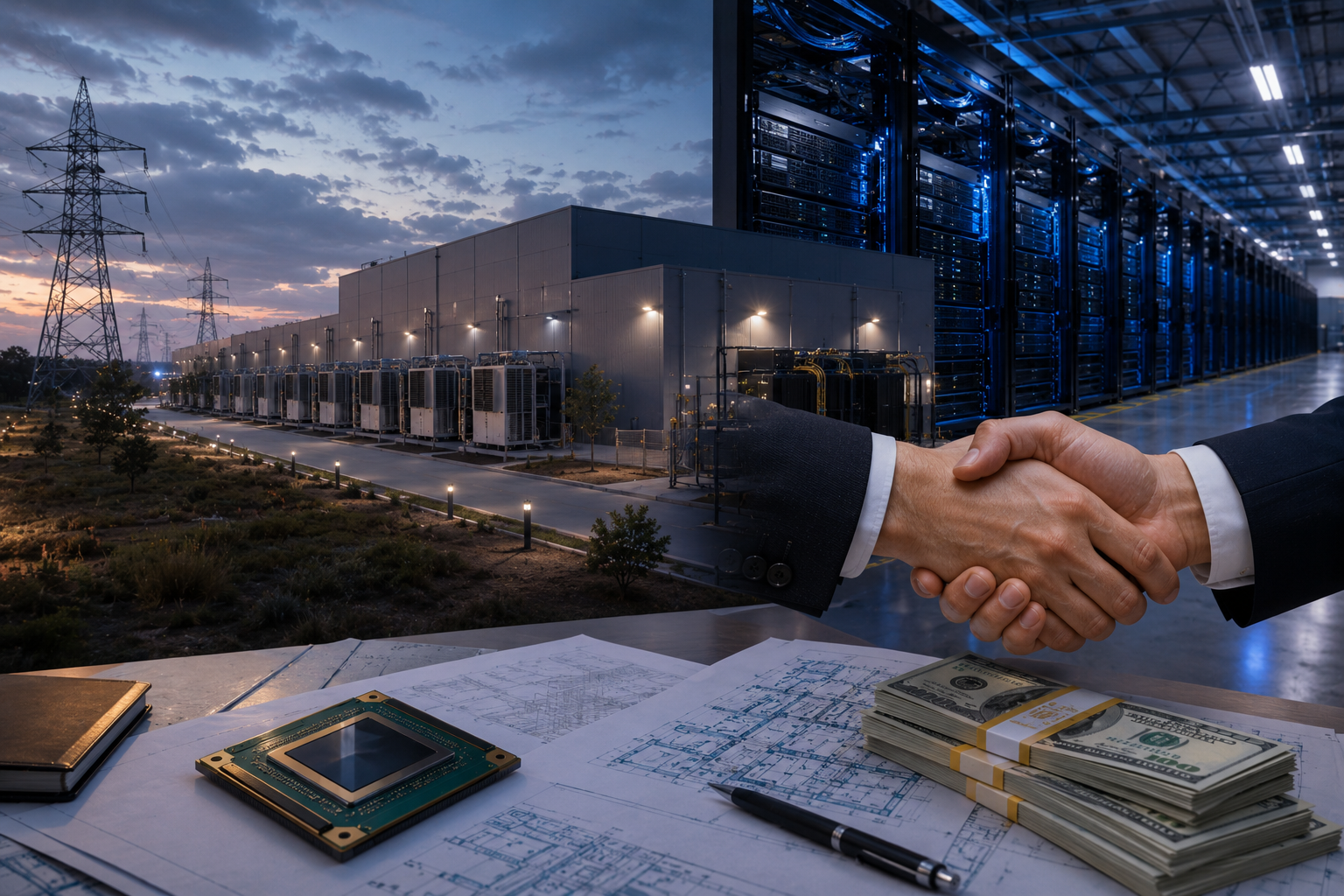
The artificial intelligence infrastructure race is entering a new phase, and investors should pay close attention. Google and Blackstone have announced a U.S.-based AI cloud venture backed by $5 billion in Blackstone equity, designed to offer Google’s Tensor Processing Units, or TPUs, as a compute-as-a-service platform. The project is expected to bring 500 megawatts of AI data-center capacity online in 2027, creating a new competitive front against Nvidia-powered cloud providers and the rapidly growing neocloud market.
The announcement immediately rippled through AI infrastructure stocks. CoreWeave and Nebius, two names closely tied to Nvidia-based AI cloud capacity, dropped after the news, with reports showing shares falling around 4% to 5% as investors reassessed the competitive landscape. For a market that has spent much of the past two years treating Nvidia-linked compute capacity as one of the most valuable assets in technology, the Google-Blackstone deal raises a bigger question: what happens when hyperscalers, private capital, custom chips, and power access start converging into vertically integrated AI infrastructure platforms?
Why This Matters for Investors
AI investing has moved beyond software subscriptions and model performance. The new bottleneck is compute: chips, data centers, power, networking, cooling, and long-term financing. Companies that control those inputs may command strategic value far beyond traditional cloud margins.
Blackstone said the joint venture will offer efficient data-center capacity, operations, networking, and Google Cloud TPUs through a compute-as-a-service model. That matters because the venture is not simply a chip resale arrangement. It is an attempt to package hardware, cloud capacity, and infrastructure operations into a full-stack AI compute platform.
For investors, this represents a structural shift. The AI boom has created enormous demand for Nvidia GPUs, but it has also exposed customers to supply constraints, pricing pressure, and dependence on a relatively narrow infrastructure ecosystem. Google’s TPUs offer an alternative route, especially for workloads optimized around Google’s AI stack. Blackstone brings the capital and data-center development capability needed to scale that vision.
The result is a direct challenge to the assumption that Nvidia-centered GPU clouds will dominate AI compute indefinitely.
A New Competitive Threat to Neocloud Providers
The most immediate market impact was felt in neocloud stocks. CoreWeave and Nebius have benefited from investor enthusiasm around AI cloud capacity, especially as demand for high-performance Nvidia GPUs has outpaced supply. But the Google-Blackstone venture changes the competitive narrative.
Barron’s reported that the new AI cloud company is aimed at competing with Nvidia-led infrastructure providers and neocloud companies such as CoreWeave and Nebius. The company is expected to deliver 500 megawatts of capacity in 2027 and expand significantly thereafter. MarketWatch also reported that CoreWeave shares fell after the announcement, citing concerns that the deal could signal increased competition in AI cloud services.
That does not mean CoreWeave or Nebius are broken businesses. The demand environment for AI compute remains strong. But it does mean investors may start applying more scrutiny to their valuations, margins, customer contracts, debt loads, and long-term differentiation.
If AI compute becomes less supply-constrained over time, customers may gain more bargaining power. That could pressure pricing, reduce margin expectations, and make pure capacity leasing less attractive unless providers offer differentiated software, networking, reliability, or enterprise services.
Google’s TPU Strategy Moves Into the Open Market
Google has used TPUs internally for years, but this venture pushes the company toward a more aggressive external commercialization strategy. TPUs are custom chips designed for machine-learning workloads, and Google has increasingly positioned them as part of its broader AI Hypercomputer architecture.
The timing is important. In April, Anthropic announced an expanded partnership with Google and Broadcom for multiple gigawatts of next-generation TPU capacity, expected to come online starting in 2027. Anthropic said it trains and runs Claude on a range of AI hardware, including AWS Trainium, Google TPUs, and Nvidia GPUs, allowing it to match workloads to the chips best suited for performance and resilience.
That statement captures the direction of the market. Major AI labs do not want a single-chip world. They want optionality. Nvidia may remain the dominant AI hardware platform, but Google’s TPU push suggests the next phase of AI infrastructure will be multi-chip, multi-cloud, and increasingly customized by workload.
For Alphabet investors, that creates a potentially powerful opportunity. If Google can convert TPUs from an internal advantage into an external infrastructure business, it could strengthen Google Cloud’s competitive position and support a broader AI monetization story.
Blackstone’s Role: AI Infrastructure as a Real-Asset Class
Blackstone’s involvement may be just as important as Google’s. The firm is not merely providing capital; it is validating AI infrastructure as a major real-asset investment category. AI data centers require massive upfront spending, long-term power access, complex site development, and financing structures that resemble infrastructure more than traditional technology investing.
The Financial Times reported that Blackstone will hold the majority stake in the venture, with the investment potentially growing through leverage. The same report noted Blackstone’s broader exposure to AI and data centers, including its role in QTS and investments connected to AI infrastructure demand.
This is a meaningful signal for investors. Private capital is becoming one of the most important sources of AI buildout financing. The winners in AI infrastructure may not be limited to semiconductor companies. They may include data-center developers, power suppliers, utilities, electrical-equipment makers, cooling-system providers, fiber-network operators, and alternative asset managers with the balance sheet to fund large-scale projects.
In other words, AI infrastructure is becoming a capital stack, not just a chip cycle.
Nvidia Is Still the Leader, but the Moat Is Being Tested
Nvidia remains the most important company in AI infrastructure. Its GPUs, CUDA software ecosystem, networking products, developer base, and deep customer relationships give it a formidable advantage. The Google-Blackstone venture does not erase that lead.
But it does test the market’s valuation assumptions. Investors have been willing to assign premium multiples to Nvidia and Nvidia-linked infrastructure providers because AI compute has been scarce, demand has been explosive, and Nvidia’s ecosystem has been difficult to replicate. If Google TPUs become more widely available through dedicated compute-as-a-service capacity, the scarcity premium could gradually narrow.
The risk is not immediate displacement. It is competitive pressure at the margin. Even a modest increase in credible alternatives can affect pricing, contract terms, and investor sentiment. That is why CoreWeave and Nebius sold off after the announcement. Markets are forward-looking, and they are beginning to ask whether GPU-only cloud economics will remain as favorable by 2027.
The Power Constraint Becomes an Investment Theme
The venture’s 500-megawatt target is also significant because power is now one of the defining constraints in AI. AI data centers are energy-intensive, and access to reliable electricity has become a strategic advantage. Investors should not view megawatts as a technical detail. They are becoming a core valuation metric in the AI infrastructure market.
A company with chips but no power cannot scale. A company with data-center demand but no interconnection queue position may miss the cycle. A company with capital but no operational expertise may face delays and cost overruns.
That makes power providers, grid equipment suppliers, cooling companies, and data-center infrastructure firms key beneficiaries of the AI buildout. It also explains why partnerships between technology firms and capital providers are likely to increase.
Key Investment Insight
The key investment insight is that AI infrastructure is moving toward vertical integration. The most valuable platforms may be those that control or coordinate chips, software, data centers, power, financing, and customer demand.
Investors should watch Alphabet, Blackstone, Nvidia, CoreWeave, Nebius, Broadcom, data-center operators, energy suppliers, and AI networking companies. Alphabet may benefit if TPUs gain broader commercial traction. Blackstone may benefit if AI infrastructure becomes a durable private-capital growth category. Nvidia remains the benchmark, but its valuation could face more scrutiny if custom silicon alternatives gain scale. CoreWeave and Nebius must prove that their contracted demand, execution speed, and customer relationships can withstand new competition.
For portfolio strategy, investors should avoid treating AI as a single-stock story. The broader opportunity spans semiconductors, cloud platforms, power infrastructure, real assets, and networking. The risk is that some names already price in years of flawless growth.
Future Trends to Watch
The first trend to watch is customer adoption. The venture will need major enterprise or AI-lab customers to validate TPU-based compute at scale. Investors should monitor whether large model developers, software companies, or cloud customers publicly commit to the platform.
The second trend is pricing. If TPU compute is offered at attractive economics compared with Nvidia GPU capacity, it could pressure neocloud margins. If pricing is similar, Nvidia’s software ecosystem may remain a major defensive advantage.
The third trend is execution. Bringing 500 megawatts online by 2027 requires permitting, power, construction, networking, cooling, and operational reliability. Any delays could limit the near-term competitive impact.
The fourth trend is hyperscaler custom silicon. Amazon, Microsoft, Google, and other major cloud players are all motivated to reduce dependence on third-party chips where possible. That does not eliminate Nvidia demand, but it could change the balance of power over time.
Google and Blackstone’s TPU cloud venture is one of the clearest signs yet that the AI infrastructure race is broadening. Nvidia still leads, but the market is no longer assuming a one-company compute future. For investors, the next phase of AI investing will require a deeper understanding of who controls the full stack — from silicon to power to financing.
Stay with MoneyNews.Today for daily investor-focused coverage of the technology trends, AI infrastructure shifts, and market signals shaping tomorrow’s portfolios.




