
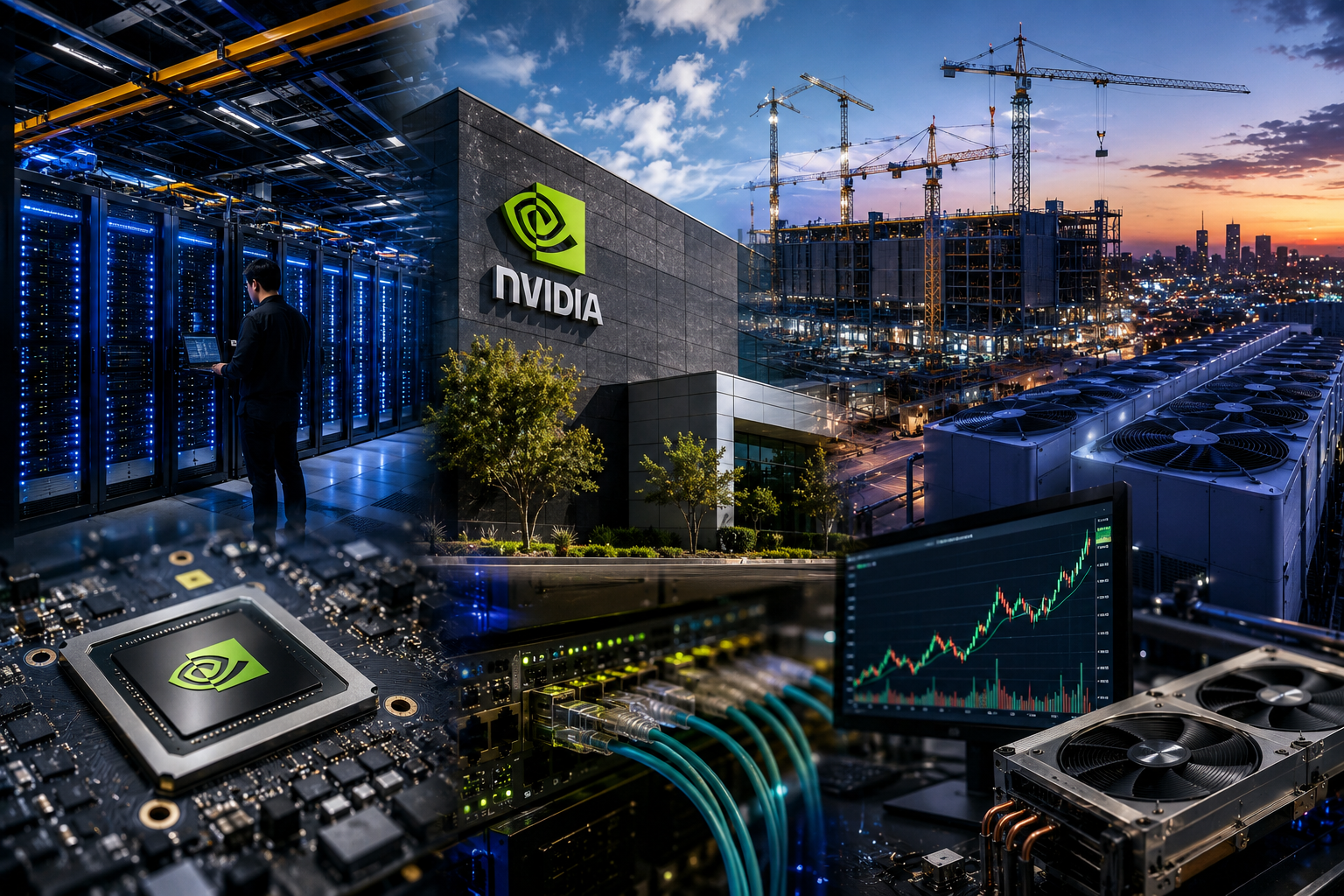
The artificial intelligence boom is entering a new phase — and investors are rapidly expanding their focus beyond the familiar mega-cap technology giants that dominated the first wave of the rally. While NVIDIA Corporation continues to sit at the center of the AI revolution, Wall Street is increasingly hunting for the next generation of AI winners across small-cap software firms, networking providers, cooling-system manufacturers, memory-chip companies, and data-center infrastructure plays.
The shift reflects a broader realization taking hold across markets in 2026: the AI trade is no longer just about chatbots or semiconductor headlines. It is becoming a massive global infrastructure buildout comparable to the early internet era or the rise of cloud computing.
That narrative gained even more momentum this week after NVIDIA CEO Jensen Huang said the company plans to spend approximately $150 billion annually within Taiwan’s AI ecosystem, according to Reuters and Investing.com reporting. The scale of that figure underscores how AI investment is evolving into one of the largest capital-spending cycles in modern technology history.
For investors, the implications extend far beyond Nvidia itself.
The AI Rally Is Broadening Across the Market
The first phase of the AI boom was largely concentrated in a handful of mega-cap technology companies. NVIDIA, Microsoft Corporation, Alphabet Inc., Amazon.com Inc., and Meta Platforms Inc. absorbed enormous investor attention as enterprises rushed to build AI models, cloud infrastructure, and advanced semiconductor capabilities.
Now, the market is broadening.
According to Reuters, investors are increasingly rotating into smaller AI-linked companies that could benefit from secondary and tertiary effects of the AI infrastructure expansion. This shift is important because it suggests Wall Street is beginning to view AI not as a narrow technology trend, but as a long-duration economic transformation affecting multiple industries simultaneously.
The new AI beneficiaries span several categories:
- Data-center REITs
- Power and cooling infrastructure providers
- Networking and fiber-optic companies
- Semiconductor equipment manufacturers
- Memory-chip producers
- AI cybersecurity firms
- Enterprise software companies
- Industrial automation providers
In many ways, investors are beginning to apply a “picks and shovels” strategy to AI investing — looking for companies that enable the ecosystem rather than just the companies building the most visible AI models.
This broader participation is helping sustain market momentum even as valuations for mega-cap AI leaders become increasingly stretched.
Nvidia’s Spending Plans Highlight the Scale of the AI Buildout
Jensen Huang’s comments regarding Nvidia’s planned annual spending in Taiwan reveal just how massive the AI infrastructure race has become.
Taiwan remains central to the global semiconductor supply chain, particularly through Taiwan Semiconductor Manufacturing Company (TSMC), which produces many of the advanced chips powering AI systems worldwide. Nvidia’s deepening investment ties to Taiwan reflect the strategic importance of semiconductor manufacturing capacity in the global AI economy.
The spending surge also highlights a crucial point for investors: AI growth depends heavily on physical infrastructure.
Behind every AI model sits an enormous network of semiconductor fabrication plants, advanced packaging facilities, hyperscale data centers, power systems, cooling technologies, and networking infrastructure. Building this ecosystem requires hundreds of billions of dollars in capital expenditures.
According to estimates from McKinsey and Goldman Sachs, AI-related infrastructure spending could reach trillions of dollars globally over the next decade as companies race to integrate AI into enterprise operations.
That spending wave is already reshaping capital allocation across the technology sector.
Cloud providers are increasing AI infrastructure budgets. Semiconductor manufacturers are expanding fabrication capacity. Utilities are preparing for rising electricity demand from AI data centers. Real-estate investment trusts focused on data-center properties are seeing renewed investor interest.
The ripple effects are becoming increasingly widespread.
Small-Cap Tech Stocks Gain Momentum
One of the biggest emerging themes in today’s AI market is the resurgence of small-cap technology stocks.
For much of the past several years, large-cap technology companies dominated market performance due to their scale, profitability, and AI leadership positions. Smaller companies struggled under higher interest rates and tighter financial conditions.
That dynamic is beginning to shift.
As investors search for undervalued AI exposure beyond the crowded mega-cap trade, smaller firms involved in AI infrastructure, enterprise software, cybersecurity, and specialized hardware are attracting growing attention.
This rotation is partly driven by valuation concerns. Some of the largest AI-related companies now trade at historically elevated multiples, forcing investors to seek opportunities elsewhere within the ecosystem.
It is also driven by the realization that AI adoption will require thousands of specialized suppliers and service providers.
For example:
- Cooling-system companies are benefiting from rising thermal-management needs in data centers.
- Networking providers are seeing demand surge as AI workloads require faster data transmission.
- Memory-chip manufacturers are benefiting from increased high-bandwidth memory demand.
- Software firms enabling AI workflow automation are experiencing stronger enterprise adoption.
According to Bank of America and Morgan Stanley analysts, the AI opportunity is gradually expanding from a concentrated semiconductor story into a much broader digital-industrial transformation.
That could create opportunities across previously overlooked areas of the market.
AI Infrastructure Is Becoming an Energy Story
One of the most underappreciated aspects of the AI boom is its impact on energy infrastructure.
AI data centers consume enormous amounts of electricity. Training large AI models requires advanced chips operating at extremely high power densities, forcing technology companies to rethink long-term energy sourcing strategies.
This is creating investment opportunities beyond traditional technology sectors.
Utilities, nuclear-energy providers, natural gas infrastructure firms, and grid-modernization companies are increasingly viewed as indirect AI beneficiaries. Analysts at Goldman Sachs recently projected substantial growth in electricity demand tied to AI infrastructure expansion over the coming decade.
Copper demand is also expected to rise sharply because of its critical role in electrification and data transmission infrastructure.
As a result, AI investing is beginning to overlap with:
- Energy infrastructure
- Industrial manufacturing
- Utilities
- Metals and mining
- Nuclear energy
- Grid modernization
This convergence could become one of the defining investment themes of the next decade.
Enterprise AI Spending Remains Strong
Another key driver supporting the AI rally is the continued acceleration in enterprise adoption.
Corporations across industries are rapidly integrating AI into customer service, logistics, cybersecurity, software development, marketing, and operational automation. Executives increasingly view AI implementation as a competitive necessity rather than an optional technology upgrade.
According to Deloitte and PwC surveys, enterprise AI spending intentions remain extremely strong despite broader economic uncertainty.
This matters because enterprise adoption creates recurring demand for cloud infrastructure, semiconductors, software subscriptions, consulting services, and cybersecurity tools.
The transition from experimental AI deployment toward mission-critical operational integration is likely to sustain long-term revenue growth across large portions of the technology ecosystem.
For investors, this shift suggests the AI cycle may have significantly longer duration than previous speculative technology booms.
Risks Investors Should Monitor
Despite the optimism, investors should remain aware of several important risks.
Valuation risk remains one of the biggest concerns. Many AI-related companies have experienced extraordinary share-price appreciation, raising questions about whether future earnings growth can justify current valuations.
Market concentration also remains elevated. A relatively small number of companies continue driving a large share of index performance, increasing sensitivity to earnings disappointments or regulatory developments.
Geopolitical risks are another factor. Taiwan’s central role in semiconductor manufacturing creates strategic vulnerabilities amid rising tensions between the United States and China.
Additionally, competition within AI infrastructure markets is intensifying rapidly. Companies investing aggressively today may face margin pressure or oversupply risks later in the cycle.
Investors should also recognize that not every company branded as an “AI stock” will become a long-term winner.
Key Investment Insight
The AI investment boom is evolving from a narrow semiconductor rally into a global infrastructure transformation affecting multiple industries simultaneously.
Investors should closely monitor:
- Semiconductor equipment makers
- High-bandwidth memory producers
- Networking and optical infrastructure companies
- Data-center REITs
- Cooling and power-management firms
- Enterprise AI software providers
- Cybersecurity companies tied to AI deployment
- Utilities and nuclear-energy firms benefiting from rising electricity demand
The next phase of AI investing may increasingly reward companies enabling the ecosystem rather than only the headline-generating mega-cap leaders.
As global AI spending accelerates and infrastructure requirements expand, second-tier technology firms and industrial enablers could emerge as some of the market’s most important long-term growth opportunities.
Stay with MoneyNews.Today for more daily investor insights covering AI infrastructure, semiconductor markets, enterprise technology, and the trends reshaping global financial markets.




