
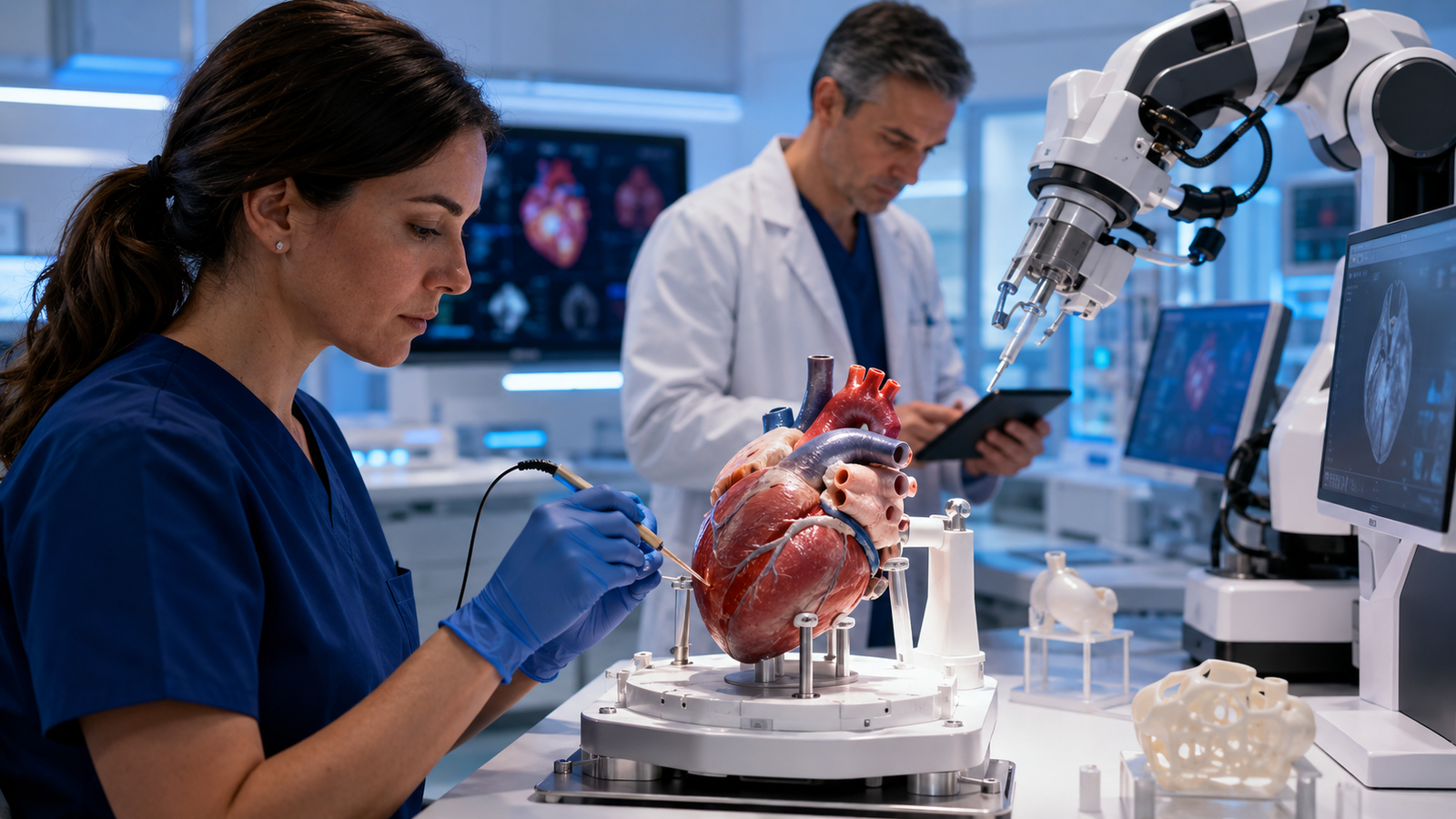
Artificial intelligence may dominate headlines, but another technological revolution is quietly gaining momentum in healthcare—and it could create significant long-term opportunities for investors. Researchers are rapidly advancing the development of synthetic human organs designed for surgical training and medical education, a breakthrough that promises to reduce training costs, improve patient safety, and accelerate innovation across the healthcare industry.
According to Reuters, biomedical engineers have developed highly realistic artificial organs that closely replicate the texture, structure, and behavior of human tissue. While the technology is not intended for transplantation, it represents a major step toward commercial adoption in medical simulation, surgical education, and healthcare training. For investors, the development highlights the growing commercial potential of the medical technology sector, where innovation is increasingly driven by the convergence of biotechnology, advanced materials, robotics, and artificial intelligence.
As healthcare systems worldwide seek more efficient and safer ways to train medical professionals, synthetic organs could emerge as one of the most promising growth areas within the broader MedTech industry.
A New Era for Medical Training
For decades, medical schools and hospitals have relied on cadavers, animal tissue, and basic simulation models to train surgeons. While these methods remain valuable, they present several limitations, including high costs, limited availability, ethical concerns, and inconsistencies in anatomical quality.
Synthetic organs aim to solve many of these challenges.
Developed using advanced biomaterials and sophisticated manufacturing techniques, these artificial organs are engineered to mimic the physical properties of real human tissue. Surgeons can practice complex procedures repeatedly under highly controlled conditions without relying on donated organs or animal models.
According to Reuters, the latest generation of synthetic organs offers a level of realism that could significantly improve surgical education while reducing costs for healthcare institutions.
This advancement has the potential to transform how future surgeons are trained, ultimately improving clinical outcomes and patient safety.
Why Investors Should Pay Attention
Healthcare innovation has traditionally focused on pharmaceuticals, medical devices, and diagnostic technologies. Medical simulation, however, is emerging as an increasingly attractive investment theme.
Healthcare providers continue facing growing pressure to improve training efficiency while reducing operational costs and minimizing medical errors.
Simulation technologies offer a scalable solution.
Unlike traditional training resources, synthetic organs can be manufactured consistently, customized for specific procedures, and integrated into advanced surgical simulation systems.
As global healthcare spending continues rising, demand for high-quality medical education tools is expected to increase alongside the need for highly skilled surgeons.
For investors, this creates opportunities extending beyond biotechnology into software, robotics, advanced manufacturing, imaging systems, and artificial intelligence.
The commercial ecosystem surrounding medical simulation is becoming increasingly diversified.
The Convergence of Multiple Emerging Technologies
One of the most compelling aspects of synthetic organ development is that it brings together several rapidly growing industries.
Artificial intelligence assists researchers in designing increasingly accurate anatomical models and personalized simulation environments.
Advanced materials science enables engineers to recreate the elasticity, density, and responsiveness of biological tissue.
Three-dimensional printing continues improving manufacturing precision while reducing production costs.
Robotic-assisted surgery platforms increasingly require sophisticated training systems capable of preparing physicians for minimally invasive procedures.
Cloud computing and data analytics also contribute by enabling performance tracking, remote collaboration, and personalized educational programs.
This convergence creates a broader investment opportunity than medical simulation alone.
Companies operating across these adjacent technologies may benefit as healthcare institutions modernize surgical education.
Commercial Adoption Could Accelerate
Although synthetic organ technology remains in the early stages of commercialization, several factors support broader adoption.
Healthcare systems worldwide continue experiencing physician shortages while simultaneously managing growing demand for complex surgical procedures.
Medical schools increasingly seek scalable educational tools capable of supporting larger student populations.
Hospitals are also investing more heavily in continuous professional training as surgical techniques become increasingly sophisticated.
Unlike one-time medical equipment purchases, simulation systems often generate recurring revenue through replacement models, software subscriptions, curriculum updates, maintenance services, and instructor training.
This recurring revenue profile makes the sector particularly attractive from an investment perspective.
As production costs decline and product performance improves, synthetic organs could become standard components of surgical education worldwide.
Medical Robotics Could Receive an Additional Boost
The growing adoption of robotic-assisted surgery may further strengthen demand for realistic medical simulation technologies.
Modern robotic systems require surgeons to master specialized techniques before performing procedures on patients.
Highly realistic synthetic organs provide an ideal training platform for practicing robotic operations in controlled environments.
As hospitals continue investing in robotic surgery platforms, complementary technologies—including surgical simulators, imaging software, and training solutions—may experience parallel growth.
This creates opportunities for companies operating across the broader digital healthcare ecosystem rather than solely within traditional medical device manufacturing.
Investors increasingly recognize that healthcare innovation often develops through interconnected technology platforms rather than isolated product categories.
Challenges Remain Before Widespread Adoption
Despite the promising outlook, commercialization will not occur overnight.
Healthcare institutions typically evaluate new technologies carefully before incorporating them into formal training programs.
Clinical validation, regulatory approvals where applicable, manufacturing scalability, and cost competitiveness will all influence adoption rates.
Researchers must also continue improving anatomical realism while ensuring synthetic organs accurately replicate various medical conditions and patient characteristics.
Educational institutions may require curriculum redesign and instructor training before fully integrating simulation technologies into medical programs.
These challenges suggest that commercialization will likely occur gradually rather than through rapid industry-wide adoption.
Nevertheless, successful pilot programs and positive clinical feedback could accelerate acceptance over the coming years.
Future Trends to Watch
Several trends could determine the pace of growth within the medical simulation industry.
Continued investment in healthcare artificial intelligence is expected to improve simulation realism while enabling personalized surgical training.
Advancements in biomaterials and additive manufacturing should reduce production costs and improve product durability.
Partnerships between universities, hospitals, biotechnology firms, and medical device manufacturers may accelerate commercialization.
Growing global demand for minimally invasive surgery and robotic-assisted procedures is also likely to increase the need for advanced simulation tools.
Finally, aging populations across developed economies will continue driving demand for surgical procedures, reinforcing the importance of efficient physician training.
These long-term trends position medical simulation as one of the more promising emerging healthcare technologies.
Key Investment Insight
Synthetic human organs represent far more than an educational innovation—they signal the continued evolution of healthcare toward technology-driven, data-enabled medical training.
As commercialization advances, investors should monitor companies operating across medical simulation, surgical robotics, biotechnology, advanced materials, healthcare software, and medical device manufacturing. The greatest opportunities may emerge not only from organizations producing synthetic organs themselves but also from businesses providing complementary technologies that support modern surgical education.
Healthcare innovation increasingly depends on integrated ecosystems where artificial intelligence, robotics, cloud computing, advanced manufacturing, and biotechnology work together to improve patient outcomes and reduce costs. Investors who recognize these interconnected trends early may be well positioned to benefit from one of healthcare’s fastest-growing emerging industries.
While commercialization will likely occur gradually, today’s advances demonstrate that medical simulation is moving from research laboratories toward real-world healthcare applications. As adoption expands, this sector could become an increasingly important component of the global healthcare technology landscape.
Stay informed with MoneyNews.Today for trusted daily investor news, in-depth market analysis, and actionable insights covering emerging industries, biotechnology, healthcare innovation, artificial intelligence, and the global economy.




