
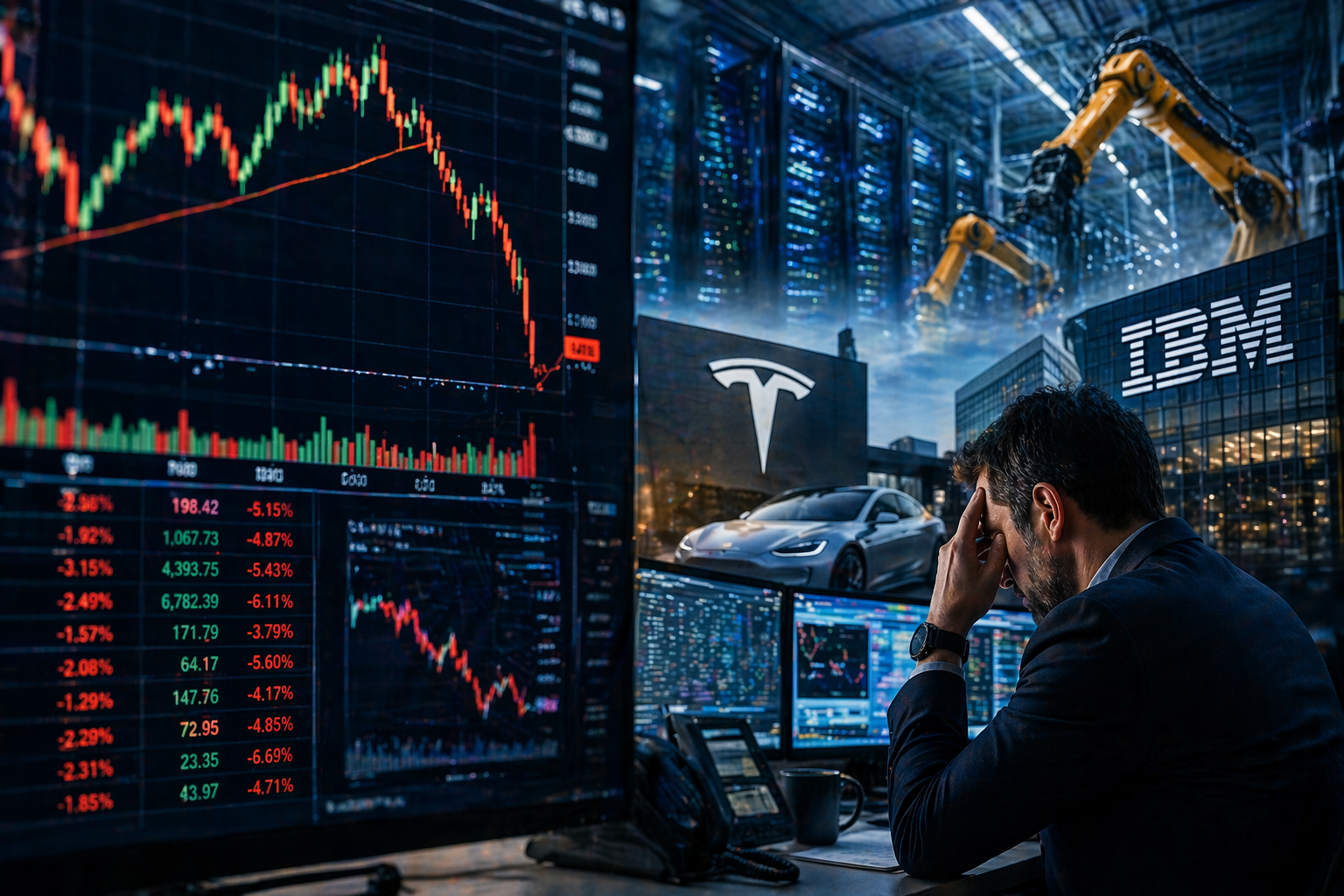
The technology sector—long the engine of market gains—is entering a more complex phase. Strong earnings are no longer enough to guarantee stock appreciation. Instead, investors are increasingly scrutinizing how those earnings are being generated—and more importantly, how much is being spent to sustain future growth.
This shift is playing out in real time. Despite delivering solid financial results, major tech names are seeing mixed market reactions. Companies like Tesla and IBM have experienced notable volatility following earnings releases, highlighting a critical transition in investor expectations.
According to Reuters and Investopedia (April 23, 2026), the market is moving away from the “growth at any cost” mindset that defined the last decade—and toward a new paradigm: efficient, disciplined growth.
Strong Earnings, Weak Reactions: What’s Going On?
At first glance, the current earnings season appears robust. Many technology companies are reporting revenue growth, expanding customer bases, and continued demand for AI-driven products and services.
However, the market’s response tells a different story.
Stocks are no longer rallying simply because earnings beat expectations. Instead, investors are dissecting balance sheets, cost structures, and forward guidance with greater intensity. Rising capital expenditures—particularly those tied to artificial intelligence—are becoming a focal point.
For example:
- Tesla has faced pressure despite stable delivery numbers and revenue growth, as concerns mount over margins and future investment needs.
- IBM has delivered steady performance, yet its stock has shown volatility amid questions about the pace and efficiency of its AI investments.
This divergence between earnings performance and stock price reaction signals a broader shift in market dynamics.
The AI Investment Boom—and Its Costs
Artificial intelligence remains the dominant theme across the technology sector. Companies are racing to build infrastructure, develop models, and secure competitive advantages.
But this race comes at a cost.
Hyperscalers and enterprise tech firms are committing tens—if not hundreds—of billions of dollars toward AI-related capital expenditures. This includes:
- Data center expansion
- Advanced semiconductor procurement
- Cloud infrastructure upgrades
- Talent acquisition and R&D
While these investments are essential for long-term growth, they are compressing margins in the near term.
Reuters highlights that investors are increasingly concerned about the return on these massive investments. The key question is no longer whether AI will transform industries—it’s how quickly companies can monetize it.
Why This Matters for Investors
The evolving landscape presents several critical implications for investors:
1. Margin Pressure Is Back in Focus
Rising capex is putting pressure on operating margins. Even companies with strong revenue growth may face declining profitability if costs escalate too quickly.
2. Valuation Sensitivity Is Increasing
High-growth tech stocks have historically commanded premium valuations. But as interest rates remain elevated and macro uncertainty persists, investors are becoming less willing to pay for future growth without clear visibility.
3. Execution Risk Is Rising
Investing heavily in AI does not guarantee success. Companies must demonstrate not only innovation but also execution—turning investment into measurable returns.
4. Market Expectations Are Higher Than Ever
The bar for performance has risen. Meeting expectations is no longer sufficient; companies must exceed them while maintaining efficiency.
A Shift Toward “Efficient Growth”
The concept of “efficient growth” is rapidly becoming the new benchmark for evaluating technology companies.
In practical terms, this means:
- Generating sustainable revenue growth
- Maintaining or improving profit margins
- Demonstrating disciplined capital allocation
- Providing clear pathways to monetization
This shift is being reinforced by commentary from major financial institutions:
- Reuters (April 23, 2026): Emphasizes investor concerns around rising AI-related capex and its impact on profitability.
- Bloomberg: Highlights the growing importance of return on invested capital (ROIC) in tech valuations.
- McKinsey: Notes that companies successfully balancing innovation with cost discipline are outperforming peers.
- Goldman Sachs: Points to a divergence between “efficient growers” and “cash burners” within the tech sector.
The implication is clear: the market is becoming more selective.
Future Trends to Watch
1. AI Monetization Timelines
Investors will be closely watching how quickly companies can convert AI investments into revenue streams. Delays could lead to valuation resets.
2. Capex Discipline
Companies that demonstrate disciplined spending—prioritizing high-return projects—are likely to be rewarded.
3. Sector Rotation Within Tech
Not all tech segments are equally exposed. Software companies with scalable models may face less capex pressure than hardware or infrastructure-heavy firms.
4. Macroeconomic Influence
Interest rates, inflation, and global growth trends will continue to shape investor sentiment and valuation frameworks.
Actionable Investment Insight
Navigating this environment requires a more nuanced approach than simply buying into the tech sector as a whole.
- Prioritize Quality Over Hype: Focus on companies with strong fundamentals, proven business models, and clear profitability metrics.
- Analyze Capex Efficiency: Look beyond headline investment numbers—assess how effectively companies are deploying capital.
- Diversify Within Tech: Balance exposure across different segments, including software, semiconductors, and cloud services.
- Watch Earnings Guidance Closely: Forward-looking statements are becoming more important than past performance.
- Consider Risk Management Strategies: Volatility is likely to remain elevated, making hedging strategies increasingly relevant.
The key takeaway: growth alone is no longer enough—efficiency is now the defining factor.
A Sector at an Inflection Point
The technology sector is not weakening—it is evolving.
The current volatility reflects a market recalibrating its expectations, adjusting to a new reality where capital is no longer free and growth must be justified. AI remains a transformative force, but the path to profitability is under greater scrutiny.
For investors, this is both a challenge and an opportunity. Those who can identify companies that balance innovation with discipline will be best positioned to navigate the next phase of the tech cycle.
As the market continues to digest earnings and reassess valuations, one thing is clear: the era of unchecked growth is over, and a more mature, efficiency-driven market is taking its place.
Stay ahead of the trends shaping technology and global markets with MoneyNews.Today—your trusted source for daily investor insights.




