
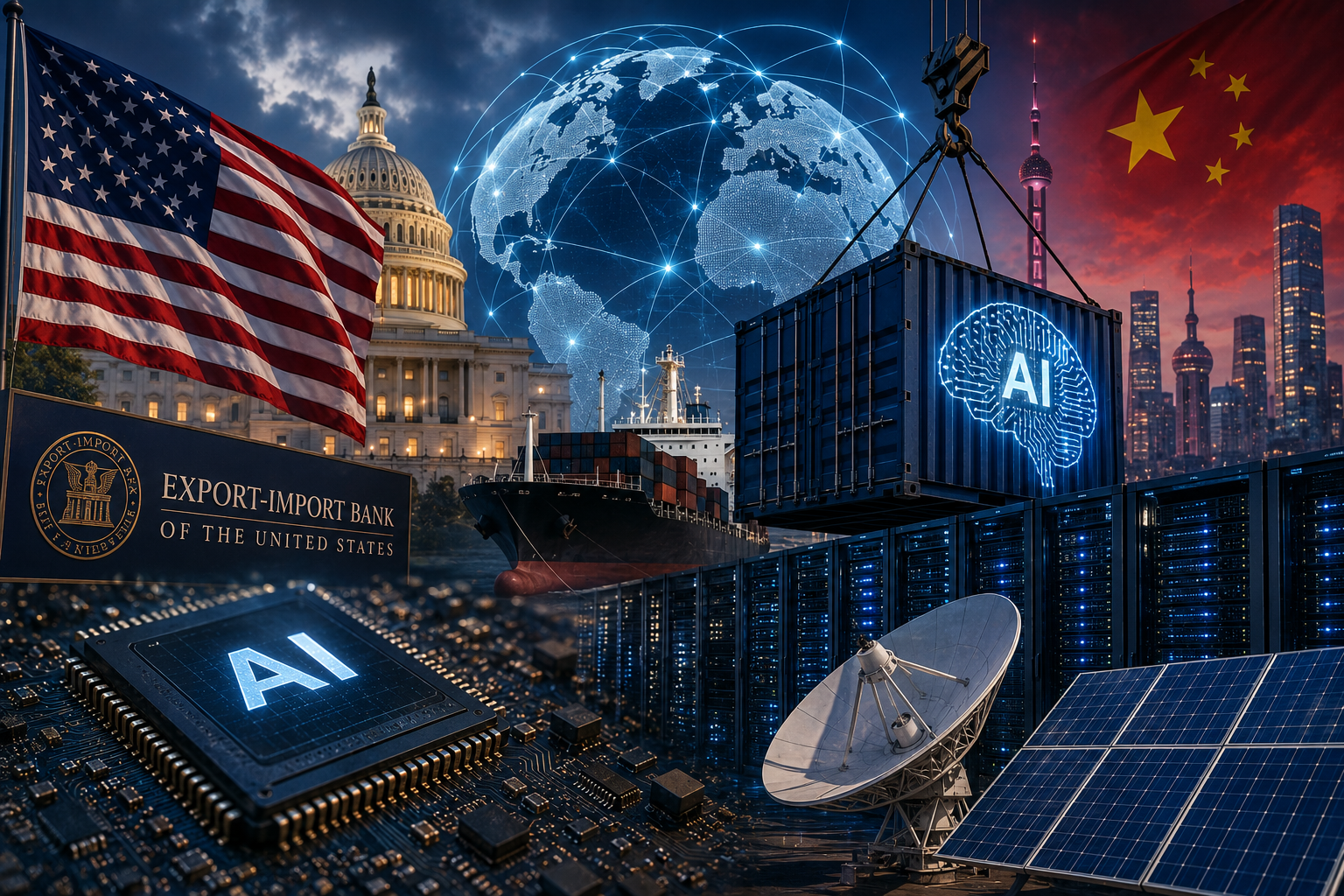
Artificial intelligence is rapidly becoming the defining geopolitical and economic battleground of the modern era — and Washington is now moving aggressively to ensure American companies remain at the center of that global power shift.
According to a Reuters report published May 21, 2026, the Trump administration is preparing a multibillion-dollar AI export financing initiative through the U.S. Export-Import Bank designed to accelerate worldwide adoption of American artificial intelligence technologies. The initiative aims to strengthen U.S. influence in global AI infrastructure while countering China’s expanding presence across emerging technology markets.
The proposed program would support financing for U.S.-made AI chips, hyperscale cloud infrastructure, cybersecurity systems, advanced networking equipment, and high-performance computing technologies. Industry leaders including NVIDIA, Microsoft, Amazon, and Alphabet are expected to sit at the center of the initiative as the United States attempts to expand its technological footprint globally.
For investors, the significance extends far beyond another government spending program.
The initiative signals that artificial intelligence is evolving into a strategic industrial sector directly supported by U.S. geopolitical and economic policy. That shift could have major implications for semiconductors, cloud computing, cybersecurity, defense technology, energy infrastructure, and the broader stock market over the next decade.
In many ways, AI is beginning to resemble previous strategic industries like oil, telecommunications, aerospace, and semiconductors — sectors where government policy and private-sector growth became deeply interconnected.
AI Is Becoming a National Strategic Asset
Over the past two years, artificial intelligence has transitioned from a technology trend into a central pillar of global economic competition.
Governments increasingly recognize that leadership in AI could influence everything from military capabilities and cybersecurity to economic growth, industrial productivity, and geopolitical influence.
The United States and China are now locked in an escalating race to dominate the next generation of digital infrastructure.
China has already invested heavily in:
- AI development
- Semiconductor manufacturing
- Advanced surveillance systems
- Smart infrastructure
- Cloud computing
- Strategic technology exports
Chinese firms have aggressively expanded across developing economies by offering telecommunications infrastructure, digital platforms, cloud systems, and financing support tied to large-scale infrastructure projects.
The Trump administration’s latest export financing initiative appears designed to directly challenge that strategy.
By leveraging the U.S. Export-Import Bank, Washington hopes to make American AI technologies more financially accessible to foreign governments and enterprises, particularly across emerging markets where digital infrastructure demand is accelerating rapidly.
The strategy represents a significant evolution in U.S. industrial policy.
Rather than relying solely on private-sector competition, policymakers are increasingly willing to use government-backed financing to strengthen America’s global technology position.
Why Investors Are Paying Close Attention
The market implications of government-backed AI expansion could be enormous.
Artificial intelligence infrastructure already represents one of the most powerful growth themes driving global markets. Government financing support may accelerate that trend substantially.
Several sectors stand to benefit directly.
Semiconductor Manufacturers
Advanced AI chips remain the backbone of the entire AI ecosystem.
NVIDIA continues dominating the global AI accelerator market, while companies including Advanced Micro Devices, Intel, and semiconductor equipment suppliers are aggressively competing for long-term AI infrastructure demand.
Government-backed export financing could significantly expand international demand for U.S.-designed chips, particularly among nations seeking alternatives to Chinese technology ecosystems.
This may reinforce the view that AI-related semiconductor demand remains in the early stages of a long-duration investment cycle.
Cloud Infrastructure Providers
Hyperscale cloud companies are investing hundreds of billions of dollars into AI infrastructure expansion.
Microsoft, Amazon, and Alphabet are rapidly building global AI computing capacity through data centers, enterprise AI services, and cloud platforms.
If U.S.-backed financing helps foreign governments and corporations adopt American AI ecosystems, hyperscalers could benefit from expanding international enterprise demand and long-term recurring revenue growth.
Cybersecurity Firms
AI infrastructure is increasingly viewed as a national security issue.
As governments adopt AI systems tied to sensitive data, communications, and industrial infrastructure, cybersecurity demand is expected to rise significantly. Companies specializing in AI security, network protection, cloud defense, and digital infrastructure resilience may become major beneficiaries of the expanding geopolitical AI race.
Data-Center and Power Infrastructure
Artificial intelligence requires enormous computational capacity and electricity consumption.
This dynamic is creating strong demand growth across:
- Data centers
- Cooling systems
- Grid infrastructure
- Utilities
- Power generation
- Networking equipment
AI-related electricity demand has already become a major discussion point across energy and infrastructure markets.
Emerging Markets Could Become the Next AI Battlefield
One of the most important aspects of the initiative is its emphasis on emerging economies.
Countries across Southeast Asia, Latin America, Africa, and the Middle East are rapidly investing in digital infrastructure modernization. These regions represent some of the largest future growth opportunities for AI adoption and cloud expansion.
Historically, Chinese firms secured influence in many developing markets through infrastructure financing and state-backed investment programs.
The U.S. now appears focused on countering that strategy by offering financing support tied specifically to American AI technologies and infrastructure providers.
For investors, this matters because emerging-market adoption could become one of the biggest long-term drivers of AI industry growth.
If successful, the initiative could expand demand well beyond traditional U.S. and European enterprise markets and create a broader global customer base for American AI firms.
Geopolitics Is Reshaping Technology Investing
The AI export initiative highlights a broader transformation occurring across global markets: technology investing is increasingly becoming geopolitical investing.
For years, investors primarily evaluated technology companies based on innovation, earnings growth, and product adoption. Today, geopolitical positioning and government policy are becoming equally important drivers of valuation and market leadership.
The AI sector now sits directly at the intersection of:
- National security
- Trade policy
- Industrial strategy
- Energy infrastructure
- Semiconductor supply chains
- Global diplomacy
- Military modernization
This evolving landscape may create powerful advantages for firms aligned with U.S. strategic priorities.
It also introduces new risks.
Risks Investors Should Monitor
Despite the bullish implications for AI infrastructure, several important risks remain.
U.S.-China Tensions
Escalating competition between Washington and Beijing could increase trade restrictions, export controls, and supply-chain disruptions.
Valuation Pressures
Many AI-related companies already trade at historically elevated valuations following the sector’s enormous rally over the past two years.
Regulatory Expansion
As governments become more involved in AI markets, companies may face increased oversight, compliance costs, and national security reviews.
Infrastructure Bottlenecks
Semiconductor production constraints, energy limitations, and data-center shortages could limit how quickly AI infrastructure expands globally.
Future Trends Investors Should Watch
Several developments may shape the next phase of AI-related investing.
Sovereign AI Infrastructure
Governments worldwide are increasingly building national AI capabilities and strategic digital ecosystems.
AI and Defense Convergence
Military applications of AI, autonomous systems, cybersecurity, and intelligence infrastructure could drive significant defense-tech growth.
Expansion of Export Financing Programs
The U.S. may eventually expand financing support into areas including quantum computing, advanced networking, semiconductor manufacturing, and digital infrastructure projects.
Energy and Utility Demand
AI-driven electricity consumption could significantly reshape utility markets, nuclear energy investment, and grid modernization spending.
Key Investment Insight
The Trump administration’s AI export financing initiative reinforces the idea that artificial intelligence is no longer just a commercial technology trend — it is becoming a core pillar of geopolitical and economic strategy.
Investors should closely monitor companies tied to AI infrastructure, semiconductors, cloud computing, cybersecurity, networking systems, and data-center expansion as government-backed support increasingly accelerates global AI adoption.
At the same time, the growing overlap between industrial policy and technology investing means geopolitical developments may become just as important as earnings reports in determining future market leadership.
As governments compete for dominance in artificial intelligence, investors who understand both the technological and geopolitical dimensions of the AI race may be best positioned to capitalize on the next major phase of global market growth.
Stay ahead of the markets with more daily investor insights and breaking financial analysis at MoneyNews.Today.




