
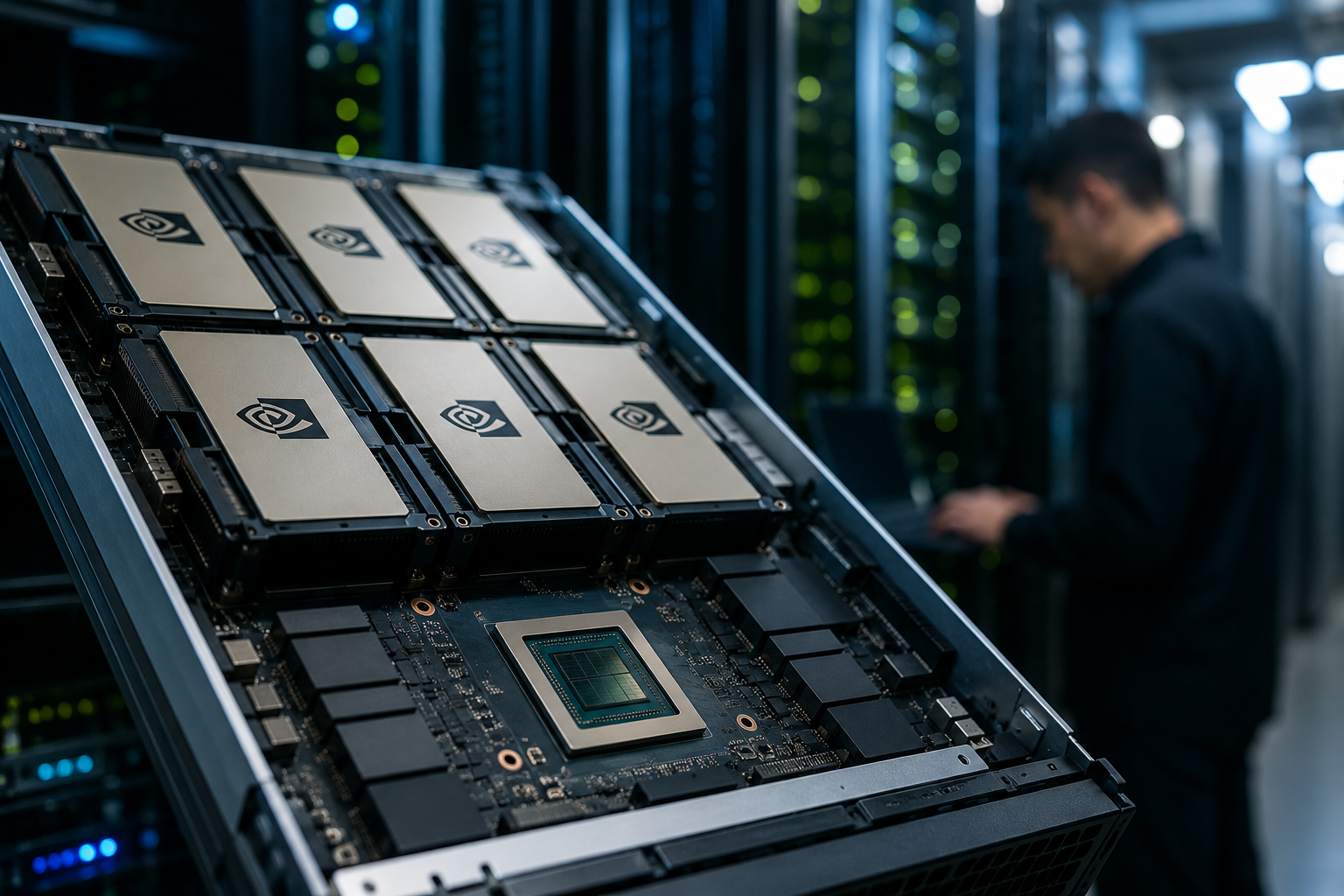
For nearly two years, artificial intelligence has been the dominant force driving Wall Street optimism, propelling semiconductor giants, cloud providers, and AI infrastructure companies to historic valuations. Now, investors are confronting a new phase of the AI trade: proving whether the extraordinary spending fueling the boom can remain sustainable.
That question moved back to center stage after NVIDIA announced an enormous $80 billion share repurchase authorization alongside quarterly revenue guidance that surpassed Wall Street expectations. The announcement reinforced confidence that AI demand remains powerful, but it also intensified debate across financial markets about whether hyperscalers such as Microsoft, Amazon, Alphabet, and Meta can continue spending at current levels without eventually facing diminishing returns.
The company’s latest forecast is not just another earnings update. For investors, Nvidia has effectively become the most important barometer for the entire AI economy.
According to Reuters coverage and Bloomberg analysis, Nvidia’s results signaled that enterprise AI demand remains resilient despite rising investor concerns surrounding capital expenditure intensity, valuation risk, and mounting competition in the semiconductor sector.
Nvidia’s Buyback Sends a Strong Message
Large buyback programs are often interpreted as a signal that management believes shares remain undervalued relative to long-term growth potential. Nvidia’s $80 billion authorization stands among the largest repurchase plans ever announced by a technology company and comes at a pivotal moment for the AI market.
The announcement serves two purposes.
First, it reassures investors that Nvidia continues generating extraordinary levels of cash flow from the AI infrastructure boom. Demand for high-performance GPUs used in training and deploying generative AI models remains robust across hyperscale cloud providers, governments, sovereign AI initiatives, and enterprise customers.
Second, the buyback signals confidence from management that AI demand growth will persist even as concerns emerge about overspending across the sector.
Nvidia’s latest quarterly guidance exceeded analyst expectations, further supporting the thesis that AI infrastructure spending has not yet peaked. Data center revenue continues to dominate the company’s growth story as organizations race to secure computing power for generative AI workloads.
Still, investors are increasingly shifting from enthusiasm to scrutiny.
Wall Street’s central question is no longer whether AI will transform industries. It is whether the hundreds of billions of dollars currently being deployed across AI infrastructure will generate sufficient long-term returns.
The AI Spending Debate Is Intensifying
Over the past 18 months, major technology companies have collectively committed well over $300 billion toward AI-related capital expenditures, according to estimates from Bloomberg and various Wall Street analysts.
Cloud giants including Microsoft, Amazon, Alphabet, and Meta Platforms continue investing aggressively in data centers, advanced networking, AI accelerators, and power infrastructure.
While investors initially rewarded virtually every AI-related spending announcement, market sentiment is becoming more selective.
Concerns are emerging around several key issues:
- Whether enterprise customers will monetize generative AI fast enough to justify current spending levels
- The possibility of oversupply in AI infrastructure by 2027 or 2028
- Rising energy and operational costs associated with large-scale AI deployments
- Increasing competition from custom AI chips developed internally by hyperscalers
- Regulatory uncertainty surrounding AI deployment and international trade restrictions
Nvidia’s guidance matters because the company sits at the center of all these trends.
If Nvidia continues posting explosive growth, investors may interpret it as evidence that the AI buildout remains in its early stages. However, any signs of slowing demand could trigger broader concerns about the sustainability of current AI valuations across the market.
Why Enterprise and Government Demand Could Become Critical
One of the most important themes emerging in the AI sector is diversification beyond hyperscalers.
During the initial phase of the AI boom, spending was overwhelmingly concentrated among a handful of mega-cap technology firms. Now, investors are increasingly watching whether enterprise customers, governments, healthcare organizations, financial institutions, and industrial companies begin driving the next wave of AI adoption.
This transition could prove crucial for sustaining long-term growth.
Governments globally are accelerating investments in sovereign AI infrastructure as geopolitical competition intensifies between the United States and China. AI is increasingly viewed as both an economic and national security priority.
Meanwhile, enterprise adoption continues expanding across sectors such as:
- Healthcare diagnostics
- Financial services automation
- Manufacturing optimization
- Cybersecurity
- Autonomous systems
- Defense technology
- Energy infrastructure management
According to McKinsey estimates, generative AI could contribute between $2.6 trillion and $4.4 trillion annually to the global economy over time. However, realizing those gains will require AI adoption to spread well beyond large cloud providers.
For Nvidia investors, this diversification matters enormously.
If enterprise and government demand accelerate, the company could maintain elevated growth rates even if hyperscaler spending eventually moderates.
Semiconductor Supply Constraints Remain a Major Factor
Another key driver supporting Nvidia’s bullish outlook is the continuing supply imbalance across advanced semiconductors.
Recent comments from ASML CEO Christophe Fouquet suggested that supply constraints across the semiconductor ecosystem may persist for years due to surging demand from AI, robotics, and advanced computing markets.
This dynamic creates a favorable environment for companies controlling critical portions of the AI supply chain.
Beyond Nvidia itself, several categories may continue benefiting:
- Semiconductor equipment manufacturers
- Advanced memory producers
- Data center infrastructure providers
- Power management companies
- Networking hardware firms
- Cooling and energy infrastructure suppliers
The AI boom is increasingly becoming an industrial infrastructure story rather than simply a software narrative.
That shift is also creating secondary investment opportunities in utilities, nuclear energy, natural gas infrastructure, and construction firms tied to data center expansion.
Valuation Risk Cannot Be Ignored
Despite Nvidia’s strong guidance, valuation concerns remain a significant issue for investors.
The company’s market capitalization has surged dramatically during the AI rally, and expectations remain exceptionally high. Any signs of slowing growth, weaker margins, or reduced spending from hyperscalers could create heightened volatility.
This risk extends beyond Nvidia.
Many AI-linked stocks now trade at premium multiples based on future growth assumptions that may take years to fully materialize. Investors are increasingly distinguishing between companies with sustainable AI monetization strategies and those benefiting primarily from market hype.
The next phase of the AI market may reward operational execution and profitability more heavily than narrative-driven momentum.
That evolution could create greater dispersion across technology stocks going forward.
What Investors Should Watch Next
Several developments will likely determine the direction of the AI trade during the second half of 2026:
Hyperscaler Capital Expenditures
Upcoming earnings reports from Microsoft, Amazon, Alphabet, and Meta will provide critical insight into whether AI infrastructure spending remains aggressive.
Enterprise AI Adoption
Investors should monitor whether AI revenue growth broadens beyond cloud providers into traditional industries.
Regulatory and Geopolitical Risks
Export restrictions, AI regulation, and U.S.-China technology competition remain major variables for semiconductor companies.
Energy Infrastructure Demand
AI data centers are rapidly increasing electricity consumption, creating investment implications across utilities, nuclear energy, and natural gas markets.
Semiconductor Supply Chains
Equipment suppliers and advanced foundries may continue benefiting if AI demand outpaces production capacity.
Key Investment Insight
Nvidia’s $80 billion buyback reflects strong confidence in the durability of the AI infrastructure cycle, but the market is entering a more selective phase where sustainability matters as much as growth.
Investors should look beyond headline AI enthusiasm and focus on companies positioned to benefit from long-term infrastructure demand, enterprise adoption, and supply chain expansion. Diversification across semiconductors, energy infrastructure, networking, and industrial AI applications may become increasingly important as the market matures.
As AI evolves from a speculative theme into a foundational economic technology, investors who identify durable beneficiaries rather than short-term momentum plays could be better positioned for the next stage of the cycle.
Stay ahead of the markets with more daily investor insights and breaking financial analysis at MoneyNews.Today.




