
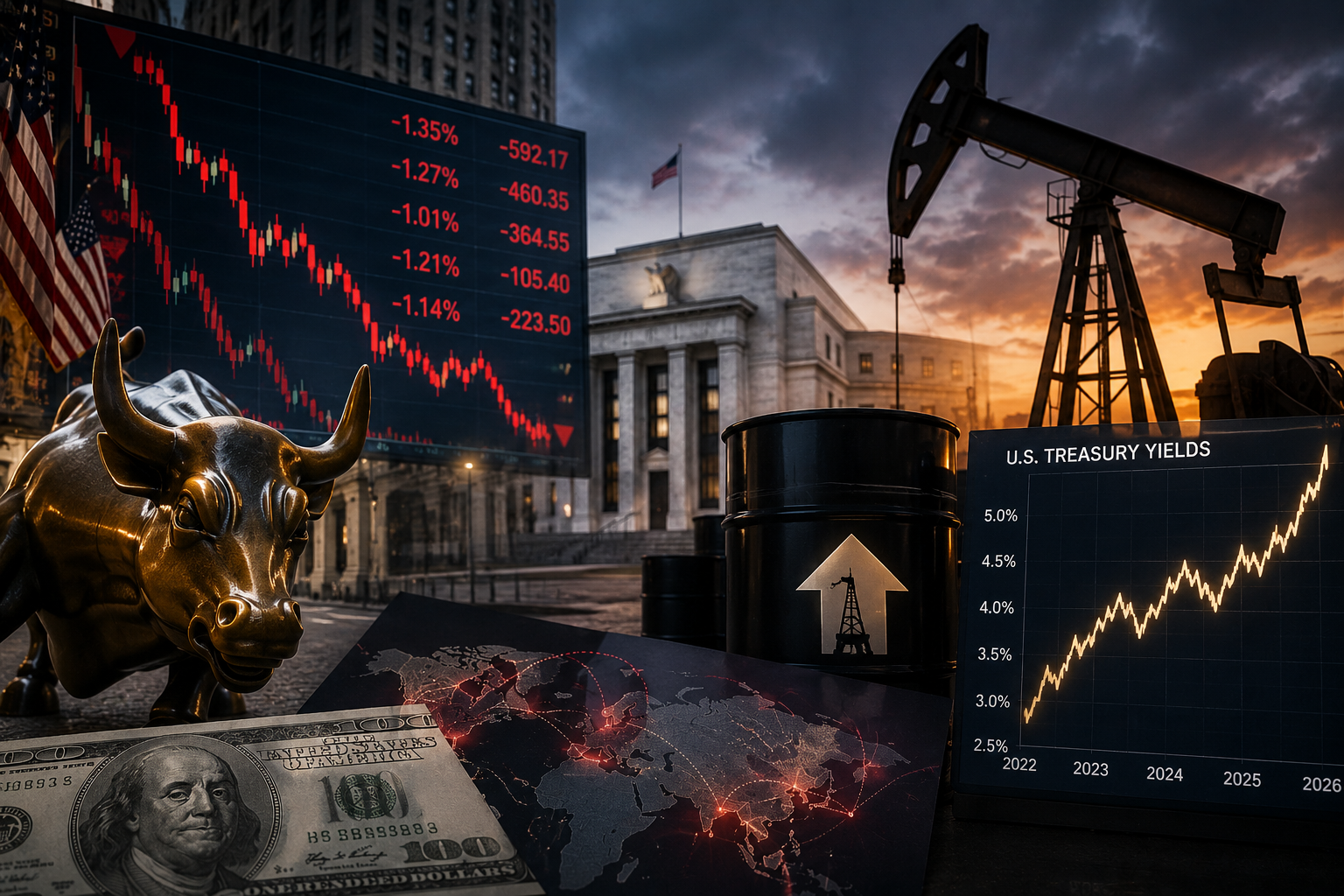
Wall Street’s powerful AI-driven rally is colliding with a reality investors cannot ignore: macroeconomic risk is back in control of the market narrative.
U.S. stock futures moved lower Thursday after oil prices surged above $106 per barrel amid renewed geopolitical tensions involving Iran, while Treasury yields climbed toward multi-year highs. The combination is reigniting investor fears that inflation could remain elevated longer than expected, potentially delaying interest-rate cuts from the Federal Reserve and pressuring already stretched equity valuations.
According to Reuters and MarketWatch reports published May 21, 2026, markets are increasingly shifting focus away from pure artificial intelligence optimism and toward broader concerns surrounding inflation, bond yields, energy prices, and geopolitical instability.
The recent market pullback highlights a critical turning point for investors. After months of AI-fueled momentum lifting technology shares and major indexes to record territory, traders are now being forced to reassess whether the macroeconomic environment can continue supporting elevated valuations.
The answer may shape the next phase of the bull market.
Oil Prices Are Reemerging as a Major Market Threat
Energy markets have once again become one of the biggest drivers of investor sentiment.
Crude oil prices climbed sharply after escalating Middle East tensions raised concerns about potential disruptions to global supply flows. Iran-related geopolitical risks have historically carried significant implications for energy markets, and investors are increasingly worried that any sustained conflict could trigger prolonged supply instability.
Oil moving above $106 per barrel represents more than just an energy story.
Higher crude prices ripple across the global economy by increasing transportation costs, manufacturing expenses, and consumer prices. Those pressures can ultimately feed directly into inflation readings, complicating the Federal Reserve’s efforts to move toward monetary easing.
For markets that have spent much of the past year pricing in eventual rate cuts, this creates a major problem.
Investors had largely expected moderating inflation and slowing economic growth to push the Fed toward lower rates during the second half of 2026. Rising energy costs now threaten that assumption.
If inflation remains stubbornly elevated, policymakers may have little flexibility to ease financial conditions as quickly as markets anticipated.
That dynamic is already affecting equity markets.
Treasury Yields Are Becoming the Market’s Biggest Concern
While oil prices grabbed headlines, many institutional investors remain even more focused on the bond market.
Treasury yields have climbed toward levels not seen in years, with long-term government debt increasingly reflecting concerns over persistent inflation, rising fiscal deficits, and elevated borrowing costs.
Higher Treasury yields matter enormously for equities because they directly influence how investors value future corporate earnings.
This effect is especially important for high-growth technology companies.
During periods of ultra-low interest rates, investors were willing to pay premium valuations for companies expected to generate substantial future growth. However, as yields rise, the present value of those future earnings declines, placing pressure on growth-stock multiples.
That explains why technology shares and AI-related companies often react negatively when bond yields surge.
The market is now confronting a difficult balancing act:
- AI demand remains extraordinarily strong
- Corporate earnings have generally held up well
- Economic growth remains relatively resilient
But at the same time:
- Inflation risks are resurfacing
- Oil prices are rising
- Treasury yields remain elevated
- Geopolitical tensions are increasing
The combination is forcing investors to rotate away from pure momentum trading and toward more defensive positioning.
Why the AI Rally Is Facing a New Test
Artificial intelligence has been the dominant investment theme across financial markets for nearly two years.
Companies tied to semiconductors, cloud infrastructure, cybersecurity, and data-center expansion have generated massive gains as investors poured capital into the AI trade. Firms like NVIDIA, Microsoft, Amazon, and Meta Platforms became central drivers of broader market performance.
Now, however, macroeconomic conditions are beginning to challenge the sustainability of those valuations.
Even strong AI-related earnings may not fully offset the pressure created by higher discount rates and tightening financial conditions.
This does not necessarily mean the AI boom is ending.
Instead, it may signal a transition from speculative momentum toward a more selective phase where investors focus more heavily on profitability, cash flow generation, and sustainable demand trends.
In other words, the market environment is becoming less forgiving.
Defensive Sectors Are Starting to Outperform
As macroeconomic uncertainty increases, investors are beginning to rotate into sectors traditionally viewed as defensive or inflation-resistant.
Several areas are benefiting from this shift:
Energy Stocks
Rising oil prices are improving earnings outlooks for energy producers, refiners, and oil-service firms. Energy companies may continue outperforming if geopolitical tensions keep crude prices elevated.
Utilities
Utilities often benefit during periods of market volatility because of their relatively stable cash flows and defensive characteristics. Additionally, AI-driven electricity demand is creating long-term growth opportunities for power providers.
Defense and Aerospace
Geopolitical instability tends to increase investor interest in defense contractors and aerospace companies tied to national security spending.
Commodities and Materials
Inflation-sensitive sectors including metals, mining, and industrial commodities may attract renewed investor attention if energy prices remain elevated.
At the same time, speculative growth segments and highly leveraged companies could face increased pressure if financial conditions tighten further.
The Federal Reserve Remains at the Center of the Market
Despite the growing influence of AI narratives and geopolitical developments, the Federal Reserve remains the single most important force shaping financial conditions.
Markets continue parsing every economic report for clues regarding future monetary policy decisions.
Recent inflation data had previously encouraged hopes that the Fed could begin easing rates later this year. However, the combination of rising oil prices and resilient economic activity now complicates that outlook.
Several risks remain on investors’ radar:
- Persistent wage inflation
- Elevated housing costs
- Energy-driven inflation spikes
- Strong consumer spending
- Expanding fiscal deficits
If inflation stabilizes at levels above the Fed’s target, policymakers may maintain restrictive rates longer than markets currently expect.
That possibility is one reason Treasury yields continue climbing.
Higher-for-longer interest rates could fundamentally alter the investment environment that fueled much of the recent stock market rally.
Geopolitical Risk Is Returning to Financial Markets
For much of the past decade, markets largely ignored geopolitical events unless they directly affected global trade or monetary policy.
That environment is changing.
Conflicts involving Iran, ongoing U.S.-China tensions, global supply-chain fragmentation, and strategic competition surrounding technology and critical minerals are becoming increasingly important drivers of market volatility.
Investors are beginning to recognize that geopolitical risk is no longer a temporary headline issue — it is becoming a structural market factor.
This shift may benefit sectors tied to:
- Energy security
- Defense spending
- Domestic manufacturing
- Critical minerals
- Cybersecurity
- Infrastructure resilience
At the same time, globally exposed growth companies may face greater volatility as geopolitical uncertainty increases.
Future Trends Investors Should Watch
Several developments could determine the direction of markets over the coming months.
Oil Market Volatility
Any escalation involving Iran or broader Middle East instability could push energy prices even higher.
Treasury Yield Movements
Bond market behavior may become the primary driver of equity valuations, particularly for technology stocks.
Federal Reserve Policy
Upcoming inflation reports and Fed commentary will likely remain central catalysts for markets.
AI Earnings Sustainability
Investors will closely monitor whether AI-related spending remains strong enough to offset macroeconomic pressures.
Sector Rotation
Defensive and commodity-linked sectors may continue outperforming if inflation risks intensify.
Key Investment Insight
The market environment is shifting from AI-driven momentum toward macroeconomic risk management, and investors may need to adjust positioning accordingly.
While artificial intelligence remains a powerful long-term growth theme, rising Treasury yields, elevated oil prices, and geopolitical uncertainty are creating a more challenging backdrop for high-valuation equities. Investors should focus on diversification, balance growth exposure with defensive sectors, and closely monitor inflation and bond market trends.
Energy producers, utilities, defense contractors, and inflation-sensitive industries may continue benefiting if geopolitical tensions and higher commodity prices persist. Meanwhile, investors in technology and AI-related stocks should pay close attention to valuation risk and interest-rate sensitivity.
As markets navigate the intersection of geopolitics, inflation, and AI transformation, disciplined risk management may become just as important as identifying the next growth opportunity.
Stay ahead of the markets with more daily investor insights and breaking financial analysis at MoneyNews.Today.




