
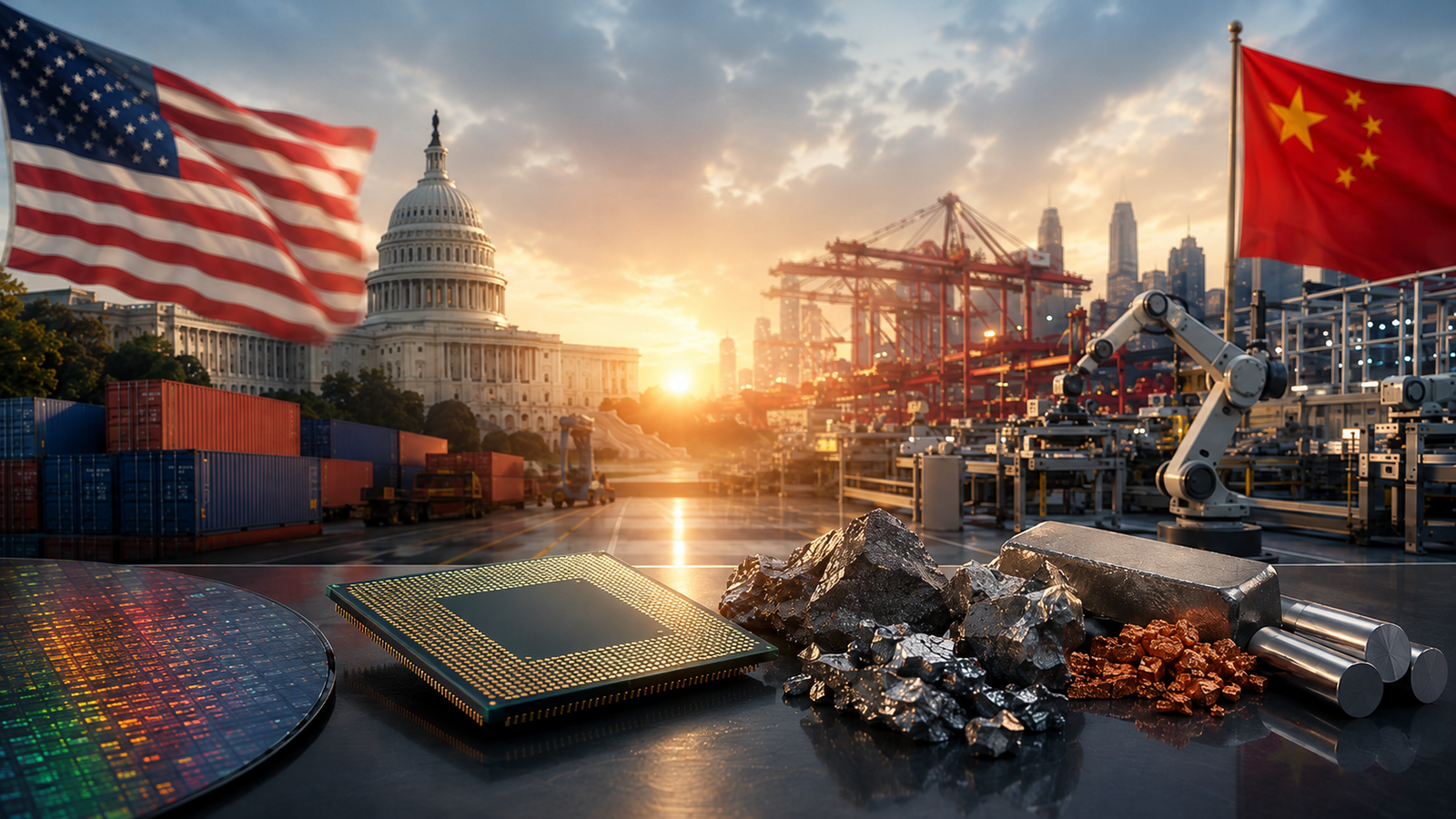
Global markets are once again being reshaped by Washington’s economic strategy toward China — and investors are increasingly realizing that the implications extend far beyond tariffs alone.
The Trump administration is accelerating a broad industrial and trade policy campaign aimed at reducing U.S. dependence on China across critical sectors including semiconductors, artificial intelligence, advanced manufacturing, clean energy infrastructure, and strategic minerals. New tariff measures, tighter technology export controls, domestic manufacturing incentives, and supply chain reshoring initiatives are now becoming central drivers of market sentiment across multiple industries.
At the same time, trade tensions involving Canada, Mexico, and China are creating fresh uncertainty for multinational corporations, commodity markets, and global supply chains.
For investors, the message is becoming increasingly clear: geopolitics is no longer a secondary market variable. It is rapidly becoming one of the dominant forces shaping long-term capital allocation, industrial investment, and sector leadership across the global economy.
According to White House fact sheets, Council on Foreign Relations analysis, and ongoing trade policy tracking from Ballotpedia and market observers, the United States is entering a deeper phase of economic nationalism focused on strategic technological independence and domestic industrial expansion.
That shift could create both major investment opportunities and significant volatility across global markets.
Washington Is Redefining Economic Security
For decades, globalization prioritized efficiency, lower production costs, and interconnected international supply chains. Companies optimized manufacturing around global trade networks heavily dependent on China’s industrial dominance.
That model is now undergoing a profound transformation.
U.S. policymakers increasingly view supply chain concentration as a national security risk — particularly in industries tied to advanced technology, defense systems, semiconductors, artificial intelligence, pharmaceuticals, and critical minerals.
The Trump administration’s evolving trade and industrial policy agenda reflects this broader shift toward “economic security.”
Several key policy priorities now dominate Washington’s strategy:
- Expanding tariffs on strategic imports
- Increasing domestic semiconductor production
- Restricting advanced technology exports to China
- Strengthening AI infrastructure independence
- Securing critical mineral supply chains
- Supporting defense and energy manufacturing
- Encouraging nearshoring and reshoring initiatives
This approach represents more than short-term political positioning. It reflects a long-term bipartisan trend toward industrial competition with China.
For investors, understanding that structural shift is becoming increasingly important.
Semiconductors and AI Have Become Strategic Battlegrounds
At the center of the geopolitical competition sits the semiconductor industry.
Modern semiconductors power virtually every critical technology sector, including:
- Artificial intelligence
- Cloud computing
- Defense systems
- Telecommunications
- Electric vehicles
- Advanced manufacturing
- Consumer electronics
The United States has intensified efforts to restrict China’s access to advanced AI chips and semiconductor technologies, while simultaneously supporting domestic manufacturing expansion through industrial incentives and strategic investment programs.
The goal is straightforward: maintain technological leadership in next-generation computing and AI infrastructure.
This policy direction has major implications for investors.
Semiconductor companies tied to domestic fabrication, advanced packaging, AI infrastructure, and U.S.-aligned supply chains may continue benefiting from government-backed spending initiatives.
At the same time, firms with heavy China exposure face increasing regulatory and geopolitical uncertainty.
This creates a more fragmented global technology landscape where supply chains are increasingly shaped by political alliances rather than purely economic efficiency.
Critical Minerals Are Emerging as Strategic Assets
Trade policy is also extending deeper into the natural resources sector.
Critical minerals including lithium, copper, uranium, graphite, nickel, and rare earth elements have become central to U.S. industrial policy planning due to their importance in:
- AI infrastructure
- Electric vehicle batteries
- Semiconductor manufacturing
- Defense systems
- Renewable energy technologies
- Energy storage systems
Washington is increasingly prioritizing domestic mining projects and allied sourcing agreements with countries like Canada and Australia in an effort to reduce reliance on Chinese-controlled processing and refining capacity.
Several recent policy initiatives have focused on:
- Expanding North American supply chains
- Accelerating mining permits
- Supporting mineral processing infrastructure
- Incentivizing strategic resource investment
- Increasing energy security
For investors, this policy environment may continue supporting long-term demand growth across select mining and energy sectors.
Companies tied to domestic production and allied supply chains could emerge as major beneficiaries of geopolitical realignment.
Trade Tensions With Canada and Mexico Add Complexity
While China remains the primary focus, trade tensions involving Canada and Mexico are also becoming increasingly important for investors.
North American supply chains are deeply integrated across industries including:
- Automotive manufacturing
- Energy infrastructure
- Agriculture
- Semiconductors
- Industrial manufacturing
Tariff disputes or renegotiations tied to regional trade agreements could create significant ripple effects across corporate earnings and supply chain costs.
For multinational companies, geopolitical uncertainty is increasingly influencing strategic decisions regarding:
- Manufacturing locations
- Capital expenditures
- Inventory management
- Supplier diversification
- Long-term investment planning
This uncertainty may continue contributing to market volatility, particularly in sectors heavily exposed to international trade flows.
At the same time, nearshoring trends may benefit certain North American industrial and logistics sectors as companies seek more geographically resilient supply chains.
Why Markets Are Becoming More Sensitive to Geopolitical Headlines
One of the biggest changes occurring across financial markets is the growing influence of geopolitical risk on asset pricing.
Trade negotiations, export restrictions, industrial policy announcements, and diplomatic tensions now routinely move markets in ways previously reserved for central bank decisions or major earnings reports.
Several factors are driving this increased sensitivity:
1. Supply Chain Vulnerability
The pandemic exposed how fragile global supply chains can become when heavily concentrated in specific regions.
2. Technological Competition
Artificial intelligence and semiconductor leadership are increasingly viewed as strategic national priorities.
3. Inflation Pressures
Tariffs and supply chain restructuring may contribute to higher production costs and inflation persistence.
4. Industrial Reshoring
Governments are increasingly supporting domestic manufacturing despite potentially higher operating costs.
5. Energy and Resource Security
Access to critical resources is becoming central to economic policy planning.
For investors, this means macroeconomic analysis increasingly requires understanding geopolitics alongside traditional financial metrics.
Why This Matters for Investors
The Trump administration’s trade and industrial policy push is reshaping investment opportunities across multiple sectors.
Several industries may continue receiving policy-driven support, including:
- Domestic semiconductor manufacturing
- AI infrastructure
- Defense technology
- Critical minerals
- Energy infrastructure
- Industrial automation
- Cybersecurity
- Nuclear energy
At the same time, companies heavily dependent on low-cost global manufacturing or Chinese supply chains may face rising operational risks and margin pressures.
This environment favors investors who can identify sectors aligned with long-term strategic government priorities.
Importantly, policy support can create durable investment tailwinds even during periods of broader economic uncertainty.
Several institutional analysts now believe industrial policy could become one of the defining market drivers of the decade alongside artificial intelligence and energy transition spending.
Future Trends Investors Should Watch
Several major developments could shape markets moving forward:
1. Additional Tariff Measures
New tariffs or trade restrictions may impact supply chains, manufacturing costs, and global corporate earnings.
2. Semiconductor Expansion
Domestic chip manufacturing investments could accelerate significantly under continued industrial policy support.
3. AI Infrastructure Competition
Government-backed AI infrastructure initiatives may continue benefiting cloud, semiconductor, and networking sectors.
4. Critical Mineral Nationalism
Strategic resource competition could reshape mining investment flows globally.
5. Supply Chain Regionalization
Companies may increasingly prioritize resilient regional supply chains over lowest-cost global sourcing.
Key Investment Insight
The growing convergence of trade policy, industrial strategy, artificial intelligence, and national security is creating a fundamentally different investment environment compared to the globalization-driven market cycles of previous decades.
For investors, sectors tied to domestic manufacturing, semiconductor independence, defense technology, energy security, and critical mineral supply chains may continue benefiting from long-term government support and capital investment.
At the same time, geopolitical tensions and tariff-driven uncertainty are likely to remain major sources of market volatility.
The global economy is increasingly shifting from an era of efficiency-focused globalization toward strategic economic competition — and investors who recognize that transformation early may be better positioned for the next phase of market leadership.
Stay informed on the latest geopolitical developments, market-moving policy trends, and investment opportunities with MoneyNews.Today, your trusted source for daily financial news and investor analysis.




