
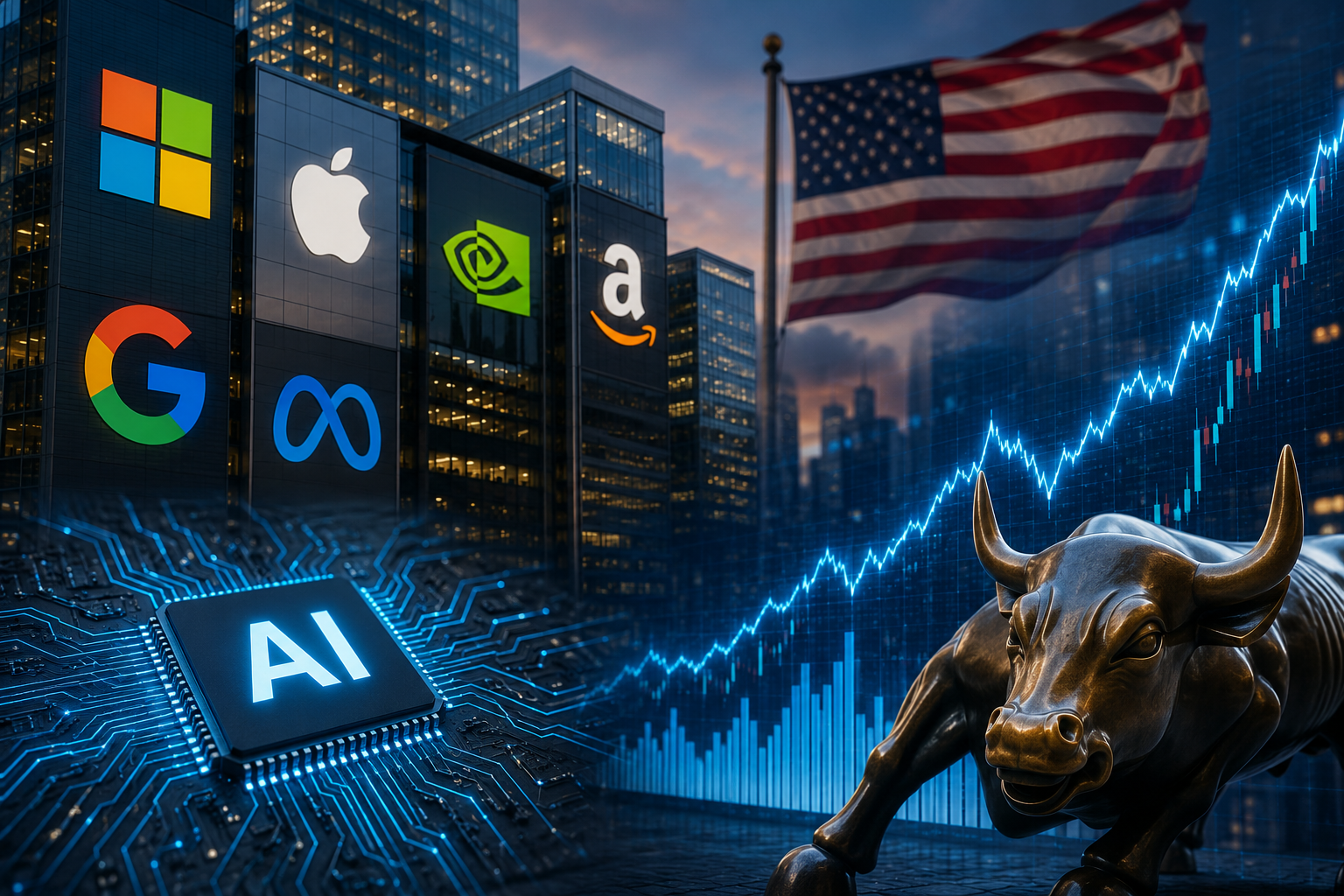
The artificial intelligence revolution is reshaping financial markets at a pace few investors could have imagined just a few years ago. Technology stocks now account for more than 39% of the S&P 500’s total market capitalization, according to a Reuters report published on June 3, 2026, surpassing concentration levels seen during the height of the dot-com boom. Driven by surging demand for AI infrastructure, cloud computing, semiconductors, and digital services, a small group of technology giants has become the primary force behind U.S. stock market performance.
For investors, this milestone represents both a tremendous opportunity and a growing challenge. While AI-driven innovation continues to generate substantial shareholder value, increasing market concentration raises important questions about risk, diversification, and the sustainability of current valuations.
As the AI rally enters a new phase, investors must decide whether today’s technology leaders can continue delivering exceptional growth—or whether concentration levels have reached a point where caution becomes necessary.
The AI Boom Has Redefined Market Leadership
Over the past two years, artificial intelligence has become the dominant theme in global investing.
The rapid adoption of generative AI, expanding cloud infrastructure, and growing enterprise demand for AI-powered solutions have fueled remarkable gains across the technology sector. Companies involved in semiconductors, data centers, networking equipment, cloud computing, and AI software have experienced significant increases in both earnings expectations and market valuations.
The result has been an extraordinary concentration of market value within a relatively small number of companies.
According to Reuters, technology now represents more than 39% of the S&P 500’s market capitalization, exceeding levels reached during the late 1990s technology bubble. While today’s market leaders generally possess stronger balance sheets, higher profitability, and more established business models than many dot-com-era companies, the degree of concentration remains historically significant.
Investors have increasingly directed capital toward firms viewed as essential participants in the AI ecosystem. This includes companies supplying advanced semiconductors, operating cloud platforms, building AI infrastructure, and developing enterprise AI solutions.
As a result, technology stocks have become the primary drivers of major market indices.
Why Technology’s Market Dominance Matters
Market concentration is not inherently negative.
Historically, periods of technological transformation have often led to significant gains for companies positioned at the center of innovation. Railroads, automobiles, telecommunications, personal computers, and the internet all produced dominant market leaders that generated substantial returns for investors.
The current AI cycle appears to be following a similar pattern.
What makes today’s environment unique is the sheer scale of concentration. A relatively small group of mega-cap technology companies now exerts enormous influence over index performance, institutional portfolios, retirement accounts, and passive investment strategies.
When a handful of stocks account for a large percentage of market capitalization, their performance can disproportionately impact broader market returns.
This creates both opportunities and risks.
If AI adoption continues accelerating and earnings growth remains strong, technology leaders could continue outperforming. However, any slowdown in AI spending, regulatory pressure, or earnings disappointments could have an outsized impact on market indices.
For investors, understanding this concentration dynamic is becoming increasingly important.
AI Infrastructure Spending Is Fueling the Rally
One of the primary reasons technology companies have maintained investor enthusiasm is their aggressive investment in AI infrastructure.
Major firms have collectively committed hundreds of billions of dollars toward data centers, advanced chips, cloud capacity, networking equipment, and energy resources required to support next-generation AI systems.
According to industry estimates from Goldman Sachs, McKinsey, and other research organizations, AI-related infrastructure spending is expected to remain elevated for years as companies compete to secure computing capacity and expand AI capabilities.
Investors view this spending as evidence that AI remains in the early stages of a long-term growth cycle rather than a short-term trend.
Semiconductor manufacturers have been among the largest beneficiaries, as demand for advanced AI chips continues to exceed supply. At the same time, cloud providers and infrastructure companies have experienced increased investor interest due to their critical role in enabling AI adoption.
This spending cycle has reinforced the perception that technology companies remain at the center of future economic growth.
Comparisons to the Dot-Com Era Are Growing
Whenever market concentration reaches historic levels, comparisons to the dot-com bubble inevitably emerge.
The similarities are easy to identify. Investor excitement surrounding a transformative technology, rapidly rising valuations, strong momentum in technology shares, and growing public participation all resemble aspects of the late 1990s.
However, there are also important differences.
Many of today’s leading technology companies generate substantial cash flow, maintain strong balance sheets, and operate highly profitable businesses. Unlike many internet startups during the dot-com era, current AI leaders have established revenue streams and significant competitive advantages.
Research from firms such as Morgan Stanley, Goldman Sachs, and Bank of America suggests that while valuations have expanded, much of the recent market performance has been supported by genuine earnings growth rather than speculation alone.
That does not eliminate risk, however.
History demonstrates that even high-quality companies can experience periods of valuation compression if expectations become overly optimistic. Investors should recognize that strong fundamentals do not guarantee uninterrupted stock performance.
Why Portfolio Concentration Risk Is Rising
One of the most important concerns facing investors today is concentration risk.
Many investors believe they own diversified portfolios because they hold broad-market index funds. However, as technology stocks represent a growing share of major indices, portfolios may be more concentrated than they appear.
For example, a significant portion of the performance of major U.S. equity benchmarks now depends on a relatively small number of technology companies.
If those companies continue performing well, investors may benefit from substantial gains. But if sentiment shifts, the impact could extend far beyond individual stocks.
This concentration creates a delicate balance for portfolio managers and individual investors alike.
Reducing exposure entirely could mean missing opportunities tied to one of the most transformative technologies in decades. Yet excessive exposure could increase vulnerability to sector-specific risks.
As a result, diversification is becoming a central topic of discussion among institutional investors.
Future Trends to Watch
Several developments could determine whether technology’s market dominance continues expanding or begins to moderate.
First, investors should monitor corporate AI spending. Continued investment in infrastructure, cloud services, and enterprise AI adoption would likely support growth across the technology sector.
Second, earnings growth remains critical. Strong revenue expansion and profitability improvements will be necessary to justify elevated valuations.
Third, regulatory developments deserve close attention. Governments around the world are increasing scrutiny of large technology companies, AI systems, competition policies, and data practices.
Fourth, broader economic conditions could influence investor sentiment. Interest rates, inflation trends, and economic growth expectations will continue affecting risk appetite and valuation multiples.
Finally, investors should watch for opportunities beyond traditional technology leaders. As AI adoption expands, industries such as utilities, industrials, energy infrastructure, cybersecurity, networking, and data center real estate may become increasingly important beneficiaries.
Why This Matters for Investors
The rise of artificial intelligence has created one of the strongest market trends of the modern era.
Technology companies remain at the forefront of innovation, and many continue to benefit from powerful secular growth drivers. However, their growing influence within market indices means investors must pay closer attention to concentration risk than at any point in recent years.
The challenge is not choosing between AI exposure and diversification—it is finding the right balance between the two.
Investors who understand both the opportunities and risks associated with market concentration may be better positioned to navigate the next phase of the AI-driven market cycle.
Key Investment Insight
AI remains the dominant investment theme in global markets, but concentration risk is becoming increasingly important. Investors may want to maintain exposure to AI leaders while also considering opportunities across the broader AI ecosystem, including data center infrastructure, utilities, industrial construction, cybersecurity, networking equipment, and energy providers.
The most successful portfolios in the coming years may not simply own the biggest technology companies—they may own the companies enabling the AI revolution from every angle.
Stay informed with MoneyNews.Today for daily investor insights, market-moving developments, and in-depth analysis of the trends shaping the future of global finance.




