
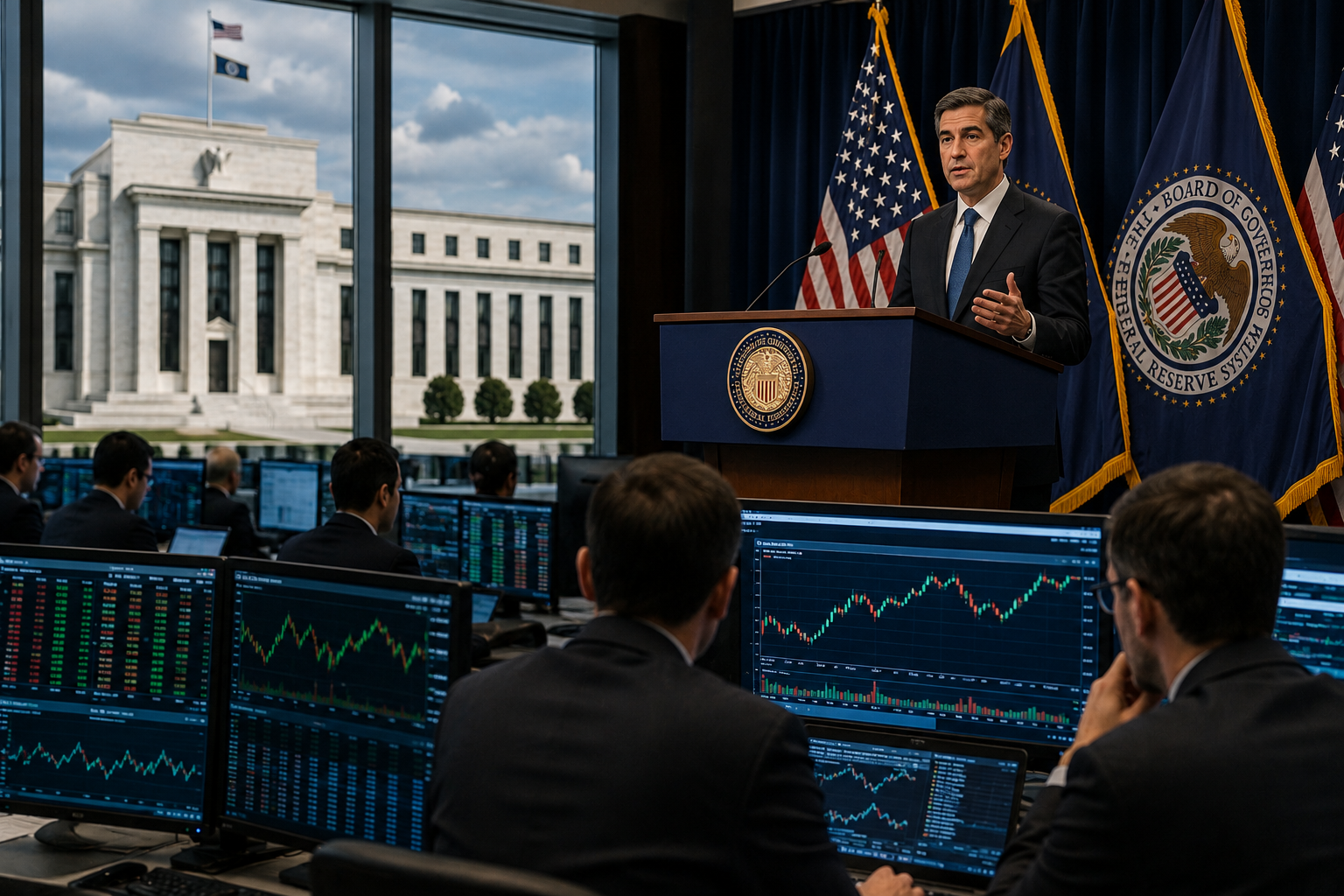
Few events command Wall Street’s attention quite like a Federal Reserve policy announcement. But today’s meeting carries an added layer of significance: it marks the first interest-rate decision and press conference under newly appointed Federal Reserve Chair Kevin Warsh.
Investors across global markets are closely monitoring not only the Fed’s rate decision but also every word Warsh delivers regarding inflation, economic growth, labor markets, and the future path of monetary policy. U.S. stock futures moved higher ahead of the announcement, reflecting cautious optimism that policymakers may provide clarity on whether interest rates are likely to move lower, remain unchanged, or potentially stay elevated for longer.
The stakes are enormous. From AI-driven technology stocks and high-growth companies to bonds, currencies, commodities, and cryptocurrencies, nearly every major asset class could react to today’s guidance.
For investors navigating an increasingly complex market environment, understanding the implications of the Federal Reserve’s first decision under Warsh may be one of the most important factors influencing portfolio performance during the second half of 2026.
A New Era Begins at the Federal Reserve
Leadership transitions at the Federal Reserve have historically been major events for financial markets.
The central bank remains the most influential economic institution in the world, with its decisions affecting borrowing costs, corporate investment, consumer spending, employment, inflation, and asset valuations.
Kevin Warsh inherits a U.S. economy that has demonstrated resilience despite years of elevated interest rates, persistent inflation concerns, geopolitical uncertainty, and rapid technological transformation driven by artificial intelligence.
Markets are eager to understand how Warsh intends to balance the Fed’s dual mandate of price stability and maximum employment.
According to Reuters, investors are particularly focused on whether the new Fed chair signals openness to future rate cuts, maintains a neutral stance, or adopts a more hawkish position aimed at preventing inflation from reaccelerating.
The answer could shape market expectations for months to come.
Why Interest Rates Matter So Much
At its core, the Federal Reserve influences financial markets through interest rates and liquidity conditions.
When rates are lower, borrowing becomes cheaper for consumers and businesses. Companies can invest more aggressively, economic activity tends to accelerate, and investors often become more willing to take risks.
Lower rates have historically supported higher valuations for growth-oriented sectors, including technology, artificial intelligence, cloud computing, and other innovation-driven industries.
Conversely, higher interest rates increase borrowing costs and make future earnings less valuable when discounted back to present value. This dynamic can pressure growth stocks and encourage investors to shift toward more defensive sectors.
The relationship between rates and valuations has become especially important in today’s market because many of the strongest-performing companies derive a significant portion of their value from expected future earnings growth.
As a result, even subtle changes in Federal Reserve guidance can trigger substantial market moves.
The AI Boom Raises the Stakes
One of the defining themes of 2026 has been the continued surge in artificial intelligence investment.
Technology giants are spending hundreds of billions of dollars on data centers, semiconductors, cloud infrastructure, and power-generation capacity to support expanding AI capabilities.
This investment boom has become a major driver of economic growth and stock-market performance.
According to analysts at Goldman Sachs, Morgan Stanley, and other major Wall Street firms, AI-related spending remains one of the strongest secular growth trends in global markets.
However, the AI boom has also complicated the Federal Reserve’s outlook.
Some economists argue that artificial intelligence could boost productivity and help contain inflation over time. Others believe that massive infrastructure spending and increased energy demand may contribute to inflationary pressures.
This debate has become increasingly relevant as policymakers assess whether the economy can sustain strong growth without reigniting inflation.
Investors will be listening closely for any comments Warsh makes regarding productivity gains, technological investment, and the broader impact of AI on economic conditions.
Why This Matters for Investors
Today’s Fed decision could influence virtually every corner of the financial markets.
Equities
Stock valuations remain highly sensitive to interest-rate expectations.
Technology companies, AI leaders, semiconductor manufacturers, and growth-oriented businesses tend to benefit when investors anticipate lower rates. A dovish tone from the Fed could provide additional support for these sectors.
A hawkish message, however, may lead investors to reassess valuations and reduce exposure to higher-risk assets.
Bonds
Treasury yields are likely to react immediately to any change in policy expectations.
If investors believe rate cuts are approaching, bond yields could decline while bond prices rise. Conversely, a more restrictive outlook could push yields higher.
Currencies
The U.S. dollar remains closely tied to Federal Reserve policy.
A softer policy outlook could weaken the dollar, while a hawkish stance could strengthen the currency against major global peers.
Commodities and Crypto
Gold, Bitcoin, and other alternative assets often respond to changes in interest-rate expectations and liquidity conditions.
Lower rates typically create a more favorable environment for risk assets and inflation-sensitive investments.
Three Possible Market Scenarios
Investors should prepare for multiple outcomes following today’s announcement.
Scenario One: Dovish Fed
If Warsh signals confidence that inflation is moving toward target levels and suggests rate cuts could occur later this year, markets may react positively.
Technology stocks, AI leaders, cryptocurrencies, and growth-oriented sectors could experience renewed buying interest.
Bond yields would likely move lower, while risk appetite could improve broadly across markets.
Scenario Two: Neutral Fed
A neutral stance may indicate that policymakers require additional economic data before adjusting rates.
Markets could experience temporary volatility but ultimately remain focused on future inflation and employment reports.
This outcome may be viewed as broadly supportive if investors interpret it as preserving the possibility of future easing.
Scenario Three: Hawkish Fed
If the Fed emphasizes inflation risks or indicates rates may remain elevated for an extended period, markets could react negatively.
Growth stocks and other rate-sensitive sectors would likely face the greatest pressure.
The dollar could strengthen, bond yields may rise, and broader market volatility could increase.
Future Trends to Watch
Today’s announcement represents only one chapter in a larger economic story.
Several key developments will continue shaping investor expectations throughout the remainder of 2026.
Inflation Data
Consumer Price Index (CPI) and Personal Consumption Expenditures (PCE) reports remain critical indicators for future policy decisions.
Labor Market Conditions
Employment growth, wage trends, and labor-force participation rates will influence the Fed’s assessment of economic strength.
AI-Driven Productivity
Investors should monitor evidence that artificial intelligence is improving efficiency and supporting economic growth without generating excessive inflation.
Corporate Earnings
Company guidance regarding spending, hiring, and capital investment will provide valuable insight into economic conditions.
Global Geopolitics
Developments involving trade policy, supply chains, energy markets, and international relations could affect both inflation and growth expectations.
Key Investment Insight
The first Federal Reserve decision under Chair Kevin Warsh represents a pivotal moment for investors across all asset classes.
While today’s rate decision is important, the broader market impact may ultimately depend on how policymakers characterize inflation risks, economic growth prospects, and the future path of monetary policy. Growth stocks, particularly those tied to artificial intelligence, remain among the most interest-rate-sensitive investments in today’s market.
Investors should focus not only on the Fed’s immediate actions but also on the longer-term implications of Warsh’s policy framework. Understanding how the new chair views inflation, productivity, technological innovation, and financial conditions may provide valuable clues about market direction in the months ahead.
As Wall Street waits for answers, one reality remains clear: Federal Reserve policy continues to be one of the most powerful forces shaping investment outcomes in 2026.
Stay informed with MoneyNews.Today for daily investor insights, market-moving developments, and expert analysis covering the trends driving global financial markets.




