
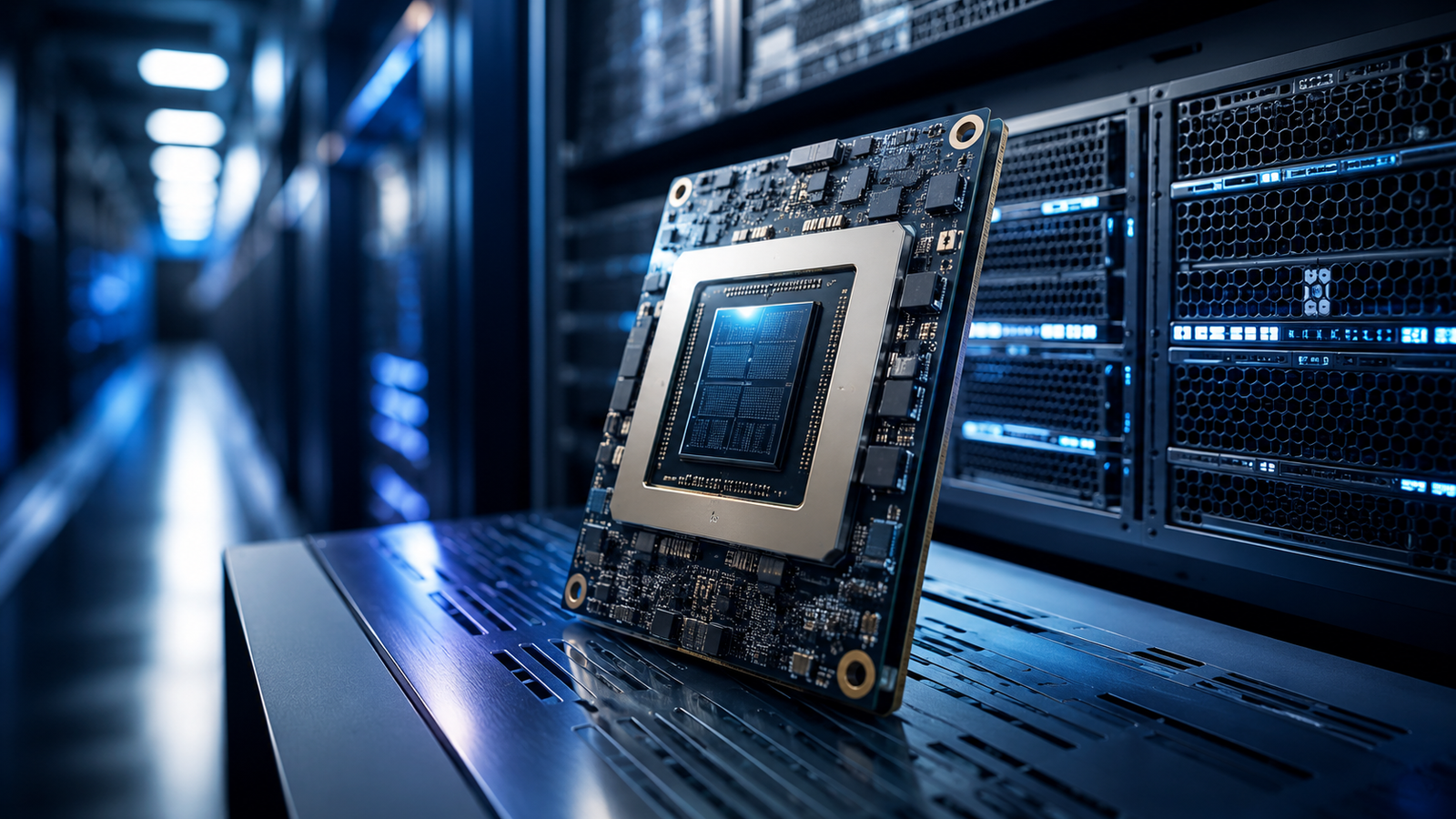
Private capital is sending a clear message to the artificial intelligence market: the AI infrastructure race is not over, and Nvidia is not the only name investors should be watching.
SambaNova Systems, the Palo Alto-based AI chip and systems startup, has reportedly raised $1 billion at an $11 billion valuation, marking one of the most closely watched private-market AI infrastructure financings of the year. The funding round arrives at a critical moment for investors, as public semiconductor stocks face renewed volatility and debate grows over whether the AI trade has become overheated.
SambaNova’s latest raise comes just months after its previous major funding round and follows a period of intense investor interest in alternatives to the dominant AI chip ecosystem. Bloomberg-syndicated reporting also noted that the round underscores continued conviction in demand for artificial intelligence infrastructure, even as public markets show signs of fatigue around crowded chip stocks.
For investors, the story is bigger than one startup. SambaNova’s valuation jump reflects a broader capital-market shift toward companies that can support the next phase of AI adoption: inference, enterprise deployment, sovereign AI infrastructure, custom accelerators, and more cost-efficient computing architectures.
Why This Funding Round Matters Now
The AI investment cycle is entering a more selective phase. In 2023 and 2024, much of the market’s focus centered on training large models and securing access to Nvidia GPUs. By 2026, investors are increasingly asking a different question: which companies can reduce the cost, power burden, and supply-chain concentration of AI computing?
That is where SambaNova’s timing becomes important. The company is part of a growing group of AI hardware challengers attempting to offer alternatives to GPU-heavy infrastructure. Its systems are designed around dataflow architecture and enterprise AI workloads, aiming to address performance and efficiency challenges as companies move from experimentation to production-scale AI.
SambaNova’s reported $1 billion financing suggests that major private investors still see significant room for competition in AI infrastructure. The round also signals that venture and growth-equity capital remains willing to fund capital-intensive AI hardware companies, despite the long commercialization cycles and high execution risk that come with semiconductor and systems businesses.
This matters because AI compute remains one of the largest bottlenecks in the technology sector. Cloud providers, enterprises, governments, and financial institutions are all competing for access to faster and more efficient infrastructure. If demand continues to expand, investors may see opportunities not only in chipmakers, but also in memory, networking, data-center power, cooling, semiconductor equipment, and AI systems integration.
Public Chip Stocks Are Under Pressure
The SambaNova news is especially notable because it comes as public semiconductor names are showing weakness. Investopedia’s July 8 market briefing reported that chip stocks were set to extend losses, with major hardware names including Nvidia, Intel, Marvell, AMD, Micron, and Sandisk under pressure in premarket trading. The same report noted that the AI trade had stumbled after Samsung’s preliminary second-quarter results failed to impress investors enough to sustain momentum.
That contrast is important. Public-market investors appear increasingly sensitive to valuation, earnings expectations, and signs of an AI bubble. Private-market investors, meanwhile, are still backing large AI infrastructure bets at premium valuations.
This divergence does not necessarily mean private investors are right and public investors are wrong. Instead, it shows that the AI market is splitting into two conversations. Public investors are asking whether the biggest chip stocks have already priced in too much future growth. Private investors are asking whether the next wave of AI infrastructure winners is still being built.
For MoneyNews.Today readers, that distinction is critical. A sell-off in public semiconductor stocks does not automatically mean AI infrastructure demand is weakening. It may simply mean investors are rotating away from crowded public names and searching for exposure to earlier-stage platforms, specialized chips, and next-generation AI systems.
The Bigger Trend: AI Inference Is Becoming the Next Battleground
The next stage of AI growth is likely to be driven less by model training alone and more by inference — the process of running AI models in real-world applications. Every chatbot query, enterprise automation task, fraud-detection workflow, medical imaging system, and AI search result requires inference capacity.
That creates a different investment profile. Training rewards massive scale and expensive compute clusters. Inference rewards efficiency, latency, cost control, energy management, and deployment flexibility.
This is where alternative AI chip companies are trying to gain ground. If enterprises can reduce the cost of running AI models, adoption can expand faster. That would benefit companies offering specialized hardware, optimized software stacks, and full-system solutions rather than chips alone.
SambaNova’s latest valuation suggests investors believe that enterprise AI infrastructure is still in the early innings. The company’s position is not simply about competing with Nvidia on raw chip performance. It is about whether a differentiated architecture can win enterprise customers that need secure, scalable, and cost-efficient AI deployments.
What Investors Should Watch Next
The most important question is whether SambaNova can convert investor enthusiasm into commercial traction. Large funding rounds make headlines, but enterprise AI infrastructure companies ultimately need recurring customer demand, clear performance benchmarks, strong gross margins, and a credible path to scale.
Investors should watch for three developments.
First, customer adoption. Major enterprise or government contracts would validate demand and help justify the company’s valuation. In AI hardware, customer wins matter because switching costs, software compatibility, and ecosystem lock-in can be significant.
Second, competitive positioning. Nvidia remains the dominant force in AI accelerators, supported by its CUDA software ecosystem, developer base, and deep relationships with hyperscale cloud providers. Any challenger must prove not only that its hardware works, but that customers can deploy it without operational friction.
Third, exit potential. A private company valued at $11 billion needs either substantial revenue growth, a strategic acquisition path, or a future IPO market willing to reward AI infrastructure at premium multiples. Earlier reports of Intel’s interest in SambaNova highlight how strategic buyers may view alternative AI chip companies as important assets in the race to close the gap with Nvidia.
Key Investment Insight
SambaNova’s $1 billion raise is a bullish signal for the AI infrastructure ecosystem, but investors should avoid treating every AI chip startup as an automatic winner. The better approach is to track the broader supply chain.
Public-market investors may not be able to buy SambaNova directly, but they can monitor related areas that could benefit from the same trend: semiconductor equipment, high-bandwidth memory, advanced packaging, data-center networking, power infrastructure, liquid cooling, and cloud AI deployment platforms. If private capital continues to fund AI chip challengers, it could create additional demand across the entire infrastructure stack.
At the same time, valuation risk is real. An $11 billion valuation raises expectations. If AI spending slows, if enterprise adoption disappoints, or if Nvidia and other incumbents lower pricing aggressively, private AI hardware valuations could come under pressure.
The practical takeaway: investors should stay constructive on AI infrastructure, but more selective. The next winners may not be the most hyped names. They may be the companies that solve the least glamorous but most urgent problems in AI: cost, energy consumption, deployment reliability, and supply-chain resilience.
SambaNova’s funding round shows that the AI infrastructure race remains wide open. For investors, the opportunity is not just in finding the next Nvidia — it is in understanding the entire industrial ecosystem being built around artificial intelligence.
Stay connected with MoneyNews.Today for daily investor-focused analysis on the market trends, emerging industries, and technology shifts shaping tomorrow’s portfolios.




