
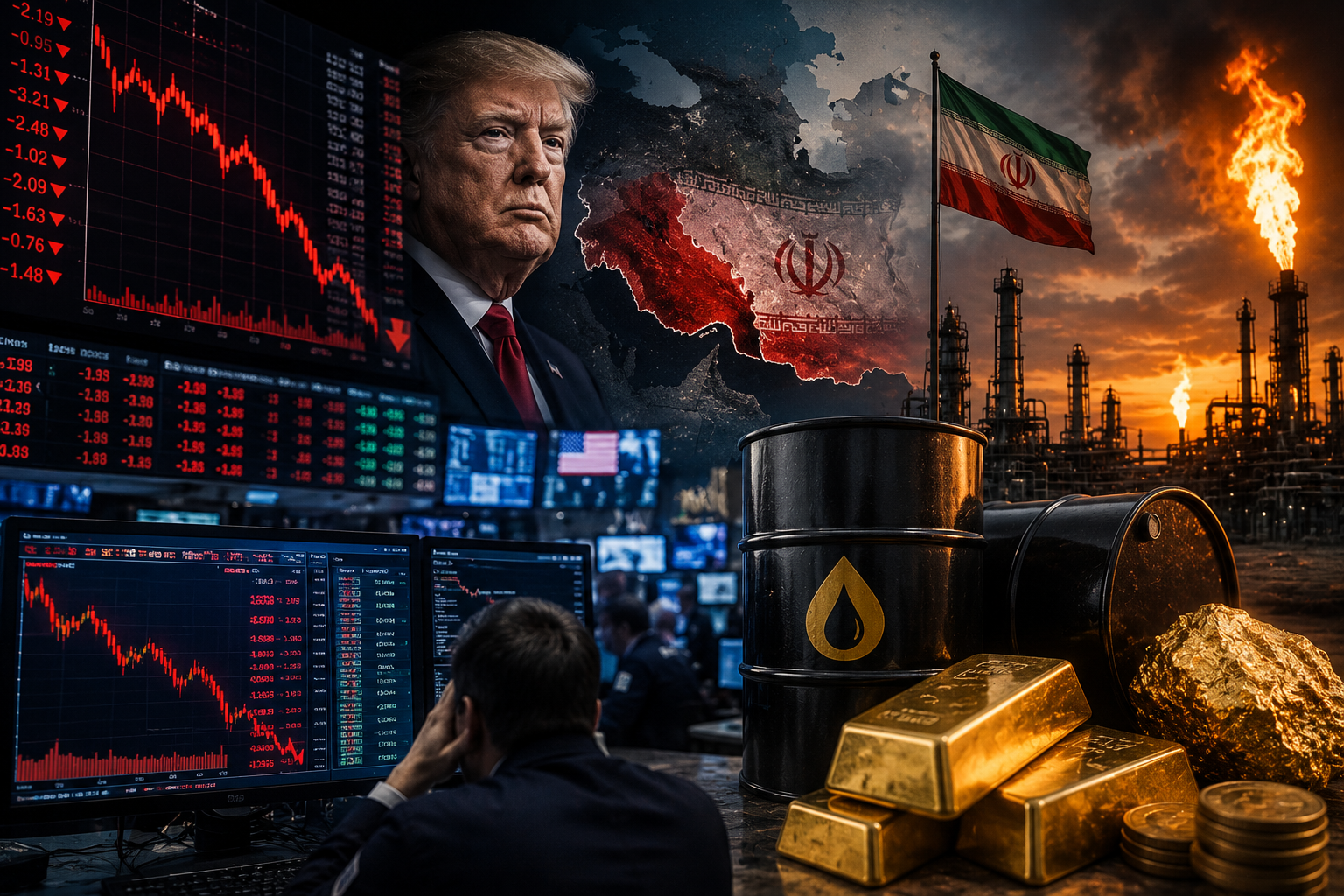
Global financial markets shifted abruptly into risk-off mode on Wednesday after President Donald Trump declared that the interim agreement with Iran was “over,” reigniting concerns about geopolitical stability in the Middle East. The remarks sent shockwaves through financial markets, with U.S. stock futures falling sharply while Brent and West Texas Intermediate (WTI) crude oil prices surged more than 6% as investors rushed to assess the implications of renewed regional tensions.
The market reaction underscores a familiar reality for investors: geopolitical events can rapidly reshape market sentiment, often outweighing corporate earnings, economic data, and monetary policy in the short term. While energy stocks climbed alongside oil prices, sectors dependent on lower fuel costs—including airlines, transportation companies, and consumer discretionary businesses—came under renewed pressure.
For investors, Wednesday’s developments serve as another reminder that markets remain highly sensitive to geopolitical headlines, with volatility likely to remain elevated until greater clarity emerges.
Markets Quickly Shift Into Defensive Mode
According to Reuters, futures tied to major U.S. stock indexes declined after President Trump’s comments suggested the collapse of diplomatic progress with Iran. At the same time, oil prices surged as traders priced in the possibility of tighter global crude supplies and increased geopolitical risk in one of the world’s most strategically important energy-producing regions.
The response was swift across asset classes.
Equity futures moved lower.
Oil prices rallied sharply.
Gold attracted fresh safe-haven demand.
Investors rotated toward traditionally defensive sectors while reducing exposure to growth-oriented and economically sensitive industries.
This broad-based repositioning highlights how quickly market participants can alter portfolio allocations when geopolitical uncertainty intensifies.
Although no immediate supply disruption has been confirmed, markets often react proactively to elevated geopolitical risks, particularly when they involve major oil-producing regions.
Why Oil Prices Matter to the Broader Stock Market
The immediate jump in crude oil prices has implications extending well beyond the energy sector.
Higher energy prices affect virtually every part of the global economy. Businesses face increased transportation and production costs, consumers pay more for fuel, and inflation pressures can intensify if elevated oil prices persist.
Historically, rising oil prices have created winners and losers across financial markets.
Energy producers often benefit from stronger commodity prices and improved cash flow.
Conversely, industries with significant fuel exposure—including airlines, shipping companies, trucking firms, logistics providers, and cruise operators—typically experience margin pressure as operating costs rise.
Consumer-focused companies may also feel the impact if households allocate more income toward energy expenses, leaving less discretionary spending available for retail, travel, entertainment, and other non-essential purchases.
For equity investors, understanding these sector-level dynamics becomes increasingly important during periods of commodity-driven volatility.
Geopolitical Risk Returns as a Primary Market Driver
Over recent months, investors have primarily focused on artificial intelligence, corporate earnings, and Federal Reserve policy as the dominant market themes.
Wednesday’s developments illustrate how quickly geopolitical events can reclaim center stage.
Markets generally dislike uncertainty.
When geopolitical tensions escalate, investors often seek assets perceived as more resilient during periods of instability.
This explains why capital frequently flows toward:
- Energy companies
- Defense contractors
- Gold and precious metals
- Utilities
- Consumer staples
- Government bonds
Meanwhile, higher-risk assets—including technology shares, small-cap stocks, emerging markets, and cryptocurrencies—often experience increased volatility.
While these rotations may prove temporary, they frequently influence short-term market performance until geopolitical conditions stabilize.
Inflation Concerns Return to the Forefront
One of the biggest implications of higher oil prices involves inflation.
Central banks, including the U.S. Federal Reserve, have spent several years attempting to bring inflation under control through higher interest rates and tighter monetary policy.
Should crude oil remain elevated for an extended period, energy costs could once again contribute to broader inflationary pressures across the economy.
This presents an additional challenge for financial markets.
Many investors had anticipated that moderating inflation would eventually allow the Federal Reserve to reduce interest rates, creating a more favorable environment for equities.
However, renewed inflation risks could delay future monetary easing.
Higher-for-longer interest rates generally reduce valuations for growth-oriented companies because future earnings become less valuable when discounted at higher rates.
Technology stocks, particularly companies trading at premium valuations, are often among the most sensitive to these shifts.
Which Sectors Could Benefit?
Although broader equity markets weakened, several industries could emerge as relative beneficiaries if geopolitical uncertainty persists.
Energy Producers
Oil exploration and production companies stand to benefit from stronger crude prices, particularly firms with low operating costs and disciplined capital allocation strategies.
Integrated energy companies may also generate higher free cash flow, supporting dividends and share repurchase programs.
Defense Companies
Renewed geopolitical tensions frequently lead investors to revisit defense contractors, cybersecurity providers, and aerospace manufacturers.
Higher government defense spending expectations often improve long-term revenue visibility for companies operating within these sectors.
Gold Mining Companies
Safe-haven demand has supported gold prices alongside higher oil.
Gold miners could benefit from improved margins if precious metal prices continue rising while production costs remain manageable.
Sectors Facing Increased Pressure
Several industries may experience headwinds if elevated energy prices persist.
Airlines
Fuel represents one of the largest operating expenses for airlines. Sustained increases in jet fuel costs can significantly reduce profitability unless carriers successfully pass higher expenses on to travelers.
Transportation and Logistics
Freight operators, trucking companies, rail networks, and shipping businesses also face higher fuel costs, potentially squeezing operating margins.
Consumer Discretionary
Higher gasoline prices reduce disposable household income, potentially slowing spending on retail goods, travel, restaurants, and entertainment.
Investors should monitor earnings guidance from companies operating within these sectors for any signs that higher energy costs are beginning to affect profitability.
Why This Matters for Investors
The latest geopolitical developments reinforce the importance of monitoring macroeconomic events alongside corporate fundamentals.
Several factors deserve close attention over the coming weeks:
Oil Prices: Continued gains could support energy stocks while increasing inflation concerns.
Federal Reserve Communication: Policymakers may adjust their outlook if higher energy prices influence inflation expectations.
Corporate Earnings: Management teams may revise guidance to reflect changing energy costs and consumer demand.
Defense Spending: Additional government policy announcements could strengthen outlooks for defense contractors.
Market Volatility: Geopolitical headlines are likely to continue influencing daily trading activity.
Markets often recover from geopolitical shocks, but the speed of that recovery depends on how quickly uncertainty subsides and whether economic fundamentals remain intact.
Key Investment Insight
While geopolitical headlines often dominate short-term market movements, disciplined investors should distinguish between temporary volatility and long-term structural trends.
Higher oil prices may create attractive opportunities within the energy sector while simultaneously increasing risks for transportation, consumer discretionary, and other fuel-sensitive industries.
Diversification remains especially valuable during periods of geopolitical uncertainty.
Investors should continue monitoring energy markets, inflation expectations, Federal Reserve policy, and corporate earnings guidance to assess whether current volatility develops into a more sustained market trend.
Companies with strong balance sheets, consistent cash flows, and pricing power are generally better positioned to navigate periods of elevated uncertainty than businesses heavily dependent on favorable economic conditions.
As global markets respond to rapidly changing geopolitical developments, informed decision-making becomes increasingly important. Stay with MoneyNews.Today for daily investor news, in-depth market analysis, and timely insights into the economic and geopolitical forces shaping investment opportunities around the world.




