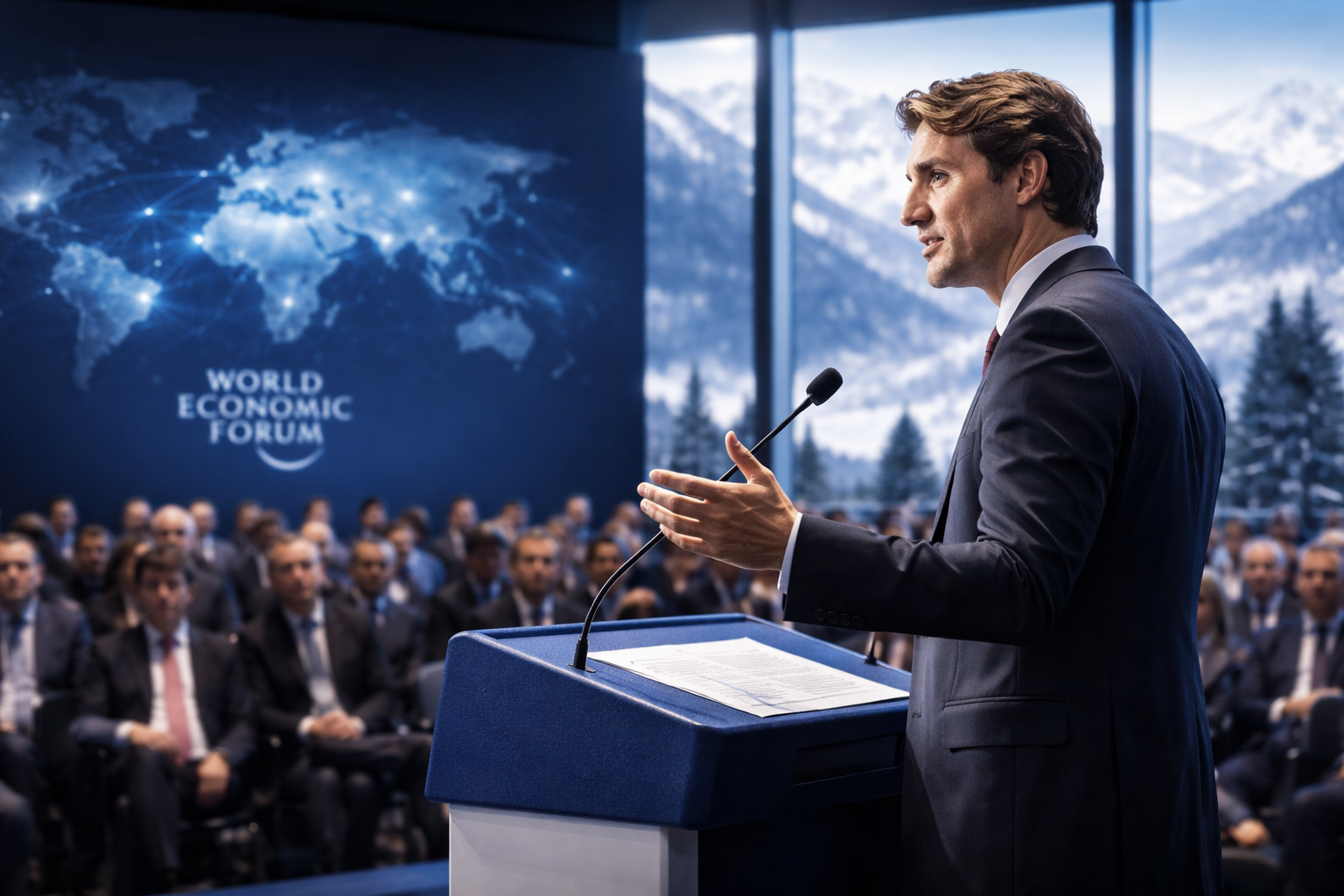
The message from Davos this week was blunt—and markets are listening. Speaking at the World Economic Forum, Canadian Prime Minister Mark Carney warned that the post-Cold War, rules-based global order is “not coming back,” urging middle powers to band together as geopolitical fault lines widen and great-power competition intensifies.
For investors, the remarks landed at a sensitive moment. Global markets are already grappling with elevated volatility driven by trade uncertainty, renewed tariff threats from Washington, and escalating diplomatic rhetoric surrounding Greenland and Arctic sovereignty. Carney’s comments reinforced a growing realization across boardrooms and trading desks alike: geopolitics is no longer a background risk—it is a primary market driver.
A Shifting Global Framework
Carney’s address emphasized that the assumptions underpinning decades of globalization—predictable trade rules, stable alliances, and multilateral coordination—are eroding. According to coverage from Bloomberg and Reuters, the Canadian leader called on countries outside the U.S.–China power axis to coordinate around shared economic and security norms, rather than wait for a return to the old system.
This message resonated strongly in Davos, where executives and policymakers are increasingly focused on resilience over efficiency. Supply chains, capital flows, and strategic investments are being re-evaluated through a geopolitical lens.
For investors, this shift signals a structural change rather than a temporary disruption.
Why This Matters for Investors
Political risk has become a tangible input in asset pricing. Markets have already reacted sharply this year to tariff threats, trade retaliation scenarios, and policy unpredictability—particularly in sectors tied to global trade, commodities, and advanced manufacturing.
Canada’s position as a resource-rich, politically stable middle power places it at the center of this evolving dynamic. Analysts note that countries able to navigate between major blocs may attract increased capital inflows, particularly in energy, critical minerals, defense, and infrastructure.
According to data cited by the World Economic Forum, more than 60% of global executives now rank geopolitical instability as a top threat to growth—up sharply from pre-pandemic levels. That shift is directly influencing corporate investment decisions and long-term capital allocation.
Trade, Tariffs, and the Arctic Factor
Carney’s comments come amid renewed diplomatic tension linked to U.S. trade policy signals and rhetoric involving Greenland, a strategically vital Arctic territory rich in natural resources. The Arctic has become a focal point for geopolitical competition, with implications for shipping routes, energy exploration, and national security.
Investors are increasingly aware that policy statements—especially those involving tariffs or territorial influence—can have immediate spillover effects across equity markets, currencies, and commodities. Earlier this week, U.S. equities experienced their sharpest pullback in months before stabilizing, while gold and other safe-haven assets rallied.
Such moves underscore how sensitive markets have become to political signaling.
Middle Powers and Market Stability
Carney’s call for middle-power coordination reflects a broader effort to reduce reliance on dominant powers and create alternative frameworks for trade and investment. Countries like Canada, Australia, and parts of Europe are positioning themselves as stable, rules-oriented partners amid rising uncertainty.
From an investment standpoint, this may benefit regions perceived as predictable and institutionally strong. Sovereign bonds, infrastructure assets, and equities in these markets could see increased interest as investors seek diversification away from geopolitical flashpoints.
McKinsey and IMF research suggests that fragmentation of the global economy could shave percentage points off long-term growth—but also create localized winners in strategically aligned regions.
Future Trends to Watch
Looking ahead, investors should expect geopolitical commentary to remain a consistent market catalyst. Election cycles, trade negotiations, and security alliances will increasingly influence sector performance and cross-border capital flows.
Key areas to monitor include:
- Trade and tariff policy shifts affecting global supply chains
- Resource nationalism tied to energy and critical minerals
- Defense and cybersecurity spending trends
- Currency volatility linked to political risk perception
Markets may continue to oscillate between risk-on and risk-off sentiment as political narratives evolve.
Key Investment Insight
Carney’s Davos warning reinforces a crucial takeaway for investors: geopolitical alignment and political stability are becoming core investment fundamentals. Portfolios exposed to resilient economies, strategic resources, and policy-backed industries may be better positioned in a world where the old global order is no longer the baseline.
As politics increasingly shapes markets, staying informed is no longer optional—it’s essential.
Follow MoneyNews.Today for daily insights on how global political shifts are influencing markets, capital flows, and investment strategy in real time.