
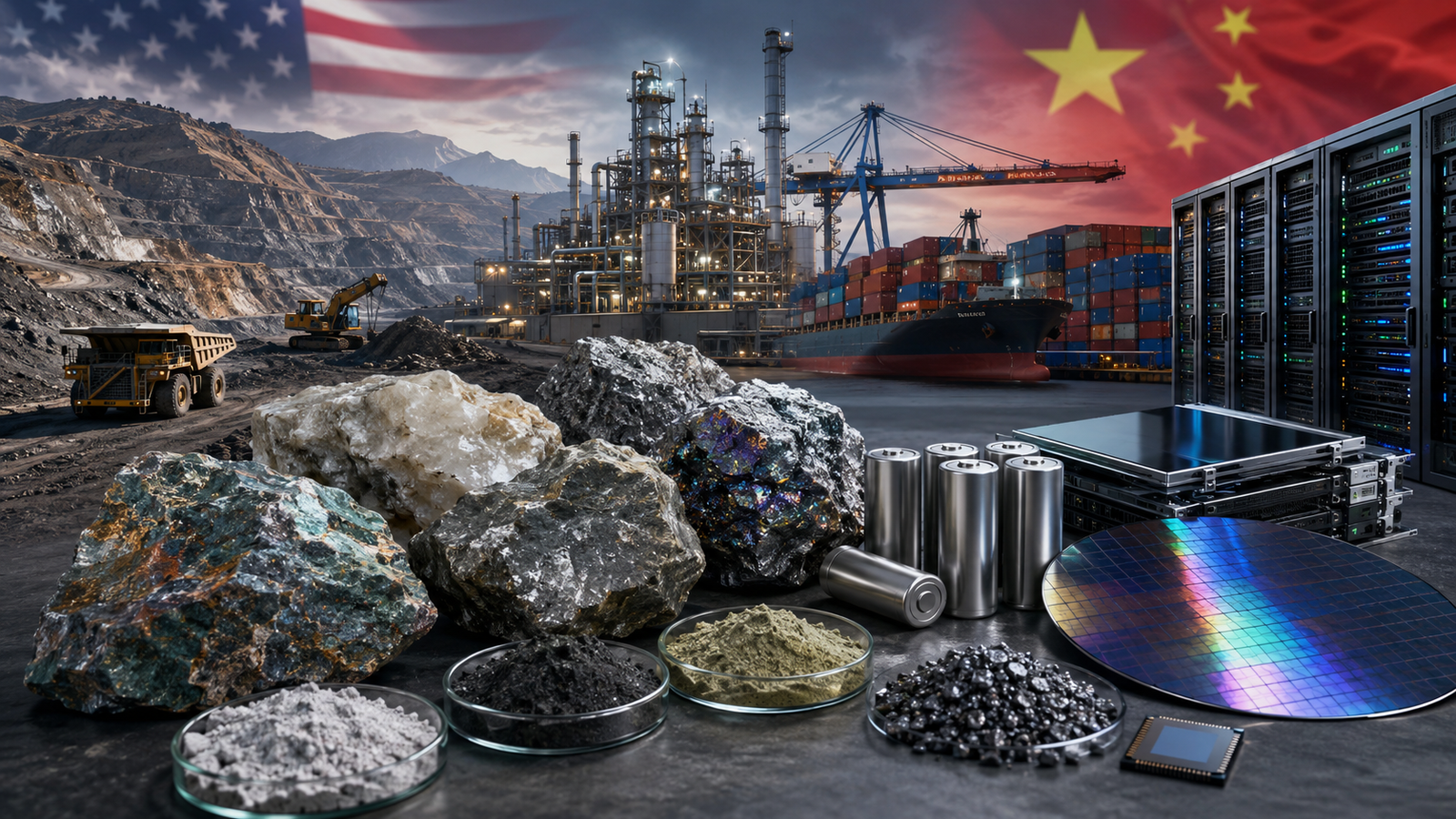
The global race for critical minerals is no longer just about mining — it is increasingly about geopolitical power, industrial dominance, and the future of advanced technology. From electric vehicles and semiconductors to AI infrastructure and defense systems, the materials underpinning the next generation of economic growth are becoming strategic assets in the escalating competition between the United States and China.
Investors are now closely watching how governments across North America and allied nations are accelerating efforts to secure domestic and friendly-nation supply chains for lithium, copper, uranium, nickel, graphite, and rare-earth elements. The push comes amid growing concerns that China’s dominance across mineral processing and refining could become a major economic and national-security vulnerability for Western economies.
Recent policy announcements, strategic investment initiatives, and international partnerships tied to critical minerals are reinforcing one of the market’s most important long-term themes: resource security is rapidly becoming central to industrial policy, energy transition strategies, and AI-era infrastructure expansion.
For investors, the implications could be profound.
Why Critical Minerals Have Become a Geopolitical Priority
The modern global economy depends heavily on a relatively small group of minerals that are essential for advanced manufacturing and high-tech systems. Lithium powers electric vehicle batteries. Copper is critical for electrification and AI-driven data center expansion. Rare-earth elements are indispensable in magnets used for defense systems, wind turbines, and semiconductors.
China currently dominates many of these supply chains.
According to data from the International Energy Agency (IEA), China controls a substantial share of global rare-earth processing, graphite production, and battery-material refining capacity. In some categories, Chinese companies account for more than 70% of global processing output.
That concentration has alarmed Western policymakers.
The United States, Canada, Australia, Japan, and European allies are now aggressively pursuing supply-chain diversification strategies aimed at reducing dependence on Chinese-controlled minerals and refining infrastructure. Recent agreements involving North American and Indo-Pacific partners reflect growing urgency around securing long-term access to strategic resources.
The geopolitical backdrop has become especially important as tensions between Washington and Beijing continue escalating over semiconductors, artificial intelligence, trade policy, and defense technology.
In many ways, critical minerals have become the raw materials foundation of the AI and energy-transition economy.
AI Infrastructure Is Quietly Driving Commodity Demand
While electric vehicles have dominated discussions around battery metals for years, artificial intelligence infrastructure is rapidly emerging as another major source of long-term mineral demand.
The global AI boom has triggered a massive expansion in hyperscale data centers, semiconductor manufacturing, power infrastructure, and advanced cooling systems. These facilities require enormous quantities of copper, aluminum, rare-earth magnets, and energy resources.
Analysts increasingly view AI infrastructure spending as a powerful secular driver for industrial metals markets.
According to Goldman Sachs and McKinsey estimates, global electricity demand from AI data centers could rise dramatically over the next decade, forcing additional investment into grid infrastructure, transmission systems, and energy generation. Copper demand, in particular, is expected to benefit significantly because of its central role in electrification and data transmission.
At the same time, advanced semiconductor manufacturing relies heavily on highly specialized mineral inputs and precision materials that are strategically sensitive.
This convergence between AI growth and resource security is one reason governments are increasingly treating mining and mineral processing as national-security priorities rather than simply commodity industries.
North America’s Strategic Resource Push Gains Momentum
Canada and the United States are attempting to position themselves as major suppliers of strategic minerals needed for Western industrial independence.
Canada possesses significant reserves of lithium, uranium, nickel, cobalt, copper, and rare-earth elements. Recent investment initiatives tied to sovereign technology, energy security, and advanced manufacturing are encouraging domestic production and exploration activity.
Meanwhile, the United States has expanded support for domestic mining, refining capacity, and battery supply chains through legislation such as the Inflation Reduction Act and various defense-related procurement programs.
Australia has also emerged as a critical partner within allied supply-chain networks, particularly in lithium and rare-earth production.
Together, these countries are forming what many analysts describe as a “friend-shoring” strategy — relocating critical industrial supply chains toward politically aligned nations.
The broader objective is not necessarily to eliminate Chinese supply entirely, which would be difficult and expensive, but rather to reduce strategic dependence and improve resilience.
That trend is already influencing capital flows across mining and exploration markets.
Rare Earths Move Back Into Focus
Rare-earth elements are once again becoming a major investor focus as geopolitical competition intensifies.
These materials are essential for permanent magnets used in electric motors, missile systems, robotics, wind turbines, and semiconductor technologies. Despite their name, rare-earth minerals are relatively abundant globally, but processing them economically and at scale remains highly complex.
China’s dominance in rare-earth refining has historically discouraged Western competitors because of lower-cost Chinese production and environmental challenges associated with processing.
However, recent geopolitical developments are changing that calculation.
Governments are increasingly willing to subsidize strategic projects to build alternative supply chains, even if costs are initially higher. Several North American and Australian rare-earth projects are now attracting renewed investor interest because policymakers view them as strategically necessary.
Defense applications are particularly important. Military systems ranging from fighter jets to precision-guided weapons rely heavily on rare-earth components, making supply security a critical issue for NATO-aligned countries.
For investors, the sector remains volatile, but policy support may create long-term tailwinds for selected producers and developers.
Uranium and Nuclear Energy Reenter the Conversation
Another important trend within the critical-minerals landscape is the resurgence of uranium and nuclear-energy investing.
As governments pursue decarbonization goals while simultaneously expanding AI infrastructure and electrification, concerns about grid reliability and energy security are growing. Nuclear energy is increasingly being reconsidered as a stable, carbon-free power source capable of supporting large-scale industrial and AI-related electricity demand.
Canada remains one of the world’s leading uranium producers through Saskatchewan’s Athabasca Basin, while U.S. policymakers continue exploring domestic nuclear supply-chain security.
The intersection of AI power demand, energy transition policies, and geopolitical competition is creating renewed momentum for uranium markets after years of underinvestment.
Many institutional investors now view uranium not only as an energy-transition asset but also as a strategic-security commodity.
Risks Investors Should Consider
Despite the compelling long-term outlook, critical-mineral investing carries substantial risks.
Commodity prices remain highly cyclical and sensitive to global economic growth, interest rates, and industrial demand. Mining projects also face regulatory hurdles, environmental opposition, permitting delays, and significant capital requirements.
Many exploration-stage companies remain speculative and may struggle with financing if broader market conditions deteriorate.
China’s market influence also remains significant. Beijing still controls large portions of refining and processing infrastructure, giving Chinese companies considerable pricing power across global supply chains.
Additionally, rapid technological changes could alter long-term demand forecasts for specific minerals or battery chemistries.
For investors, selectivity remains critical.
Key Investment Insight
The critical-minerals story is evolving into one of the defining geopolitical and industrial-investment themes of the decade.
The most important opportunity may not simply come from commodity price appreciation, but from the restructuring of global supply chains around energy security, AI infrastructure, defense technologies, and economic sovereignty.
Investors should closely monitor:
- North American lithium and copper developers
- Rare-earth processing and refining projects
- Uranium producers tied to nuclear-energy expansion
- Battery supply-chain infrastructure companies
- AI-driven industrial electrification trends
- Government-backed mining and strategic-resource initiatives
As AI infrastructure, electrification, and geopolitical fragmentation continue reshaping global markets, critical minerals are likely to remain at the center of economic competition between major powers.
Stay with MoneyNews.Today for more daily investor insights covering metals and mining, AI infrastructure, energy security, and the geopolitical trends shaping tomorrow’s markets.




