
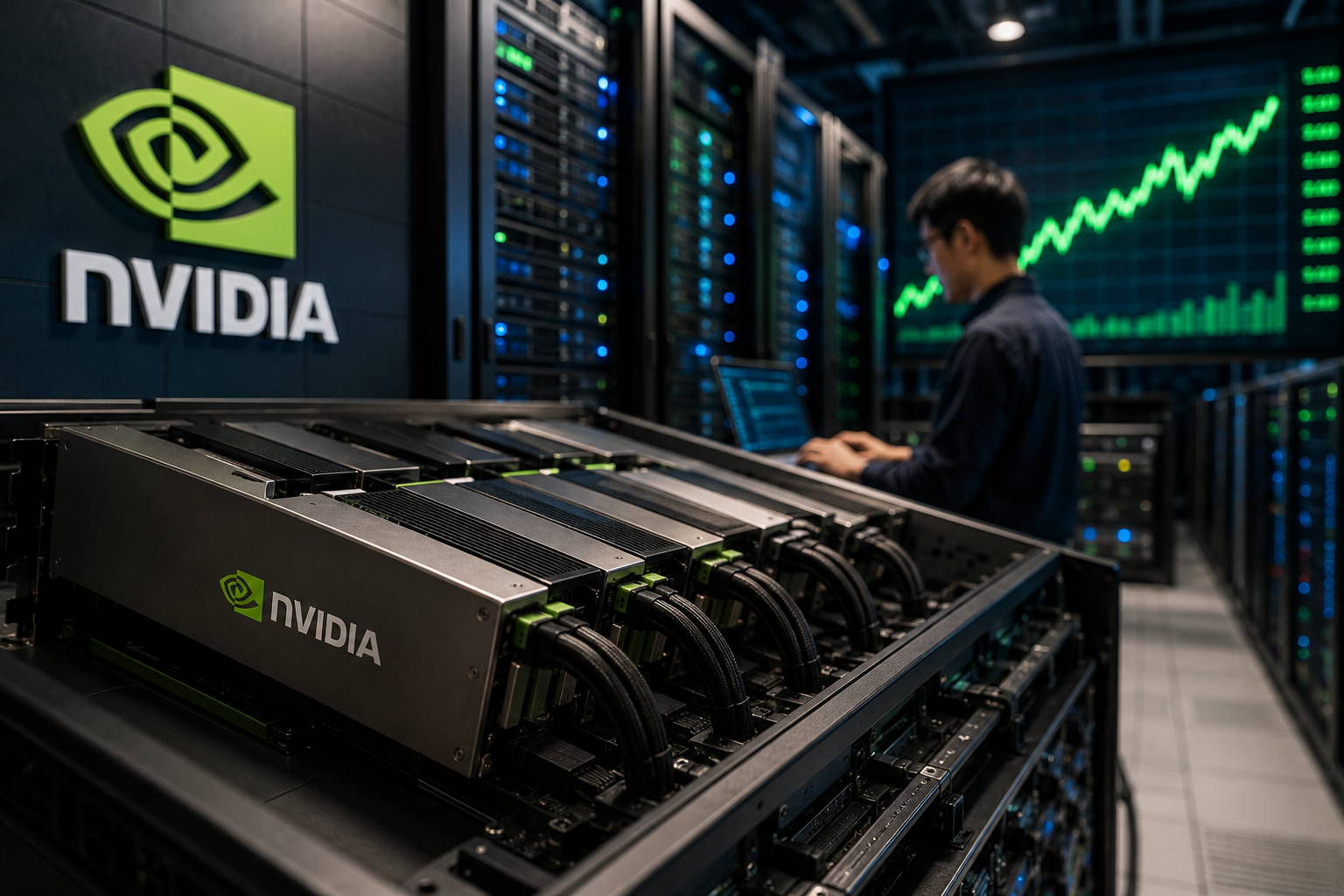
The artificial intelligence boom that has powered Wall Street for nearly three years is entering a critical new phase — and once again, Nvidia sits at the center of it.
After another powerful earnings-driven rally that reinforced its dominance in AI chips and infrastructure, investors are now asking a more complicated question: can the unprecedented level of AI spending from Big Tech continue long enough to justify today’s soaring valuations?
That debate is quickly becoming one of the most important conversations across financial markets.
The AI trade has evolved far beyond speculative enthusiasm. Massive capital expenditures from companies like Microsoft, Amazon, Alphabet, and Meta have transformed AI into the primary driver of market leadership in 2026. Nvidia’s GPUs remain the backbone of that ecosystem, powering everything from large language models and enterprise AI platforms to autonomous systems and cloud-based AI services.
But while Nvidia continues posting extraordinary growth numbers, investors are becoming increasingly focused on what comes next: the monetization stage of AI.
The next chapter of the AI boom may not be determined by who spends the most on infrastructure — but by who can generate sustainable profits from it.
Nvidia’s AI Dominance Continues to Shape Markets
Nvidia’s influence on both the semiconductor industry and broader equity markets has become difficult to overstate.
The company remains the dominant supplier of high-performance AI GPUs used to train and deploy advanced AI models. Its CUDA software ecosystem, networking products, and expanding enterprise partnerships have created a competitive moat that rivals continue struggling to overcome.
According to industry analysts and reports from Reuters and Bloomberg, hyperscaler spending on AI infrastructure remains historically elevated heading into the second half of 2026. Microsoft, Amazon Web Services, Google Cloud, and Meta continue aggressively expanding AI data-center capacity as competition intensifies across generative AI services.
This wave of spending has benefited not only Nvidia, but also a broader ecosystem of AI infrastructure companies tied to memory chips, networking equipment, cooling systems, and power infrastructure.
Still, some analysts believe markets are beginning to shift from pure “AI excitement” toward more disciplined evaluation of long-term returns on investment.
That transition matters.
The early stages of the AI boom rewarded nearly any company associated with artificial intelligence. The next phase is expected to favor firms capable of proving measurable revenue growth, enterprise adoption, and sustainable profit expansion.
Why Investors Are Watching AI Monetization Closely
The market’s focus is increasingly turning toward a simple but essential question: where will the actual profits come from?
Big Tech companies are spending hundreds of billions of dollars collectively on AI infrastructure, but monetization timelines remain uncertain for many AI products and services. Investors are now scrutinizing whether enterprises and consumers will adopt premium AI services at a scale large enough to justify these enormous expenditures.
That dynamic is especially important because AI infrastructure spending has become one of the primary forces supporting U.S. equity market strength.
According to multiple Wall Street research firms, AI-related capital expenditures are expected to remain elevated through at least 2027. However, investors are becoming more selective about which parts of the AI ecosystem offer the strongest long-term opportunities.
Several themes are emerging as potential winners:
GPUs and Accelerated Computing
Nvidia remains the clear leader here, but competitors including AMD and several custom-chip initiatives backed by hyperscalers continue attempting to gain market share.
AI workloads require massive computational power, and demand for accelerated computing infrastructure remains extremely strong.
AI Networking and Data Infrastructure
As AI clusters scale larger, networking bottlenecks are becoming increasingly important. Companies tied to high-speed networking, optical connectivity, and AI data movement are seeing rising investor interest.
This includes firms involved in Ethernet switching, AI interconnect technologies, and cloud infrastructure optimization.
Memory and Storage
AI systems consume enormous amounts of high-bandwidth memory (HBM), making memory suppliers a major beneficiary of the AI cycle.
Industry reports from Micron, Samsung, and SK Hynix have highlighted continued strength in AI-driven memory demand as large AI models grow increasingly complex.
Energy and Power Infrastructure
One of the most overlooked themes in the AI boom may be energy.
AI data centers require enormous electricity consumption, leading to rising interest in utilities, nuclear energy, natural gas infrastructure, and advanced cooling technologies.
Recent reports from Bloomberg and the International Energy Agency have highlighted concerns that AI power demand could become one of the largest infrastructure challenges of the decade.
This trend is creating investment opportunities far beyond traditional semiconductor stocks.
U.S.-China Competition Adds Another Layer of Complexity
At the same time, the AI race is increasingly becoming a geopolitical competition.
The United States continues tightening export restrictions on advanced semiconductor technologies destined for China, while Beijing accelerates efforts to develop domestic AI capabilities and semiconductor independence.
This geopolitical tension has major implications for investors.
On one hand, U.S. restrictions may strengthen domestic semiconductor manufacturing and support government-backed industrial policy initiatives. On the other hand, escalating tensions could disrupt global supply chains and create uncertainty for multinational technology companies.
According to reports from the U.S. Commerce Department and strategic policy groups including the Center for Strategic and International Studies (CSIS), Washington remains focused on maintaining leadership in AI infrastructure, advanced computing, and semiconductor design.
Meanwhile, China continues investing heavily in AI talent acquisition, domestic chip development, and sovereign AI infrastructure projects.
The result is an increasingly fragmented global technology ecosystem that investors cannot ignore.
Valuations Are Becoming Harder to Defend
Another major investor concern involves valuation pressure.
Nvidia’s extraordinary rise has helped fuel a broader rally across technology and AI-related equities, but expectations have also become significantly more demanding.
Markets are no longer rewarding AI exposure alone.
Companies now face growing pressure to demonstrate:
- Sustainable revenue growth tied directly to AI adoption
- Expanding profit margins
- Enterprise customer traction
- Long-term monetization strategies
- Operational scalability
This environment may favor established market leaders with strong balance sheets and proven infrastructure advantages rather than speculative AI startups lacking meaningful revenue.
Some analysts believe the market could eventually separate into two categories:
- Core AI infrastructure leaders with durable competitive advantages
- Secondary AI plays vulnerable to slowing growth expectations
That distinction could become increasingly important as interest rates remain elevated and investors focus more heavily on profitability.
Future Trends Investors Should Watch
Several emerging trends could define the next phase of the AI investment cycle.
Enterprise AI Adoption
Many businesses remain in the early stages of deploying AI into core operations. Software companies capable of integrating AI into productivity tools, cybersecurity, healthcare, and automation platforms could benefit significantly over the next several years.
Sovereign AI Infrastructure
Governments around the world are beginning to treat AI infrastructure as a strategic national asset, similar to energy or defense systems. This could accelerate public-private partnerships and increase government spending tied to AI development.
AI Regulation
As AI systems become more powerful, regulation is likely to increase globally. Investors should monitor how future AI governance frameworks affect data privacy, model deployment, and competitive dynamics.
Power Constraints
Electricity availability may become one of the biggest bottlenecks limiting AI expansion. Companies tied to power generation, transmission infrastructure, and advanced cooling systems could become critical beneficiaries.
Key Investment Insight
The AI trade is evolving from a pure infrastructure spending story into a monetization and scalability story.
Nvidia remains exceptionally well positioned due to its dominant role in GPUs, networking, and enterprise AI ecosystems. However, the next wave of investment opportunities may increasingly expand into adjacent industries including memory, energy infrastructure, networking, cybersecurity, and enterprise AI software.
Investors should pay close attention to companies capable of generating recurring AI-driven revenue rather than relying solely on speculative future potential.
The AI boom is no longer just about building the technology — it is about proving that the technology can consistently generate profits.
For investors, that distinction could define the market winners of the next decade.
Stay with MoneyNews.Today for daily investor insights covering AI, technology, markets, crypto, geopolitics, and the emerging trends shaping the global economy.




