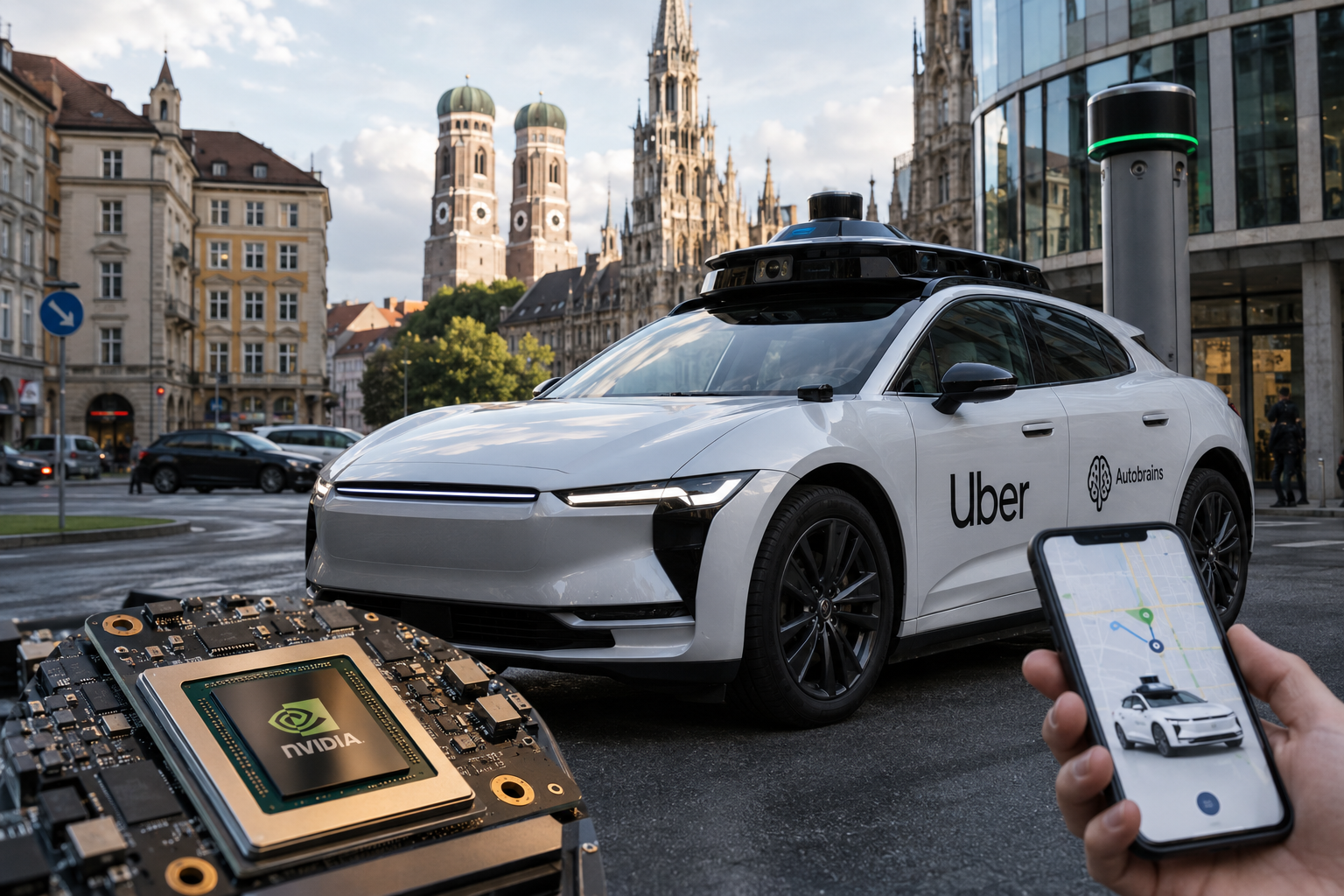
The race to commercialize autonomous transportation is entering a new phase, and investors are paying close attention. After years of development, testing, and regulatory hurdles, robotaxi technology is steadily moving from experimental pilot programs toward real-world deployment. The latest sign of this transition came on June 1, 2026, when Reuters reported that Uber and autonomous driving startup Autobrains plan to launch a robotaxi service in Munich powered by Nvidia’s artificial intelligence technology.
The announcement highlights a broader trend that is gaining momentum across the global transportation sector. Autonomous vehicle companies, technology providers, and mobility platforms are increasing investments despite ongoing challenges surrounding regulation, safety validation, and commercialization. For investors, the development signals that autonomous mobility is evolving from a futuristic concept into a potentially transformative long-term growth industry.
More importantly, the biggest opportunities may not reside solely with vehicle manufacturers. The emerging ecosystem includes AI chipmakers, sensor suppliers, simulation software developers, mapping providers, cloud infrastructure companies, and autonomous vehicle platforms that collectively form the backbone of the self-driving economy.
Autonomous Transportation Is Moving Into Commercial Reality
For much of the past decade, autonomous vehicles were viewed as one of the most promising yet elusive technologies in the market. Industry leaders repeatedly projected widespread deployment, only to encounter technical challenges and regulatory delays.
Today, the landscape looks different.
Advancements in artificial intelligence, machine learning, computer vision, high-performance computing, and sensor technology have significantly improved autonomous driving capabilities. At the same time, companies have accumulated billions of miles of real-world and simulated driving data, helping train increasingly sophisticated autonomous systems.
The planned Munich rollout by Uber and Autobrains represents another milestone in this progression. The deployment combines Uber’s mobility platform with Nvidia-powered AI systems designed to process vast amounts of environmental data in real time.
The project reflects growing confidence that autonomous ride-hailing services can begin scaling in select markets where infrastructure, regulations, and operational conditions support deployment.
For investors, the significance extends beyond a single city or pilot program. Each successful rollout strengthens confidence in the broader commercialization pathway for autonomous mobility.
Why Nvidia Continues to Be Central to the Story
While much of the public discussion around robotaxis focuses on vehicles and mobility services, Nvidia has quietly become one of the most important players in the autonomous vehicle ecosystem.
The company’s AI computing platforms power a growing number of self-driving systems worldwide. Nvidia provides the processing capabilities necessary to analyze camera feeds, lidar data, radar signals, and vehicle telemetry simultaneously while making split-second driving decisions.
CEO Jensen Huang has repeatedly emphasized the concept of “physical AI,” where artificial intelligence interacts with and navigates the real world. Autonomous vehicles represent one of the clearest examples of this vision.
As demand for autonomous transportation grows, Nvidia stands to benefit from increasing requirements for high-performance AI computing. The company’s position mirrors its leadership role in the broader AI infrastructure market, where it has become a primary supplier for cloud providers and AI developers.
For investors, this creates an important takeaway: autonomous vehicle growth is not solely an automotive story. It is also a semiconductor and AI infrastructure story.
Uber’s Strategic Position in the Autonomous Future
Uber’s involvement in the Munich initiative demonstrates how ride-hailing platforms may become major beneficiaries of autonomous transportation.
Historically, labor costs have represented one of the largest expenses for ride-sharing businesses. Autonomous vehicles have the potential to fundamentally alter the economics of ride-hailing by reducing or eliminating driver-related costs.
Industry analysts have long argued that robotaxis could significantly improve operating margins for mobility platforms once the technology reaches sufficient scale.
Uber’s strategy appears increasingly focused on partnering with autonomous technology providers rather than developing every component internally. This asset-light approach allows the company to participate in the autonomous transportation market while reducing research and development expenses.
For investors, Uber’s expanding role in autonomous mobility could become a meaningful long-term growth driver if commercial deployments continue to expand globally.
Europe Emerges as a Key Autonomous Vehicle Battleground
While much investor attention has focused on autonomous vehicle developments in the United States and China, Europe is becoming an increasingly important market.
Governments across Europe are investing heavily in digital infrastructure, smart city initiatives, and transportation modernization programs. Regulatory frameworks are also gradually evolving to accommodate autonomous vehicle testing and deployment.
Munich’s planned rollout highlights Europe’s growing role as a testing ground for next-generation mobility technologies.
The region’s dense urban environments, advanced infrastructure, and strong engineering capabilities make it an attractive market for autonomous transportation providers seeking scalable deployment opportunities.
According to research from McKinsey and various transportation industry groups, Europe could become one of the largest autonomous mobility markets over the next decade as governments pursue emissions reductions, traffic optimization, and transportation efficiency goals.
The Real Investment Opportunity May Be the Ecosystem
One of the biggest lessons from previous technology revolutions is that infrastructure providers often capture substantial value.
The autonomous vehicle industry appears likely to follow a similar pattern.
Rather than focusing exclusively on vehicle manufacturers, investors should consider the broader ecosystem supporting autonomous transportation.
AI Chips and Computing Platforms
Every autonomous vehicle relies on advanced computing systems capable of processing enormous amounts of data in real time. Companies supplying AI processors and edge computing infrastructure remain central beneficiaries of industry growth.
Sensors and Hardware
Autonomous vehicles depend on cameras, radar systems, lidar sensors, and precision navigation technologies. Demand for these components could increase significantly as deployments scale.
Simulation Software
Before autonomous vehicles operate on public roads, they undergo extensive virtual testing. Simulation software companies play a critical role in validating safety and improving system performance.
Digital Mapping and Data Infrastructure
Accurate mapping and real-time location services remain essential components of autonomous mobility ecosystems.
Connectivity and Cloud Services
Autonomous fleets generate enormous amounts of data requiring storage, analysis, and software updates. Cloud providers and networking companies could benefit from growing demand.
Risks Investors Should Watch
Despite the growing momentum, autonomous transportation remains a developing industry with substantial challenges.
Regulatory approval processes vary significantly across jurisdictions and can delay deployment timelines. Public acceptance and safety concerns also remain important considerations.
Technical limitations, cybersecurity risks, and liability questions continue to present hurdles for industry participants.
Commercial profitability is another key factor. While autonomous technology has advanced considerably, achieving large-scale economic viability remains an ongoing challenge.
Investors should therefore view autonomous mobility as a long-term investment theme rather than a short-term catalyst.
Future Trends to Watch
Several developments could shape the next phase of autonomous transportation:
- Expansion of robotaxi services into additional European cities.
- Continued adoption of Nvidia-powered autonomous driving systems.
- Advances in AI models capable of improving vehicle decision-making.
- Regulatory approvals enabling broader commercial deployment.
- Increased investment in autonomous trucking and logistics.
- Strategic partnerships between mobility platforms and AI technology providers.
Each of these trends has the potential to influence capital flows throughout the broader autonomous vehicle ecosystem.
Key Investment Insight
The Uber-Autobrains Munich rollout underscores a critical shift in the autonomous vehicle industry: commercialization is beginning to accelerate. While vehicle manufacturers remain important, investors may find greater opportunities among the companies providing the technologies that make autonomous transportation possible.
AI chipmakers, sensor developers, simulation software providers, cloud infrastructure firms, and mobility platforms are increasingly becoming the foundational pillars of the autonomous economy. As adoption expands, these segments could capture significant value from one of the most transformative transportation trends of the coming decade.
Stay informed on the technologies reshaping global markets and uncover emerging investment opportunities by following MoneyNews.Today for daily investor insights, market analysis, and breaking financial news.