
A Canadian technology company has completed a corporate transition that consolidates more than a decade of formulation and plant science under a single proposition: that biological systems, human and agricultural alike, routinely underperform what they are capable of, and that the constraint is usually addressable.
The More Life Company completed its change of corporate name and Canadian trading symbol on August 18th 2026, and now trades on the Canadian Securities Exchange under the symbol MLCO. The company was formerly Mountain Valley MD Holdings Inc.
Name changes at the small end of the market usually deserve the scepticism they attract. They are frequently a way of putting distance between a company and its own history. This one is doing something less common and more interesting. It is narrowing rather than broadening, and it is naming a thesis that the company has been building toward for years without articulating clearly.
The thesis is that living systems, whether a patient or a field of citrus, tend to use far less of what they are given than they could, and that the resulting gap is a commercial opportunity rather than a fact of nature. A therapeutic compound can be degraded before it reaches circulation. A plant can carry defensive and metabolic capacity it never activates. Neither problem is a problem of the molecule. Both are problems of biological performance.
“We divided life into categories. Biology never did.” The line opens the company’s new brand film, and it is the closest thing the business has to a first principle.
The company is structured around two commercial pillars, Human Health and Agriculture, and the connective tissue between them is not a shared product or a shared customer. It is a shared method: working within biological systems to improve performance, resilience and efficiency, rather than overriding them with external chemical force.
Pillar One: Human Health and the Quicksome Platform
Quicksome is a patented delivery platform presented as a sublingually disintegrating dosage form. Liposomal encapsulation is intended to shield the active ingredient from enzymatic degradation, while the sublingual route permits transmucosal absorption across the highly vascularised oral epithelium, avoiding both the proteolytic environment of the gastrointestinal tract and first-pass hepatic metabolism. Company materials describe a platform of fourteen patents. The commercial target is any molecule whose value is constrained by how it is administered.
That constraint is not confined to any one therapeutic category, and the breadth of the platform is the part of this story most likely to be underestimated. The company is advancing Quicksome across nutraceutical applications, the compounded pharmacy channel, and broader bioactive molecule work.
The hormone applications deserve particular attention from investors accustomed to reading these companies as single-catalyst stories. Testosterone replacement is delivered predominantly by intramuscular injection, transdermal gel or subcutaneous pellet, each of which carries well-documented adherence, handling or transference limitations. A sublingual format that preserves systemic exposure would address a large, established and reimbursement-supported market rather than an emerging one. The company is also examining female hormone applications including progesterone. These are development programmes rather than approved products, and should be read as such, but they are directed at markets whose size and payer infrastructure already exist.
The cold-chain credential
The most substantive third-party validation of the Quicksome platform is also the least discussed, and it predates the current strategy by several years.
Under a formal two-year collaborative research agreement with the United States Food and Drug Administration announced in June 2021, and following an initial FDA Polio Vaccine Laboratory evaluation reported in July 2020, the company applied a desiccated Quicksome liposome layer to trivalent inactivated poliovirus vaccine and exposed it to 40 degrees Celsius for five days. IPV serotype two achieved complete preservation and stability under those conditions, meeting the World Health Organization’s requirements across all three defined vaccine cold-chain management categories, including the Controlled Temperature Chain standard, which requires tolerance of 40 degrees Celsius for a minimum of three days. Serotypes one and three achieved partial preservation in the same evaluation.
The result is not uniform across serotypes and the company has not represented it as such. Its significance is different. Preserving antigenic integrity in an inactivated viral vaccine at ambient temperature is a demanding stability problem, and the work was quantified by an FDA laboratory using its own ELISA methodology rather than by the company. For a formulation platform, that is a class of validation that is difficult to obtain and difficult to dismiss.
Peptides in proportion
The compounded peptide channel has attracted considerable attention following the July 23 and 24, 2026 meeting of the FDA’s Pharmacy Compounding Advisory Committee, which recommended six of seven peptides for the Section 503A Bulk Drug Substances list. BPC-157, a synthetic pentadecapeptide, KPV, a tripeptide fragment of alpha-melanocyte-stimulating hormone, and TB-500, a fragment of thymosin beta-4, each cleared by eight votes to six with one abstention. MOTS-c, a mitochondrial-derived peptide, passed seven to five with two abstentions. Semax and Epitalon cleared on the second day. Only emideltide was voted down. The committee voted contrary to the recommendation of the agency’s own reviewing scientists, who had cited insufficient safety and effectiveness data and the absence of universally accepted chemical characterisation standards.
The company disclosed in late May 2026, ahead of that meeting, that it had completed initial Quicksome sublingual formulation work across several peptides drawing attention in the compounded channel, including BPC-157, GHK-Cu, a copper-binding tripeptide, KPV, SNAP-8, an acetyl octapeptide, and retatrutide, an investigational triple incretin receptor agonist. It had spent the preceding six months investing in laboratory instrumentation and controlled-environment handling capability suited to hygroscopic and thermolabile molecules.
Two points of proportion are worth stating plainly, because the market has a tendency to collapse them.
The first is legal. An advisory committee recommendation is not a rule. Any change to the 503A bulks list proceeds through notice-and-comment rulemaking under the Administrative Procedure Act, and the FDA is not bound by the committee’s view. What may lawfully be compounded at any given moment depends on the substance, its source, the compounding facility and whether it operates under section 503A or 503B, and the patient-specific circumstances of the prescription. Investors should resist the impulse to treat the July vote as a change in the law, and equally should resist treating the 503A bulks question as the single gate through which every compounded application must pass.
The second is commercial. Peptides are one emerging application category within the Quicksome platform. They are not the Human Health strategy, and the company’s nutraceutical, hormone and broader bioactive programmes do not depend on the final disposition of the six recommended substances. The company has stated separately that it does not own, develop or hold rights to GLP-class molecules, and that its work there is limited to evaluating platform applicability within the compounded channel. In a sector where adjacency to the weight-loss trade is routinely oversold, that is a disclosure worth crediting.
Pillar Two: Agriculture and the Agrarius Platform
The More Life Company (CSE: $MLCO) holds exclusive licensed rights to the Agrarius plant-signalling technology across Canada, the United States, Mexico, Central and South America and the Caribbean. The rights are licensed rather than owned, which is a distinction that matters when assessing durability, and the territory is the entire Western Hemisphere, which is a distinction that matters when assessing scale.
Agrarius is neither a fertiliser nor a pesticide, and it is not a delivery technology. It is a signalling technology. It acts through epigenetic mechanisms to upregulate the plant’s endogenous defence and growth pathways, inducing the physiological response ordinarily associated with stress without applying the stressor itself, and without introducing synthetic compounds. Company materials attribute the observed effects to improved nutrient use efficiency, enhanced photosynthetic activity, reduced oxidative stress and heat shock protein activation associated with tolerance to both abiotic and biotic pressure.
The trial base is substantial and, importantly, largely external. The company reports more than one hundred trials conducted globally across multiple climate zones, soil conditions and cropping systems, a significant majority of which have been managed, analysed or reported by third-party agricultural organisations, research institutions and commercial growers. These include work involving FARMATAC, UNESP and FEPAF in Brazil, and FEDEGAN together with the National University of Colombia.
That distinction is worth holding clearly. Independently conducted trials are not the same thing as formally peer-reviewed publications, and the results have not been through journal review. But nor are they internally managed company studies, and characterising them that way would misstate the evidentiary position.
Reported outcomes include yield increases of approximately 15 to 49 per cent in citrus depending on variety and growing conditions, approximately 18.5 per cent in potatoes, 11 to 14.8 per cent in corn, and gains exceeding 15 per cent in soybeans. In sugarcane the company reports a 10 per cent yield increase of 8 to 12 tonnes per hectare, an approximately 15 per cent rise in sugar content and a roughly 47 per cent reduction in pest damage. Potential fertiliser reduction of up to 25 per cent is cited for certain crop programmes. The citrus range spans a factor of more than three, which is characteristic of biological inputs across cultivar and climate and should be read as variability rather than inconsistency.
The company also reports visual reduction in symptoms associated with Huanglongbing, or citrus greening, across multiple trials. Huanglongbing is a bacterial disease for which no cure exists and which has materially reduced citrus production in Florida and Brazil. Symptomatic improvement observed against comparative control blocks is a meaningful agronomic signal. It is not equivalent to demonstrated disease control, and the underlying trial protocols have not been published.
Commercially, the product’s most underrated attribute is its lack of friction. The formulation is approximately 99.99 per cent water soluble, applies through standard spraying equipment, is tank-compatible alongside conventional crop inputs, and requires no new capital equipment from the grower. Agricultural biologicals fail far more often on adoption friction than on agronomy. A product that drops into an existing spray programme has already cleared the obstacle that eliminates most of its category.
Retained Technology: The Quicksol Solubilisation Platform
Alongside the two commercial pillars, the company retains Quicksol, a patented solubilisation technology that renders poorly water-soluble compounds formulable through cyclodextrin inclusion complexation. Its published foundation is an approximately 2,500-fold improvement in aqueous solubility, achieved using excipients already listed in the FDA’s Inactive Ingredient Guide rather than organic solvents. That excipient position matters more than the multiple does, because it removes a category of toxicology and regulatory work that would otherwise sit between the technology and a commercial formulation.
Quicksol is not being advanced as a third operating business. It is retained intellectual property with potential application across oncology, antiviral development and other therapeutic areas, and it should be valued as optionality rather than as a revenue line. Its relevance to the current thesis is evidentiary: the same underlying question, how to get a compound to perform in a biological system, solved twice by different chemistry, is the argument that this is a platform company rather than a collection of assets.
The Capability Build
A company moving from technology validation toward commercialisation needs a different set of relationships than the one that carried it through the laboratory, and this one has been visibly assembling that set. On August 4, 2026 it appointed five additional advisors, following an initial advisory group named in April.
Three of those appointments map onto the commercial strategy rather than decorating it. Eric Zember, general counsel of the consumer intelligence firm Affinity Solutions and formerly in senior legal and strategic roles at SAP and Lowe’s Companies (NYSE: $LOW), has negotiated more than a billion dollars of technology, artificial intelligence, intellectual property licensing and data transactions. For a business whose model runs through licensing rather than manufacturing, that is precisely the relevant experience. Erai Beckmann brings Latin American commercialisation and regulatory experience, including work with regulators and policymakers on changes to Brazil’s medical cannabinoid framework, in the market where the agricultural trial base has been concentrated. Dr Sanjeev Goel, a Canadian family physician with more than twenty-five years of clinical experience and founder of the longevity practice Peak Human, sits at the clinical end of the hormone and human performance applications.
The fourth is the most interesting. Dr Zach Bush is triple board-certified in internal medicine, endocrinology and metabolism, and hospice and palliative care, trained at the University of Virginia Health System, and is a co-founder of Farmer’s Footprint, a nonprofit working with farmers and industry on regenerative agriculture and the links between soil health, food systems and human health. A physician whose research spans the microbiome, chronic disease and soil biology is, in effect, the company’s two-pillar thesis expressed as a single career. Whether that translates into commercial outcomes is a separate question, but as a statement of what the company believes it is, the appointment is legible.
Investors should nonetheless resist overweighting advisory appointments, and the company’s own chief executive has been unusually direct on the point, stating publicly that advisors do not build businesses and that execution remains the responsibility of management. Advisory boards are cheap to assemble and easy to over-read. What they can reasonably be expected to do is improve decision quality and shorten the path to relationships that would otherwise take years to develop. What they cannot do is substitute for commercial traction.
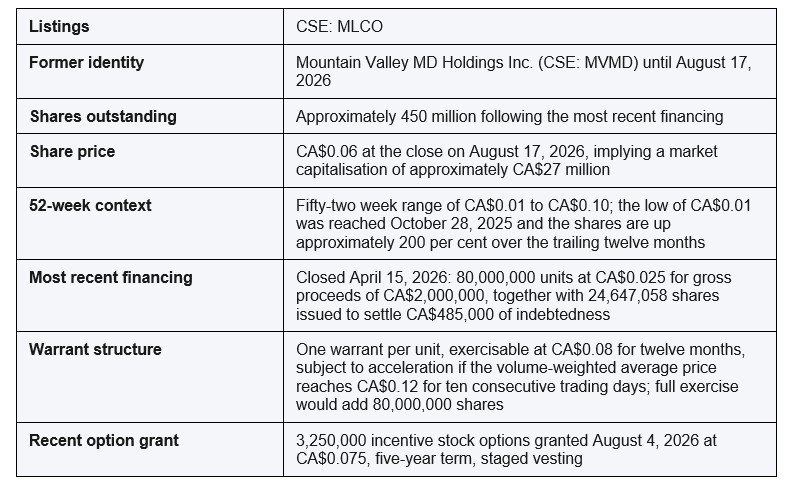
The appointments also carry a capital structure consequence. Concurrent with the August announcement, the company granted an aggregate of 3,250,000 incentive stock options to certain consultants and advisors at an exercise price of CA$0.075, exercisable over five years, vesting twenty per cent on grant, thirty per cent at six months and the balance at twelve months. The quantum is modest against the share count. The strike is not incidental: at CA$0.075 it sits below the CA$0.08 warrant exercise price, and it is a further increment of potential dilution that belongs in any full accounting of the capital structure.
Capital Structure and Financing Strategy
The equity story has to be assessed against the capital structure.

The financing merits closer reading than a headline dilution figure allows. The company describes the April placement as having been completed with strategic investors and structured to fund the business through its next phase without requiring an immediate return to the capital markets. The warrant structure is a deliberate element of that design rather than an accident of it. Eighty million warrants struck at CA$0.08, with an acceleration provision that the company may invoke if the volume-weighted average price reaches CA$0.12 for ten consecutive trading days, function as a contingent second tranche: if the shares perform, the company can compel exercise and receive up to CA$6.4 million without negotiating a new financing or resetting a price.
Investors should nonetheless size the position with the arithmetic in front of them. Full exercise would add 80,000,000 shares against a base of approximately 450 million, dilution of roughly 18 per cent, and the mechanism that converts warrants into treasury cash is the same mechanism that introduces supply into the market. Both effects are real and they arrive together. A structure can be well designed and still create a headwind.
The company has stated that its strategy is aimed at building a revenue-generating platform capable of supporting a future United States exchange uplisting, with Nasdaq named as the destination. That is a legitimate and common objective, and it is also a milestone gated on demonstrated revenue, governance and share price rather than on strategy.
The Identifiable Risks
A sober list is more useful to a sophisticated reader than an optimistic one.
Commercialisation pace is the central risk. Both pillars are advancing along parallel commercialisation pathways, and the company reports revenue from each. What is not yet established in public disclosure is the trajectory: whether Agrarius adoption across Latin American and North American markets, and Quicksome adoption across nutraceutical and compounded pharmacy channels, scale during the current year at a rate that supports the platform valuation the strategy implies. This is the most observable near-term test and the one an investor can actually track.
Regulatory dependency is a risk of degree rather than of kind. The company’s Human Health strategy is deliberately not contingent on any single regulatory outcome, and the hormone and nutraceutical programmes sit outside the 503A bulks question entirely. But the compounded peptide opportunity specifically does depend on how the FDA responds to its advisory committee, and that response is neither guaranteed nor quickly delivered.
Evidentiary depth is a risk on both pillars. Quicksome has an FDA-quantified cold-chain result and completed formulation work, but no published comparative human pharmacokinetic data across the newer applications. Agrarius has a large independently conducted trial base but no peer-reviewed publication. In each case the next tier of evidence is what converts a credible platform into a licensable one.
Financing and dilution risk remains, notwithstanding the structure described above. The company operates at a scale where the sequencing of capital and commercial milestones materially affects shareholders, and where an adverse sequence would be difficult to absorb.
And the Agrarius rights are licensed, not owned. Licence terms, renewal conditions and performance obligations are therefore part of the underlying asset quality, and investors should read them in the company’s disclosure rather than assume them.
The Case, Fairly Stated
The bear case is straightforward. This is a small-capitalisation company on a Canadian venture exchange, with two commercial pillars at an early stage of scaling, a live warrant overhang, an agricultural asset held under licence rather than owned, and an evidence base that is genuinely substantial but not yet peer-reviewed or clinically published in the areas that would command a licensing premium. Companies at this scale fail regularly, and usually for the same reason: the science was sound and the commercial ramp was slower than the balance sheet.
The bull case is narrower and rests on three things that are unusual in combination. The delivery and signalling problems the company addresses are real, durable and independent of any single regulatory cycle. The platform carries a validation credential from an FDA laboratory and an agricultural trial base built substantially by third parties, which is a different quality of evidence than most companies at this capitalisation can show. And the two pillars are genuinely uncorrelated: an agricultural adoption cycle in Brazil and a compounded pharmacy channel in the United States do not fail for the same reasons, which is a rarer property in a small-cap platform than it sounds.
The rebrand, easy to dismiss as cosmetic, is the first time the company has said clearly why these things belong in one entity. The answer it gives is that biology does not distinguish between a patient and a crop, and that the discipline of helping a living system perform better travels across both.
For investors, the watch list is unusually clear: the pace of Agrarius commercial adoption across its licensed territories, the first published comparative Quicksome data in the hormone and nutraceutical programmes, the FDA’s rulemaking response to the July recommendations, and the company’s reported revenue trajectory across both pillars. Four observable developments. The rest is narrative, and narrative is not what gets paid for.
IMPORTANT DISCLOSURES AND FORWARD-LOOKING INFORMATION
Publisher, compensation and relationships. This article was researched and written by Irrational Exuberance Media LLC on its own initiative and was not commissioned or paid for by The More Life Company, its officers, directors or shareholders, or by any third party. Readers should weigh these disclosures when assessing the independence of the analysis.
Not investment advice. This communication is for informational purposes only. It is not an offer to sell or a solicitation of an offer to buy any security, and it is not a recommendation to buy, sell or hold any security. Nothing herein constitutes investment, legal, accounting or tax advice, and it does not take into account the investment objectives, financial situation or particular needs of any reader. Securities of small-capitalisation issuers are speculative, may be illiquid, and carry a risk of total loss of capital. Readers should conduct their own due diligence and consult a registered investment adviser before making any investment decision. Past performance is not indicative of future results.
Sources and company-reported information. Market data, share capital and financing terms are drawn from public exchange and issuer disclosure as at the date of publication. Product descriptions and performance figures relating to Quicksome, Quicksol and Agrarius, including trial results, yield percentages, patent counts and statements regarding revenue, are as reported by the company and, where indicated, by third-party trial operators, and have not been independently verified by the author or publisher. Statements regarding the July 23 and 24, 2026 meeting of the FDA Pharmacy Compounding Advisory Committee reflect publicly reported outcomes of that meeting. Advisory committee recommendations are non-binding and do not constitute FDA approval. Statements regarding cold-chain evaluation reflect results reported by the company arising from its collaborative research agreement with the FDA and do not constitute FDA endorsement of the company, its technology or any product.
No product claims. Nothing in this communication constitutes an express or implied claim that any product or intended product of the company has the ability to diagnose, treat, cure, prevent or contain any disease or condition in humans, animals or plants. Development-stage programmes described herein are not approved products and no assurance is given that they will be approved or commercialised.
Forward-looking statements. This communication contains forward-looking information within the meaning of applicable securities legislation, including statements regarding commercialisation plans, revenue expectations, product development, regulatory outcomes, financing requirements and any future exchange listing. Forward-looking statements involve known and unknown risks and uncertainties, including regulatory outcomes, commercialisation pace, licence terms, financing risk, dilution and general market conditions, and actual results may differ materially. Neither the author, the publisher nor the company undertakes any obligation to update forward-looking statements except as required by law.
Limitation of liability and confidentiality. The information herein is provided without warranty of any kind, express or implied. Neither the author nor the publisher accepts any liability for any loss arising from reliance on this communication. Any non-public information provided by the company in the preparation of this article has been treated as confidential and is not reproduced herein.
The accuracy of the information is not guaranteed. Consult with your financial advisor before making any decisions relating to The More Life Company or any other company named herein. Unauthorized use, disclosure or distribution of this article is prohibited. The More Life Company is not liable for errors or omissions in this article. This article is not and should not be construed as an offer to sell or the solicitation of an offer to purchase or subscribe for any investment. No information in this article should be construed as individualized investment advice. A licensed financial advisor should be consulted prior to making any investment decision. We make no guarantee, representation or warranty and accept no responsibility or liability as to its accuracy or completeness. Irrational Exuberance Media LLC assumes no warranty, liability or guarantee for the current relevance, correctness or completeness of any information provided within this article and will not be held liable for the consequence of reliance upon any opinion or statement contained herein or any omission. Yolowire has been compensated four hundred and fifty dollars by Irrational Exuberance Media LLC for distribution of this The More Life Company article. Furthermore, we assume no liability for any direct or indirect loss or damage or, in particular, for lost profit, which you may incur as a result of the use and existence of the information, provided within this article. Be extremely careful, investing in securities carries a high degree of risk; you may likely lose some or all of the investment. Yolowire was not compensated by any public company mentioned herein to disseminate this press release.




