
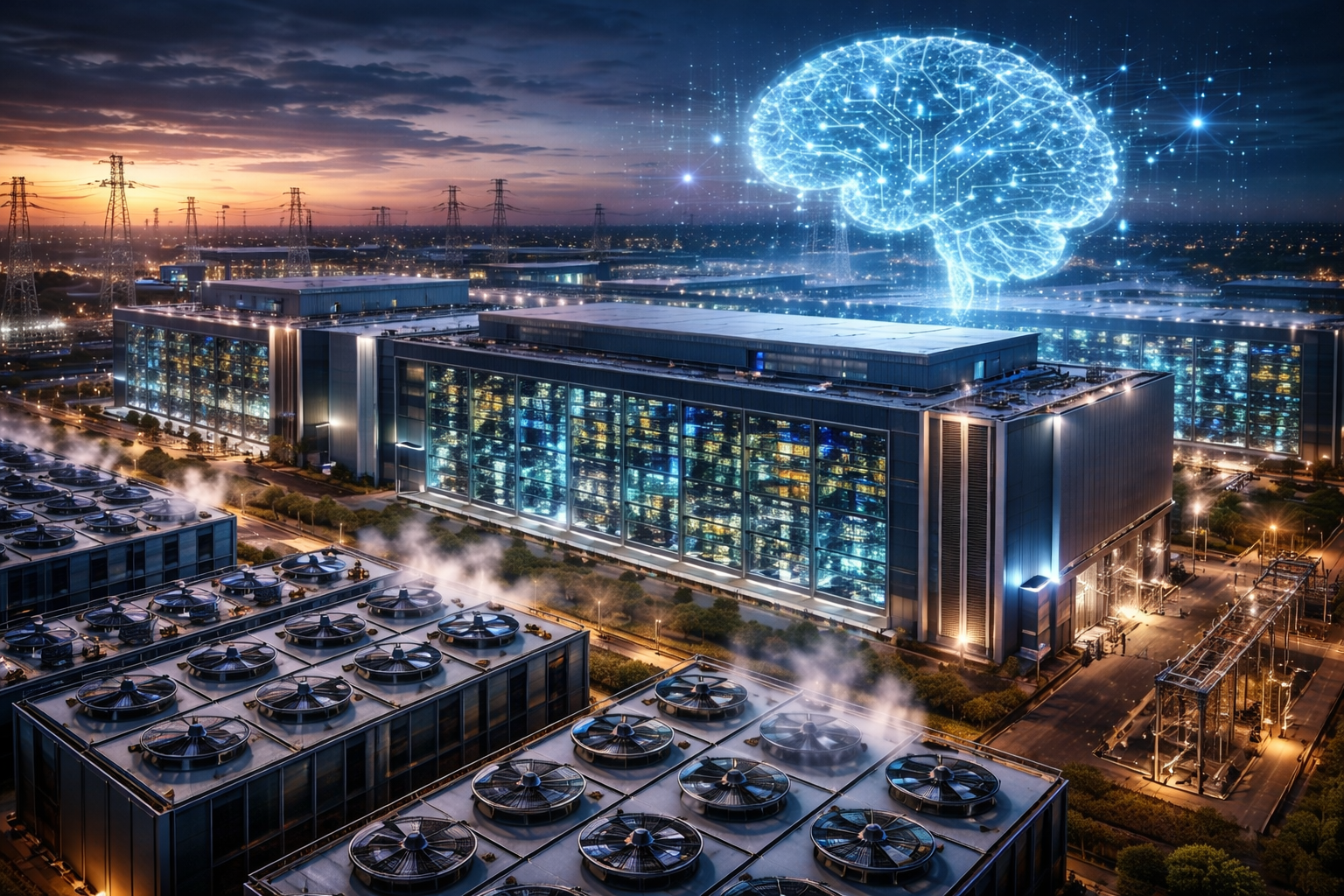
The global race to dominate artificial intelligence is rapidly transforming the physical backbone of the digital economy. Behind the surge in generative AI tools, machine learning platforms, and autonomous systems lies a massive—and often overlooked—investment boom in AI infrastructure.
Technology giants and cloud providers are now committing hundreds of billions of dollars to build next-generation data centers capable of supporting AI workloads at unprecedented scale. These facilities require enormous computing power, specialized chips, advanced cooling systems, and increasingly vast supplies of electricity.
For investors, the implications are profound. The companies building AI software may capture headlines, but the infrastructure supporting AI could generate one of the most significant industrial investment cycles of the decade.
According to recent industry analysis from Bloomberg and research from Wedbush Securities, the emerging “AI infrastructure economy” is reshaping supply chains across semiconductors, power generation, networking hardware, and industrial equipment.
The Infrastructure Behind the AI Revolution
Artificial intelligence requires vast amounts of computational power. Training advanced machine learning models involves processing enormous datasets across clusters of specialized processors capable of performing trillions of calculations per second.
To support these workloads, technology companies are rapidly expanding hyperscale data centers—massive computing facilities that house thousands of GPUs and advanced networking systems.
Cloud providers and large technology firms are leading this expansion, building specialized AI clusters designed to train and deploy increasingly powerful models.
These AI data centers differ significantly from traditional computing facilities. They require:
- High-performance AI chips and GPUs
- Advanced high-bandwidth memory systems
- Ultra-fast networking infrastructure
- Sophisticated cooling technologies
- Massive electricity supplies
The result is a new generation of data centers that function more like industrial-scale computing factories than traditional server farms.
Tech Giants Are Spending at Historic Levels
Capital expenditures across the technology sector are surging as companies race to build the infrastructure needed to support artificial intelligence.
Industry analysts estimate that spending on AI infrastructure could reach hundreds of billions of dollars annually within the next several years. Much of that investment is flowing into new data centers, chip manufacturing facilities, and energy infrastructure.
According to analysts cited by Bloomberg, the scale of this investment wave rivals previous technological transitions such as the expansion of cloud computing and the global rollout of mobile internet.
Major cloud providers are particularly aggressive in their infrastructure expansion strategies. As AI services become central to enterprise computing, these companies must deploy increasingly powerful hardware platforms to maintain competitive advantage.
This infrastructure race is rapidly reshaping the global technology supply chain.
Why AI Data Centers Are Different
Traditional data centers were designed primarily to store and process enterprise software applications or consumer web services. AI workloads, however, require dramatically different hardware configurations.
AI systems rely on specialized processors that perform parallel computations across massive datasets. These chips generate enormous heat and consume substantial electricity, requiring advanced cooling and power management technologies.
As a result, next-generation AI data centers are significantly more complex—and expensive—to build.
In addition to processors and memory, these facilities require advanced networking equipment capable of connecting thousands of computing nodes simultaneously. High-speed interconnect technologies allow AI systems to process data efficiently across distributed computing clusters.
This architectural complexity creates opportunities across multiple industries.
Companies supplying semiconductor components, networking equipment, cooling technologies, and power infrastructure are all positioned to benefit from the rapid expansion of AI data centers.
The Rise of the “AI Infrastructure Economy”
The growing demand for AI infrastructure is giving rise to what analysts increasingly describe as an AI infrastructure economy.
Rather than being limited to software development, the AI boom now encompasses a vast industrial ecosystem that includes semiconductor manufacturers, power utilities, data center developers, and advanced manufacturing firms.
Several sectors are emerging as critical pillars of this new economic landscape.
Semiconductors
AI chips remain the most visible component of the infrastructure stack. These specialized processors power machine learning workloads and require advanced manufacturing capabilities.
Semiconductor companies producing GPUs, AI accelerators, and memory components are seeing strong demand as hyperscalers expand their computing capacity.
Energy and Power Generation
AI data centers consume enormous amounts of electricity. Some large facilities require power equivalent to small cities, creating growing demand for energy infrastructure and grid upgrades.
Power providers, renewable energy developers, and energy storage companies could play an increasingly important role in supporting AI expansion.
Cooling Technologies
Advanced cooling systems are essential for maintaining stable operating temperatures inside AI computing clusters. As processors become more powerful, cooling technologies are evolving to include liquid cooling and other advanced thermal management solutions.
Companies specializing in data center cooling equipment may see rising demand as AI infrastructure grows.
Networking Infrastructure
AI clusters rely on ultra-fast networking technologies that allow thousands of processors to communicate simultaneously. High-speed optical networking and specialized interconnect systems are becoming critical components of the AI infrastructure stack.
Why This Matters for Investors
The infrastructure requirements of artificial intelligence are creating one of the most significant industrial investment cycles in modern technology history.
While software applications capture the public’s imagination, the hardware and infrastructure supporting AI may ultimately generate larger and more durable economic returns.
This dynamic is attracting attention from institutional investors seeking exposure to the long-term growth of artificial intelligence.
Research from Wedbush suggests that the companies building the physical infrastructure for AI—rather than the applications themselves—could deliver substantial long-term value as global computing demand expands.
The reason is straightforward: AI adoption requires continuous investment in hardware, data centers, and supporting technologies.
Even as individual AI applications evolve, the underlying infrastructure must continue expanding to support rising computational demand.
Future Trends to Watch
Several emerging trends could shape the next phase of the AI infrastructure boom.
Explosive Growth in Hyperscale Data Centers
Technology companies are expected to continue building massive AI data centers across North America, Europe, and Asia. These facilities will form the backbone of global AI services.
Increasing Power Demand
Electricity consumption from data centers is expected to rise significantly as AI adoption grows. Governments and utilities are already planning grid upgrades to accommodate future demand.
Specialized AI Hardware
Chipmakers are developing increasingly specialized processors designed specifically for AI workloads. This innovation could further accelerate the demand for advanced semiconductor manufacturing.
Infrastructure Investment by Governments
Governments are beginning to view AI infrastructure as a strategic asset. Public investments and policy initiatives aimed at strengthening domestic technology supply chains may further stimulate infrastructure spending.
Key Investment Insight
The global AI boom is often framed as a software revolution—but in reality, it is equally an infrastructure revolution.
Companies involved in building the physical backbone of artificial intelligence—data centers, semiconductor manufacturing, power generation, and advanced cooling systems—may represent some of the most compelling long-term investment opportunities in the technology sector.
For investors seeking exposure to the AI megatrend, focusing solely on consumer-facing applications could overlook a massive wave of infrastructure spending now reshaping the global economy.
The rise of the AI infrastructure economy suggests that the biggest winners in the AI era may not only be the companies developing algorithms—but also those building the machines that power them.
The AI revolution is accelerating across industries, markets, and global supply chains. For deeper analysis, market intelligence, and daily investor insights on emerging technologies, stay connected with MoneyNews.Today, your trusted source for the trends shaping the future of investing.




