
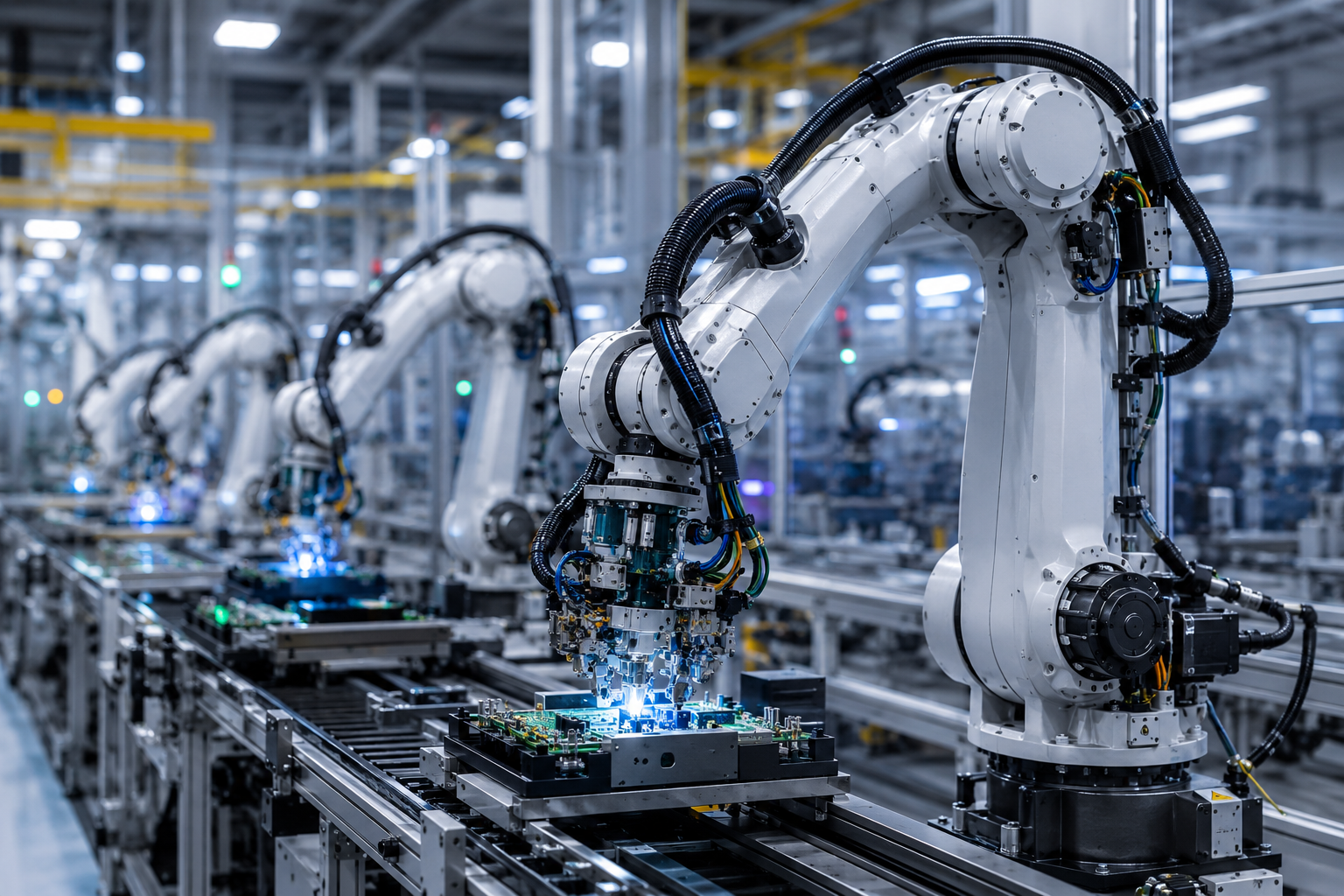
The artificial intelligence investment story is entering a new phase—and investors are beginning to follow the money.
For the past three years, Wall Street’s AI narrative has largely revolved around data centers, cloud infrastructure, and large language models. Companies building AI chips and software platforms captured investor attention and generated some of the market’s strongest returns. Now, a growing number of investors are looking beyond digital AI and toward what many industry leaders call the next frontier: physical AI.
That shift was on full display at Automate 2026 in Chicago, one of North America’s largest industrial automation events. Major players including Nvidia and ABB expanded their partnerships around AI-powered robotics, while U.S.-based robotics startup Standard Bots announced a $200 million funding round aimed at accelerating deployment of intelligent industrial robots.
Taken together, these developments suggest that the next wave of AI spending may occur not in data centers, but on factory floors, warehouse networks, manufacturing facilities, and logistics operations across the globe.
For investors, the implications could be significant.
AI Moves From Software to the Physical World
The first stage of the AI boom centered on computation.
Investors rewarded companies supplying the infrastructure needed to train and deploy advanced AI models. Semiconductor manufacturers, cloud providers, and networking companies became some of the biggest beneficiaries of the AI revolution.
However, industry leaders increasingly believe the next major opportunity lies in applying AI to physical environments.
Nvidia CEO Jensen Huang has repeatedly described robotics as one of the largest future markets for artificial intelligence. At recent industry events, the company has emphasized “physical AI”—systems capable of understanding, navigating, and interacting with the real world.
This trend is driving collaboration between AI developers and industrial automation companies. At Automate 2026, Nvidia and ABB highlighted expanded efforts to integrate advanced AI capabilities into industrial robots and automated manufacturing systems.
The goal is straightforward: create smarter machines capable of performing complex tasks with greater efficiency, adaptability, and precision than traditional automation systems.
Why Industrial Robotics Is Gaining Momentum
Several economic and technological factors are converging to accelerate robotics adoption.
First, labor shortages continue to challenge manufacturers across North America. According to industry estimates from manufacturing associations and labor market studies, many industrial sectors continue to struggle to fill skilled positions, particularly in production, logistics, and warehousing.
Second, AI technology has become significantly more capable.
Earlier generations of industrial robots often required extensive programming and operated effectively only in highly controlled environments. Today’s AI-enhanced systems can increasingly adapt to changing conditions, recognize objects, make decisions, and perform more sophisticated tasks.
Third, businesses face growing pressure to improve productivity.
Persistent wage inflation, supply-chain disruptions, and global competition are pushing companies to seek efficiency gains wherever possible. Intelligent automation offers a compelling solution.
As a result, industrial robotics is evolving from a niche technology investment into a strategic necessity for many organizations.
The Standard Bots Signal
One of the most notable announcements this week came from Standard Bots, a U.S. robotics startup that secured a $200 million funding round.
Large funding rounds often provide insight into where venture capital and institutional investors see future growth opportunities. The willingness of investors to commit substantial capital to robotics companies indicates increasing confidence that commercial adoption is accelerating.
Historically, robotics investments were concentrated in automotive manufacturing and other large-scale industrial operations. Today’s robotics companies are targeting a much broader customer base, including small and medium-sized businesses that previously lacked access to affordable automation solutions.
If successful, this democratization of robotics could significantly expand the industry’s addressable market.
Investors should pay attention not only to robotics manufacturers themselves but also to the broader ecosystem supporting deployment and adoption.
The Emerging Winners Beyond Robot Makers
The robotics boom is creating opportunities across multiple industries.
Semiconductor companies remain critical because advanced robots require increasingly powerful processors, sensors, and AI accelerators. Demand for industrial AI systems could create another long-term growth driver for chip manufacturers already benefiting from the broader AI cycle.
Machine vision companies are also positioned to benefit. These firms develop cameras, sensors, and software that allow robots to interpret and respond to their environments.
Industrial software providers represent another key segment. Modern robotic systems rely heavily on software platforms for workflow management, predictive maintenance, digital twins, and operational analytics.
Meanwhile, automation equipment manufacturers and systems integrators may experience increased demand as businesses seek assistance implementing robotic solutions.
In many ways, the robotics investment opportunity resembles the broader AI ecosystem rather than a single-industry theme. Multiple layers of suppliers, infrastructure providers, software developers, and service companies stand to benefit.
What Analysts and Industry Experts Are Watching
Industry research from organizations such as McKinsey, Deloitte, and the International Federation of Robotics has consistently highlighted the long-term growth potential of automation technologies.
The International Federation of Robotics has reported record installations of industrial robots globally in recent years, driven by manufacturing modernization efforts across major economies.
Meanwhile, consulting firms continue to identify automation as one of the most important productivity-enhancing technologies available to businesses facing demographic challenges and labor shortages.
Many analysts believe the combination of AI and robotics could unlock a new investment cycle similar to previous waves of cloud computing and digital transformation.
The key difference is that this cycle involves physical infrastructure spending, which often creates longer-duration revenue opportunities for suppliers and technology providers.
Risks Investors Should Consider
Despite the enthusiasm surrounding industrial robotics, investors should remain aware of potential risks.
Adoption rates may vary significantly across industries and regions. Some businesses may delay automation investments if economic growth slows or financing conditions tighten.
Competition is another factor. As capital floods into robotics and AI startups, not every company will emerge as a long-term winner.
Valuations could also become stretched if investor enthusiasm outpaces actual revenue growth.
As with previous technology cycles, distinguishing between companies with durable competitive advantages and those benefiting primarily from hype will be critical.
Investors should focus on businesses demonstrating strong commercial adoption, recurring revenue models, technological differentiation, and sustainable profitability.
Key Investment Insight
The investment narrative surrounding AI is evolving from model development to real-world deployment.
While software-focused AI companies continue to attract attention, industrial robotics may represent one of the most important long-term opportunities emerging from the broader AI revolution. Companies involved in robotics hardware, machine vision, industrial software, factory automation, semiconductor infrastructure, and intelligent manufacturing systems are increasingly positioned to benefit from this shift.
If enterprise adoption continues accelerating, industrial robotics could become one of the defining capital expenditure themes of the next decade—creating opportunities across public markets, private investments, and emerging technology sectors.
Investors who recognize this transition early may be better positioned to identify the next generation of AI winners.
Stay connected with MoneyNews.Today for daily market intelligence, emerging investment trends, and actionable insights shaping the future of global investing.




