
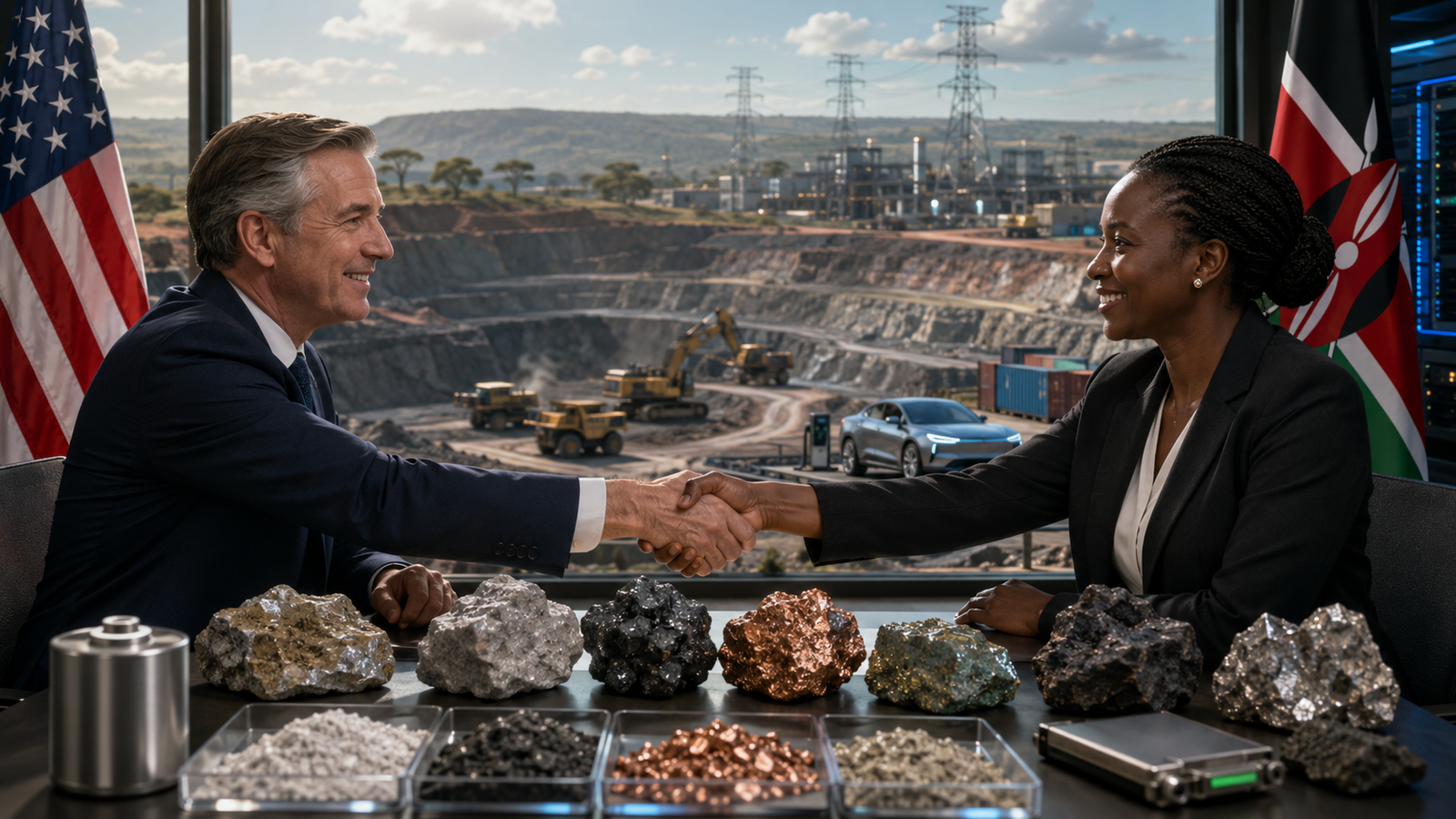
The global race for critical minerals is entering a new phase, and investors are paying close attention.
As artificial intelligence, electric vehicles, renewable energy infrastructure, and advanced defense technologies drive unprecedented demand for strategic resources, governments are increasingly competing to secure reliable supplies of the minerals that power the modern economy. Against this backdrop, reports that the United States and Kenya are nearing a major critical minerals agreement could represent far more than a diplomatic development—it could signal another significant shift in the global resource landscape.
According to Reuters, the proposed agreement would cover a broad range of strategic resources, including rare earth elements, lithium, graphite, copper, nickel, and other critical minerals essential for advanced manufacturing and clean energy technologies. The deal forms part of a wider U.S. strategy aimed at reducing dependence on Chinese-controlled supply chains while strengthening partnerships with resource-rich nations.
For investors, the implications extend well beyond mining. The agreement highlights a growing trend that is reshaping industries ranging from semiconductors and artificial intelligence to batteries, electric vehicles, defense systems, and energy infrastructure.
The critical minerals story is no longer just about commodities—it is increasingly becoming a geopolitical and investment megatrend.
Why Critical Minerals Have Become a Strategic Priority
Few sectors have experienced a transformation as dramatic as critical minerals over the past decade.
Historically, commodities such as lithium, graphite, nickel, rare earths, and copper were primarily viewed through the lens of industrial demand. Today, they are increasingly considered strategic assets with national security implications.
Governments worldwide recognize that many of the technologies expected to drive future economic growth depend on access to these materials.
Consider the role critical minerals play across key industries:
- Lithium is essential for rechargeable batteries.
- Graphite is a key battery component.
- Nickel supports higher-performance battery chemistry.
- Copper remains fundamental to electrification and power infrastructure.
- Rare earth elements are crucial for electric motors, defense technologies, and advanced electronics.
According to the International Energy Agency (IEA), demand for many critical minerals is expected to increase significantly over the coming decades as countries accelerate electrification and clean-energy deployment.
At the same time, supply chains remain highly concentrated.
China currently dominates many segments of global critical minerals processing and refining, creating concerns among Western governments about supply security and geopolitical risk.
The emerging U.S.-Kenya agreement is one example of how policymakers are attempting to address these challenges.
The Broader Strategy Behind the Agreement
The proposed deal with Kenya is not an isolated initiative.
It is part of a broader effort by the United States and its allies to diversify critical minerals supply chains and reduce dependence on any single country.
Recent developments demonstrate the scale of this strategy:
- The G7 recently announced initiatives focused on critical minerals cooperation.
- The United States has expanded resource partnerships with several nations across Africa, Latin America, and Asia.
- Governments are increasing support for domestic mining, refining, and processing projects.
- Strategic stockpiling programs are gaining momentum.
Kenya occupies an increasingly important position within this evolving landscape.
The country possesses significant mineral potential and is viewed as a stable partner for long-term resource development. By strengthening ties with Kenya, the United States aims to create additional supply channels that can support growing industrial demand while enhancing supply-chain resilience.
For investors, this trend suggests that critical minerals are becoming an increasingly important component of international economic policy.
Why Africa Is Gaining Investor Attention
Africa has emerged as one of the most closely watched regions in the global resource sector.
The continent contains substantial deposits of critical minerals that are becoming increasingly valuable as demand accelerates.
While investors have traditionally focused on mining jurisdictions such as Canada, Australia, and South America, attention is gradually expanding toward African resource opportunities.
Several factors are driving this shift:
Resource Potential
Many African nations possess significant reserves of lithium, graphite, nickel, copper, cobalt, and rare earth elements.
Growing International Investment
Governments and multinational corporations are increasing investments in exploration, infrastructure, and resource development projects across the continent.
Supply-Chain Diversification
As Western governments seek alternatives to existing supply chains, African projects are attracting greater strategic interest.
Infrastructure Development
Resource agreements often lead to broader investments in transportation, energy, and industrial infrastructure, supporting long-term economic growth.
The U.S.-Kenya agreement reflects these broader trends and may encourage additional investment across the region.
The AI and Energy Transition Connection
One reason critical minerals have become such an important investment theme is their connection to two of the most powerful growth drivers in today’s market: artificial intelligence and the energy transition.
Artificial Intelligence
The AI boom requires massive amounts of computing power, data-center infrastructure, advanced semiconductors, and electrical systems.
All of these technologies depend on critical minerals.
Copper is essential for electrical infrastructure. Rare earth elements are used in advanced electronics and industrial systems. Various specialty metals support semiconductor manufacturing and technology supply chains.
As AI investment accelerates, demand for these resources is expected to grow alongside it.
Energy Transition
Electric vehicles, battery storage systems, renewable energy projects, and power-grid modernization initiatives all require significant quantities of critical minerals.
BloombergNEF and the International Energy Agency have repeatedly highlighted the importance of securing mineral supplies to support long-term energy-transition goals.
The result is a powerful combination of demand drivers that continues attracting investor attention.
Why This Matters for Mining Companies
The market is increasingly rewarding companies positioned to benefit from critical minerals demand.
Several categories of businesses may stand to gain:
Mining Companies
Producers with exposure to lithium, copper, graphite, nickel, and rare earths could benefit from stronger long-term demand and increased government support.
Processing and Refining Firms
One of the biggest supply-chain challenges remains refining capacity. Companies involved in downstream processing may become increasingly valuable.
Infrastructure Providers
Resource development often requires transportation, energy, and logistics investments, creating opportunities beyond traditional mining stocks.
Technology and Manufacturing Firms
Companies that secure reliable access to critical minerals may gain competitive advantages in industries such as semiconductors, batteries, and advanced manufacturing.
Investors should recognize that the opportunity extends far beyond commodity producers alone.
Future Trends to Watch
Several developments could shape the critical minerals sector throughout the remainder of 2026 and beyond.
Additional International Partnerships
The United States is likely to pursue additional agreements with resource-rich nations as part of its supply-chain diversification strategy.
Government Incentives
Support for mining, processing, and refining projects may continue expanding through grants, tax incentives, and strategic investment programs.
Processing Capacity Expansion
Reducing dependence on foreign refining operations remains a major priority for policymakers.
Rising Demand from AI and Electrification
Artificial intelligence infrastructure and electrification initiatives are expected to remain major drivers of long-term mineral demand.
Geopolitical Competition
Critical minerals are increasingly becoming a focal point of global economic competition, making policy developments an important market catalyst.
Key Investment Insight
The proposed U.S.-Kenya critical minerals agreement is about far more than resource extraction. It represents another step in the global effort to build diversified supply chains capable of supporting the technologies that will define the next several decades.
Investors should closely monitor companies with exposure to African critical minerals projects, refining operations, infrastructure development, and downstream processing. As governments increasingly prioritize resource security, businesses positioned within these strategic supply chains may benefit from stronger investment flows, policy support, and long-term demand growth.
The critical minerals market is evolving into one of the most important intersections of geopolitics, technology, energy, and industrial policy. Understanding these dynamics may help investors identify opportunities before they become widely recognized.
Stay informed with MoneyNews.Today for daily market insights, breaking mining and commodities news, and expert analysis of the trends shaping the future of global investing.




